
No Attorney No Work Product Protection
Post number 5353
To Defeat a Privilege or Protection from Discovery Evidence is Required
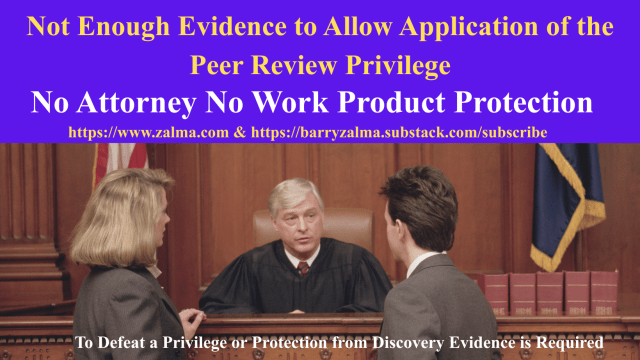 In Chelsey Holland, Individually And As Mother, Natural Guardian, And Next Friend Of A.T., A Minor v. Dayton Children’s Hospital, C. A. No. 30516, 2026-Ohio-1678, Court of Appeals of Ohio, Second District, Montgomery (May 8, 2026) the Court of Appeals dealt with the application of protections and privileges to litigation discovery.
FACTS
Chelsey Holland sued Dayton Children’s Hospital for medical negligence and breach of fiduciary duty arising from injuries allegedly caused when hospital staff attempted to insert a nasogastric feeding tube into her infant daughter, A.T., in January 2015. Holland learned of two internal emails dated January 28, 2015, and February 3, 2015, between nurses Karen Reeder and Michelle Stamm.
Dayton Children’s withheld the emails on claims of peer-review privilege and work-product protection.
The trial court reviewed the dispute and ordered production of the emails, finding the hospital had not carried its burden to establish either protection.
LEGAL ISSUES
PEER-REVIEW PRIVILEGE
Under R.C. 2305.252(A) protects proceedings and records within the scope of a peer review committee of a healthcare entity. To invoke the privilege, the resisting party must show:
- the existence of a qualifying peer review committee; and
- that the specific documents withheld are records within the scope of that committee.
Work-Product Protection
Under Civ.R. 26 the doctrine protects materials reflecting attorneys’ mental impressions, conclusions, strategies, or legal theories, or materials prepared by or at the direction of counsel in anticipation of litigation.
Peer-Review Privilege
The court reviewed the peer-review issue because privilege is a legal question, but reviewed the work-product ruling for abuse of discretion because it concerns a general discovery dispute.
Dayton Children’s relied mainly on affidavit and deposition testimony from nurse Karen Reeder, who said she was involved in PICU quality improvement and that communications with nurse Stamm were within the scope of that work. The Court of Appeals agreed there was at least some evidence that a relevant quality-improvement or quality-assurance committee existed. However, the hospital did not clearly prove that the two specific emails were generated by, exclusively for, or actually presented to such a committee.
The court noted multiple ambiguities, including:
- Reeder did not specifically remember the emails,
- Her affidavit used broad, conclusory language instead of facts tied to the two emails,
- The emails themselves did not mention any committee. and
- The record did not clearly connect Susan Childs (Director of Risk Management) to a qualifying peer-review committee.
Even so, the court found that under an Ohio Supreme Court’s recent decision in the trial court should not have treated those evidentiary deficiencies as automatically requiring disclosure. Instead, where there is some indication the privilege may apply but the record is unclear, the trial court should conduct further factual inquiry, including possible in camera review and other development of the record.
Work-Product Doctrine
On work product, the court agreed with the trial court that Dayton Children’s had not met its burden. The affidavits did not show that:
- the emails were prepared by an attorney,
- at the direction of an attorney,
- for attorney review, or
- transmitted to an attorney.
The emails were created by non-attorneys and did not contain attorney mental impressions, legal theories, or strategy. At most, the evidence showed that the Director of Risk Management gathered materials relating to possible future litigation, which was not enough by itself to establish work-product protection.
ANALYSIS
For peer review, the hospital’s proof was inadequate to establish privilege outright, but not so inadequate as to justify immediate compelled disclosure without further inquiry.
Because the record suggested the emails might fall within a quality-improvement or peer-review process, the trial court should have developed the facts more fully before ordering production.
For work product, by contrast, the missing link to legal counsel was fatal. The doctrine is narrower and focuses on attorney preparation and litigation strategy. Since there was no evidence tying the emails to counsel’s direction or mental impressions, the trial court acted within its discretion in rejecting work-product protection.
CONCLUSION
The Court of Appeals affirmed in part, reversed in part, and remanded:
- It reversed the trial court’s ruling to the extent the court had definitively held that the emails were not protected by peer-review privilege, because more factual inquiry is required.
- It affirmed the trial court’s ruling that the emails were not protected by the work-product doctrine.
- The case was remanded so the trial court could conduct further inquiry into whether the emails are protected by peer-review privilege.
Reasoning:
The judgment was affirmed to the extent the trial court found that Dayton Children’s failed to establish the January 28, 2015 and February 3, 2015 emails are protected from disclosure by the work-product doctrine.
The hospital produced some evidence that a quality-improvement or peer-review committee may have existed and the trial court should have developed the record further, including possible in camera review.
ZALMA OPINION
Privileges and protections are important to protect private communications to lawyers or peer reviewers and keep it out of litigation. The Court of Appeals acknowledge that there was no attorney involved so no need to provide the protection but there should have been more analysis of the peer review protection and sent the case back to the trial court to determine if there were facts allowing the privilege to be asserted.
(c) 2026 Barry Zalma & ClaimSchool, Inc.
Please tell your friends and colleagues about this blog and the videos and let them subscribe to the blog and the videos.
Subscribe to my substack at https://gbarryzalma.substack.com/subscribe
Go to X @bzalma; Go to Barry Zalma videos at Rumble.com at https://rumble.com/account/content?type=all; Go to Barry Zalma on YouTube- https://Cwww.youtube.com/channel/UCysiZklEtxZsSF9DfC0Expg; Go to the InsuranceClaims Library – https://lnkd.in/gwEYk.