

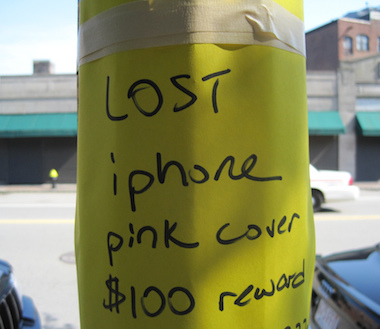
While much of the privacy news lately has revolved around data hacks, there are still thieves who prefer to take hardware – and lawmakers and trying to find ways to deter them with smartphone “kill switches.”

In January alone, the Chicago City Council proposed a resolution to ask the Federal Communications Committee to support a cell phone kill switch, a feature that allows users to remotely wipe data off of their phones if they’re stolen, and Senator Amy Klobuchar (Minn. – D) also drafted privacy legislation that calls for a similar requirement for smartphone manufacturers. Even the police force in New Haven, Conn. is joining the call for action.
While in some states, like New Jersey, cell phone thefts can lead to ten years in prison,this type of crime has become so popular that police forces are holding sting operations. In her letter to wireless carriers, Klobuchar wrote that “almost one-in-three robberies involve phone theft and the cost to consumers of lost or stolen phones is more than $30 billion each year.” The $30 billion-each-year figure was brought up earlier by New York Attorney General Eric T. Schneiderman in May 2013 in a letter asking for cooperation against “Apple picking” , notes attorney Peter Vogel of Gardere Wynne Sewell:
[Vendors] have a responsibility to their customers to fulfill their promises to ensure safety and security. This is a multi-billion dollar industry that produces some of the most popular and technologically advanced consumer electronic products in the world. Surely we can work together to find solutions that lead to a reduction in violent street crime targeting consumers.
So far, only Apple devices offer users a way to remotely delete personal data, a feature that has only been available since 2013 on iOS 7.Some carriers have taken their own steps – like Verizon, which “blacklists” stolen phones from being reactivated, reports Rich Scinto for the New Haven Register. Commercial litigator Andrew Hinkes of Berger Singerman wants to see wireless manufacturers go beyond the basic deletion feature and give users access “to select what metadata is encoded in any offloaded media, so that photographs, say, of your children at their school, will not automatically be encoded with the date, time and GPS coordinates.”
California announced their own push for kill switches last year, but cell phone manufactures refuse to make any changes because it would be expensive, Lawrence Pingree, research director for market researcher Gartner, told Bloomberg.
“The main goal for carriers is to keep support costs low and encourage subscribership, so antitheft technology could cause support nightmares,” [Pingree] says. “Especially with Android, since there is much fragmentation in the phone market and not all phones would support the feature.” And to put it bluntly, he says, “Carriers also profit from theft—for example, insurance premiums and activation charges.”
On the side of the carriers is the trade group CTIA-The Wireless Association, which said that hackers will be able to bypass kill switches. The trade group has taken their own steps to fight thefts, however, reports Meghan Neal from Vice.
To address the issue, the FCC, police, and CTIA teamed up last month to create a national database to track stolen phones, and blacklist them so they can’t be activated. But, the database doesn’t extend outside the US, which does nothing to thwart the huge smartphone black market overseas—an illegal export operation law enforcement has deemed an international criminal conspiracy.
Despite the legislative prodding, it seems unlikely that manufacturers will voluntarily make changes and keep the burden of stolen cell phones on their owners, something that the 1.6 million robbed users probably don’t want to hear.