

You don’t tug on Superman’s cape. You don’t spit into the wind. You don’t pull the mask off that old Lone Ranger.
Thanks to the late Jim Croce, you know all that. I know it, too. And I’m sure the people at Jewel Food Stores know it.
But what Jewel didn’t know is that you don’t mess around with Mike – meaning basketball great Michael Jordan — by running a full-page ad in Sports Illustrated congratulating him on his entry into the Basketball Hall of Fame without paying the guy. Because if you do, Mike will sue you for $5 million.
This whole hot mess started in September 2009, when Sports Illustrated took note of Jordan’s induction into the Naismith Memorial Basketball Hall of Fame by publishing a special commemorative issue devoted to the extraordinary career of the nonpareil cager. (Click here if you’ve ever wondered why basketball players are called “cagers.”)
Jewel Food Stores was offered a free full-page ad in the magazine if it agreed to sell it in the 175-odd Jewel-Osco supermarkets it operated in the greater Chicago area. Jewel happily agreed to the offer, and its ad ran on the back inside cover of the special Sports Illustrated issue.
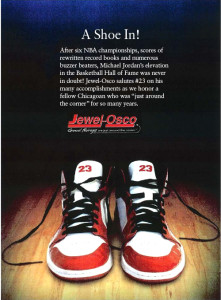
Here’s the text of the ad:
A Shoe In!
After six NBA championships, scores of rewritten record books and numerous buzzer beaters, Michael Jordan’s elevation in the Basketball Hall of Fame was never in doubt! Jewel-Osco salutes #23 on his many accomplishments as we honor a fellow Chicagoan who was “just around the corner” for so many years.
The ad also included the Jewel-Osco logo and the supermarket chain’s trademarked slogan — “Good things are just around the corner” — as well as a photo of a pair of basketball shoes bearing the number 23 (Jordan’s uniform number).
Here’s the ad in its entirety:
After the ad appeared, Jordan sued Jewel, alleging violation of the Illinois Right of Publicity Act and various other laws.
Jewel promptly moved for summary judgment, arguing that its ad was noncommercial speech and, therefore, fully protected by the First Amendment.
The district court agreed, and entered a final judgment in favor of Jewel, which relied heavily on the fact that the ad was not commercial speech at its core because it did not propose a commercial transaction.
The district court’s decision was described as “a thoughtful opinion” by the Seventh Circuit. In fact, the Seventh Circuit rejected the lower court’s holding more emphatically than ex-NBA’er Dikembe Mutombo rejected that box of cereal in the Geico commercial. In doing so, the court displayed a sophisticated understanding of modern advertising methods:
The notion that an advertisement counts as “commercial” only if it makes an appeal to purchase a particular product makes no sense today, and we doubt that it ever did. An advertisement is no less “commercial” because it promotes brand awareness or loyalty rather than explicitly proposing a transaction in a specific product or service. Applying the “core” definition of commercial speech too rigidly ignores this reality. Very often the commercial message is general and implicit rather than specific and explicit. . . . [C]onsidered in context, and without the rose-colored glasses, Jewel’s ad has an unmistakable commercial function: enhancing the Jewel-Osco brand in the minds of consumers.
The opinion notes in passing that a First Amendment defense does not necessarily defeat a right-of-publicity claim:
Even if Jewel’s ad qualifies as noncommercial speech, it’s far from clear that Jordan’s trademark and right-of-publicity claims fail without further ado. . . . [T]here is no judicial consensus on how to resolve conflicts between intellectual property rights and free-speech rights. . . . The Supreme Court has not addressed the question, and decisions from the lower courts are a conflicting mix of balancing tests and frameworks borrowed from other areas of free-speech doctrine.
But the facts of the Jordan-Jewel case were such that the Seventh Circuit was not required to address that issue. It simply ruled that Jewel’s ad was commercial speech, which defeated Jewel’s constitutional defense, and remanded the case to the lower court for further proceedings as appropriate.
P.S. The author sincerely regrets that you can’t get “You Don’t Mess Around With Jim” out of your head. (If all else fails, just whistle the theme from “The Andy Griffith Show.” That usually does the trick.)