

A little over a month ago, Rep. Sam Graves, Chairman of the House Committee on Small Business, introduced a pair of bills designed to increase the participation of small business contractors in federal contracting.
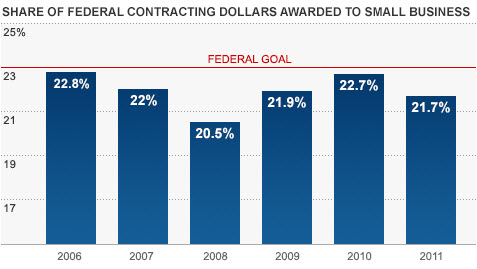
The first bill, the Greater Opportunities for Small Business Act (“GOSBA”), would raise the government’s small business contracting goal from 23% to 25%. GOSBA would also raise the government’s current goal for small business subcontracting from 35.9% to 40% percent. Government-wide goals for contracts awarded to small business concerns owned and controlled by service-disabled veterans (3%), HUBZone companies (3%), socially and economically disadvantaged individuals (5%), and small business concerns owned and controlled by women (5%) would remain the same.
Similar bills, such as the Government Efficiency Through Small Business Contracting Act have been proposed (and discussed on this blog) in the past, but have not yielded results. Critics of GOSBA cite to these past failures, and question the wisdom of an increase, pointing out that the government has routinely failed to meet the current goal of 23%. In fact, in 2012, the federal government fell short of its goal by a whopping $3 billion. Prior to that, the last time the government met its goal was 2005.
In response to these criticisms, proponents of GOSBA argue that recent legislative changes affecting small business programs, such as those authorized by the 2013 and 2014 National Defense Authorization Acts, have made it easier for the government to attain more aggressive small business contracting goals. There is some support for this argument and it came in 2013. Last year, the federal government awarded $83.2 billion in contracts to small businesses, which translates to 23.4% of all contracts issued.
The second bill introduced by Rep. Graves is known as the Contract Data and Bundling Accountability Act (“CDBAA”). This bill would update the way data is reported on bundled or consolidated contracts, by requiring the SBA and GAO to oversee agencies’ data collection and reporting. The CDBAA is a direct result of an October 2013 hearing held before the Small Business Subcommittee on Contracting and Workforce. Following that hearing, it was concluded that government agencies have routinely failed to conduct required analyses, or submit necessary data, concerning contract bundling; consequently, Congress has been unable to properly assess the impact that contract bundling has had on small companies. This is corroborated by recent GAO reports.
If passed, the CDBAA would require the SBA to work with other agencies to create and implement a data quality improvement plan aimed at promoting greater accuracy, transparency and accountability in the reporting of contract bundling and consolidation. It would further require the GAO to assess an agency’s success and offer suggestions for further improvement. The CDBAA would also impose certain consequences (unspecified in the bill) on any agency that failed to “properly identify contracts as bundled or consolidated.”
Rep. Graves expressed his hope for the new bills, stating that “[t]hese two pieces of legislation will go a long way towards increasing opportunities for small companies who want to grow and create jobs by doing business with the federal government . . . By increasing the federal-wide goal for contracts to small businesses, and requiring greater accuracy, transparency and accountability in contract bundling and consolidation, we make it easier for small businesses to enter this marketplace and compete for contracts. The federal government spends nearly half a trillion dollars on contracted goods and services, therefore, we must ensure that the money is being spent efficiently, and small businesses have proven that they can do quality work cheaper and often faster.”
The tug-of-war between big and small business on the federal landscape continues. One thing to keep in mind as these bills work their way through committee is the status of the federal workforce. There was an article in Government Executive a few days ago entitled, “Federal Agencies Shed 10,000 Jobs in March.” The article identified the fact that the federal workforce “has trended downward significantly in the last two years” due to sequestration and budget cuts, which were followed by hiring freezes and employee reductions through attrition. According the article, the government has shed about 85,000 jobs in the last year alone. This depletion of government personnel most certainly has had, and will continue to have, an impact on the procurement process. Contract bundling can alleviate stress on a taxed procurement system. However, it can adversely impact small business. Finding the correct balance will not be easy. Let us know your thoughts finding that balance.
Edward T. DeLisle is a Partner in the firm and a member of the Federal Contracting Practice Group. Maria L. Panichelli is an Associate in the firm’s Federal Practice Group.