

In a first-of-its-kind report announced this morning, Ceres and Clean Edge ranked the nation’s largest electric utilities and local subsidiaries on their renewable energy sales and energy efficiency savings. The report focused on three clean energy indicators: renewable energy sales; cumulative annual energy efficiency; and incremental annual energy efficiency.
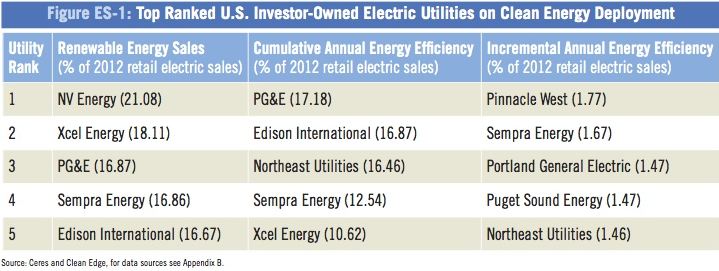
My colleague Jon Wellinghoff wrote the forward to the report. Jon noted that the traditional electric utility industry is entering what may be the “most tumultuous period” in its history. He added, 

“The different components of clean energy—energy efficiency, demand response, renewable energy, distributed generation, and the “smart” infrastructure required to integrate and optimize them—are critical elements of the 21st century electricity market. Traditional utilities and third parties will compete to offer consumers a range of customized energy-related products and services that extends far beyond today’s electricity service—and probably sooner than we think.”

“Ignoring this clean energy shift is dangerous, for both the traditional utility business and the environment. The U.S. Department of Energy recently found that renewables could feasibly provide 80 percent of the nation’s energy by 2050. The main obstacle is not the price tag (which is comparable to a business-as-usual scenario) or the technical challenges, though both are considerable. Rather, it is largely a question of leadership, market structures and political will.”

You can download a copy of the report at the Ceres website.

Photo of Jason Johns Jason Johns

Jason Johns advises independent power producers, utilities, investors, and large users of gas and power resources with matters arising in power markets and state and federal energy regulatory arenas. Jason appears regularly in proceedings before the Federal Energy Regulatory Commission and in negotiations…

Jason Johns advises independent power producers, utilities, investors, and large users of gas and power resources with matters arising in power markets and state and federal energy regulatory arenas. Jason appears regularly in proceedings before the Federal Energy Regulatory Commission and in negotiations at the ISO/RTO level, where he represents independent power developers and utilities. His experience includes negotiating major facility contracts, such as interconnection, transmission, and power purchase agreements; prosecuting disputes at FERC; and counseling and defending clients on issues related to regulatory compliance.

Jason also works closely with large commercial and industrial users of electricity and gas, such as aerospace companies, pulp and paper mills, steel mills, and tech company data centers. In that role, Jason helps clients negotiate power and gas supply contracts, interstate pipeline capacity asset management agreements, and pipeline bypass agreements. Jason has also assisted these clients with demand management agreements, the installation of on-site resources (such as battery storage, fuel cells, and solar PV), and with retail and wholesale power purchase agreements for renewable energy and other resources. Jason also serves as a board member of The Climate Trust, a national leader in carbon offset projects and innovative climate change solutions.

Jason and his wife are parents to two growing boys, and they live just outside of Portland, Oregon.

Click here for Jason John’s full bio.