

Illnesses in Arizona (4), California (1), Minnesota (4), Missouri (5), New Mexico (5), North Carolina (1), Texas (4), Utah (1), Washington (1), Wisconsin (3) and in Ontario (1) and Manitoba (1), Canada.
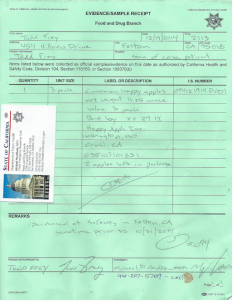
 Attorney Bill Marler of Seattle’s Marler Clark, the nation’s only law firm dedicated to representing victims of foodborne illness, has filed a wrongful death lawsuit against Safeway Inc., in the Superior Court of Santa Cruz on behalf of James Raymond Frey, 87, and the estate of his deceased wife, Shirlee Jean Frey, 81, who died tragically on December 2, 2014 after consuming a Listeria-tainted Happy Apple caramel apple purchased at the Safeway in Felton, California. The case number is CISCV180721. The lawsuit prompted both Safeway and Happy Apples to recall the caramel apples.
Missouri-based Happy Apples Co. initiated the recall after five deaths and some 29 illnesses in 10 states were linked to an outbreak of Listeria. Happy Apple caramel apples were sold in single pack, three packs, four packs and eight packs and each package will have a best use by date on the front of the label. They were available for retail sale through grocery, discount and club stores, generally in the produce section and were distributed to retailers in the following states: Alabama, Arizona, Arkansas, California, Colorado, Florida, Georgia, Hawaii, Illinois, Indiana, Iowa, Kansas, Louisiana, Massachusetts, Minnesota, Mississippi, Missouri, Montana, Nebraska, Nevada, New Mexico, North Carolina, Ohio, Oklahoma, Oregon, Pennsylvania, Tennessee, Texas, Utah, Washington, Wisconsin.
The Canadian Food Inspection Agency has also recalled America-made caramel apples contaminated with Listeria and linked to five deaths and twenty-nine illnesses in the United States. The Public Health Agency of Canada said Tuesday that two cases of listeriosis — one in Ontario and one in Manitoba — had the same genetic fingerprint seen in the U.S.
Happy Apple reported that it recently received notice from Bidart Brothers, one of its apple suppliers to the Orosi California facility, that there may be a connection between this outbreak and the apples that they supplied to that facility.
According to the St. Louis Post-Dispatch, Happy Apples in 2007 agreed to pay $599,000 to settle federal charges following the raid by federal agents. Federal authorities said the company had employed dozens of people illegally for more than five years.
Food contaminated with Listeria monocytogenes may not look or smell spoiled but can still cause illness. Symptoms can include vomiting, nausea, persistent fever, muscle aches, severe headache and neck stiffness. Pregnant women, the elderly and people with weakened immune systems are particularly at risk.
Listeria is Thankfully Rare – About 1,600 people in the US get sick from Listeria germs each year.
However, Listeria is a Killer – Listeria is the 3rd leading cause of death from food poisoning.
Listeria Attacks the Most Vulnerable – At least 90% of people who get Listeria infections are either pregnant women and their newborns, people 65 or older, or people with weakened immune systems.
Listeria: Marler Clark, The Food Safety Law Firm, is the nation’s leading law firm representing victims of Listeria outbreaks. The Listeria lawyers of Marler Clark have represented thousands of victims of Listeria and other foodborne illness outbreaks and have recovered over $600 million for clients. Marler Clark is the only law firm in the nation with a practice focused exclusively on foodborne illness litigation. Our Listeria lawyers have litigated Listeria cases stemming from outbreaks traced to a variety of foods, such as cantaloupe, cheese, celery and milk.