

Upcoming changes to Google AdWords’ ad formats will have a significant impact on pharmaceutical companies that engage in paid search advertising. In a letter to its major media agencies last month, Google announced that it will be removing two of its popular pharmaceutical advertising units.
Black Box Ad Format
On July 20, 2015, Google’s Black Box Ad Format will be removed because of changes to Google’s URL infrastructure. Google’s original Black Box Ad Format appears as follows:

The FDA requires some drug labeling and advertising to have “boxed” or “black box” warnings, which typically concern conditions about the drug that may lead to death or serious injury. FDA advertising standards prohibit such boxed drugs from having “reminder” ads that disclose a drug’s name, but do not include any representation regarding the drug, such as its indication or dosage recommendations. The use of reminder ads is important because they do not discuss the condition treated or how well the drug works. Thus a reminder ad does not need to contain a summary relating to the product’s side effects, contraindications or effectiveness.
In late 2014, the FDA indicated that boxed products could have “reminder-like” advertisements, provided the advertisements contained a “Please see …” statement (e.g., “Please see the full safety and prescribing information, including boxed warning”). For online ads, the FDA signed off on the Black Box Ad Format because the packaged insert containing the mandated disclosures was only one click away.
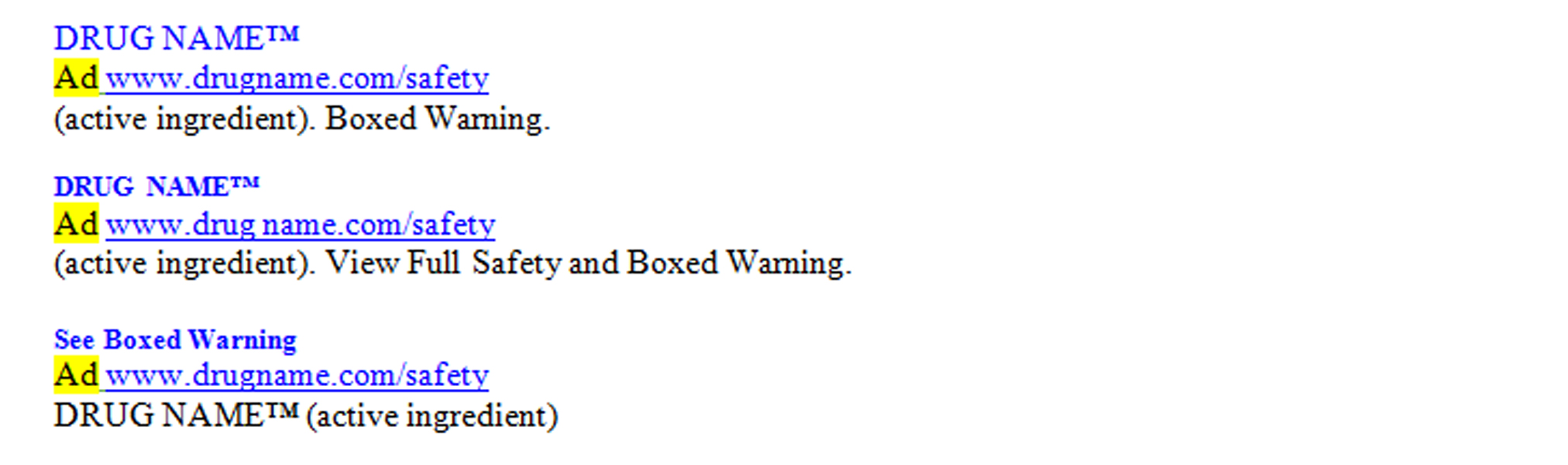
As a result of the Black Box Ad Format removal on July 20, 2015, pharmaceutical companies will now have to run their ads through Google’s standard text ad unit. The standard text ad unit will not display the full FDA-recommended disclaimer included in the last line of the Black Box Ad Format – “Click to see full safety and prescribing information, including boxed warning. More Info.” – or allow for an advertisement to link to multiple sites. Google has suggested that pharmaceutical companies follow the format below for boxed “reminder-like” ads:

However, whether this format will be acceptable to the FDA is unclear. Nor is it clear that the format is viewed as effective advertising by the pharmaceutical companies. For instance, FDA has already advised the pharmaceutical industry that reminder-like advertisements should include a clear reference (and second Internet link) directing consumers to the boxed product’s full prescribing information. By fiat, Google has eliminated that alternative. In addition, many companies will need to develop creative ways to address drugs with longer names that may not fit into Google’s standard header because of the character limit for headers. In such cases, the product’s active ingredient could be added on another line (adjacent). In all cases, however, the “reminder-like” advertisements must reference the “boxed” nature of the product, the product name, and the active ingredient. Below are a few examples:
 Vanity URLs
Google also announced it would no longer permit pharmaceutical companies to use vanity URLs as of January 12, 2016.
Employing vanity URLs has been a long-time preference for pharmaceutical companies. Vanity URLs allow a company to create an unbranded “condition awareness” ad. In a typical scenario, a consumer will search for a physical condition, see an ad that addresses the condition and click on a generic URL. The generic URL will then re-direct the consumer to a product-specific, brand website site (such as High-BloodPressure.com linking to a blood pressure drug website). This SEM advertising technique emerged in 2009 after the FDA issued 14 enforcement letters to companies for their failure to include sufficient risk information in Google banner advertisements. The 2009 letters created shock waves throughout the industry, causing many companies to reassess their Internet marketing strategies. Notably, and likely related to FDA’s 2009 action, Google has historically prohibited vanity URLs for all industries except the pharmaceutical industry.
Google has provided pharma advertisers with three potential options in the display URL field:
- CorporateCompanyName.com
- Corporate Company Name (without the .com)
- Static text that reads: “Prescription Treatment Website” or “Prescription Device Website”
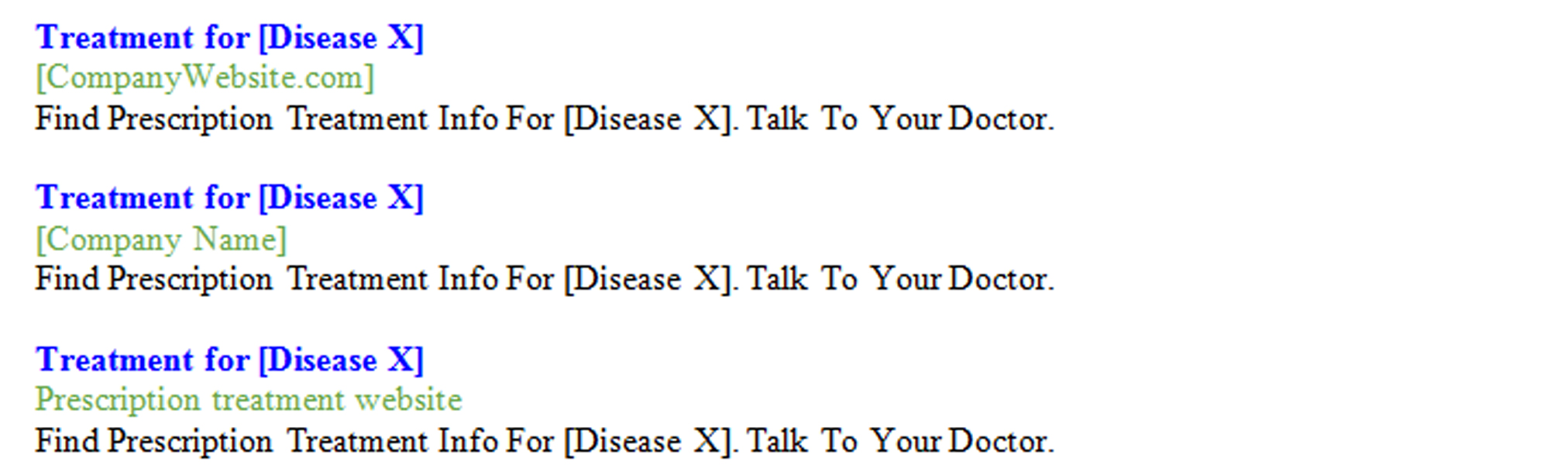
The first two options could be problematic if the company’s name triggers an immediate association with a specific branded product. The third option – “Prescription treatment website” – may be the most logical adjustment, in part because the URL is directing a person to a product-specific, brand website. Although these formats are not currently supported and still need to be implemented, pharmaceutical companies should be mindful of the changes before the January 12, 2016, deadline.
BOTTOM LINE – If pharmaceutical companies have not already done so, they need to contact their media-buying agency and be certain the agency is aware of the changes and is implementing acceptable work-arounds.