

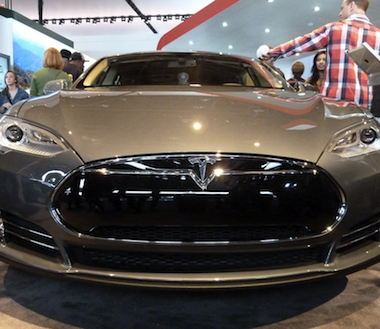
Tesla is officially road-testing its autopilot programming, which some Model S owners have been waiting more than a year for. But what will the law say about it?
Legislators have been making moves self-driving cars for a few years now, but while the industry is suddenly surging ahead regulation doesn’t seem to be keeping pace.

If Tesla’s release is popular enough, it’s possible regulators will have something more widespread and concrete to draw inspiration from and draft around. For now, legislators and manufacturers alike are wrestling with the same question: What does an autonomous car driving safely look like?
In 2012 alone, roadway crashes reportedly cost the U.S. economy about $212 billion, and resulted in over 1,000 fatalities. To some self-driving cars are the answer, creating a safe mode of transportation while also giving drivers time to do other things in lieu of driving. But for others that’s also where much of the potential concern comes from. And with the market decidedly mixed on driverless cars, and no guidelines for companies to aim for, the roads could be a hodge-podge of different driving standards and styles.
Google, one of the earliest developers of self-driving cars, has had their cars involved in 16 accidents, but all of them have been minor and have been the fault of a human, not the machine. For Google, caution is key. In fact, their problem has been that their driverless cars follow the law to the letter—which obviously isn’t the case for all drivers. The New York Times reports:
Google’s fleet of autonomous test cars is programmed to follow the letter of the law. But it can be tough to get around if you are a stickler for the rules. One Google car, in a test in 2009, couldn’t get through a four-way stop because its sensors kept waiting for other (human) drivers to stop completely and let it go. The human drivers kept inching forward, looking for the advantage — paralyzing Google’s robot.
…Google cars regularly take quick, evasive maneuvers or exercise caution in ways that are at once the most cautious approach, but also out of step with the other vehicles on the road.
“It’s always going to follow the rules, I mean, almost to a point where human drivers who get in the car and are like ‘Why is the car doing that?’” said Tom Supple, a Google safety driver during a recent test drive on the streets near Google’s Silicon Valley headquarters.
Google is now trying something new: Teaching its cars to drive a bit more like humans by edging into intersections and cutting corners. The problem is, while autonomous cars need the right balances of aggression and safety, that right amount depends on the culture and location of the roads they’re driving on.
For now, most self-driving car developers are sticking to the partial-autonomy model, which still tasks drivers with monitoring the car. As Electrek reported, the Model S update presents two different alerts which make it clear where Tesla wants liability to fall:
Something as simple as a faded road line or the sun glaring on the road can cause this alert to popup. Even when the road conditions appear ideal to you for the Autopilot, the alert could still popup. If you position yourself at the height of the front-facing camera, which is behind the rear-view mirror, you could more easily understand why it momentarily lost data if, for example, at that particular angle the sun is glaring on the road markings.
If you ignore the “hold the steering-wheel” alert for too long, even if it’s now back to normal for the Autopilot, it will change into a “take control immediately” alert, which will flash your hazard lights, slow down and steer the vehicle to the side of the road. The transition is presumably the Autopilot assuming that if you are not seeing the alert, you might be incapacitated and therefore it stops the vehicle.
But many questions around that liability haven’t been decided, and if the car were to crash it wouldn’t be a sure thing where the liability would fall. Still, Tesla CEO Elon Musk estimates we’ll have full autonomy within three years.
Meanwhile the NHTSA hasn’t updated its stance on automated vehicles since May 2013. Hopefully by the time the cars are moving amongst us there’s some standard of safety we can expect from them.