

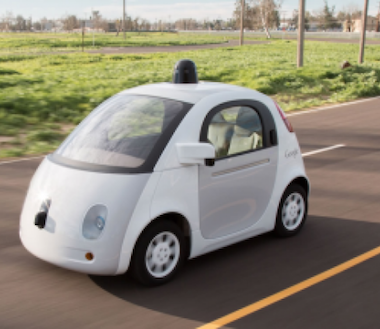
It’s not exactly like they’ve been the most productive branch of government lately. But autonomous car manufacturers have no time to waste.
Today the U.S. Senate Commerce Committee will hear from self-driving car company representatives, including Google, General Motors, and Lyft. Entitled “Hands Off: The Future of Self-Driving Cars,” the hearing will explore advancements being made and on the horizon for autonomous driving. So what’s finally pushing these groups to put the pedal to the metal on driverless cars?
For starters, new lanes are popping up, with even more questions of their own.
Those conversations are arising in ways that weren’t being thought about years before. For instance, there’s Uber who sees autonomous driving as the ticket to avoiding the taxi industry’s fate. Mining and farming industries are already seeing applications, and construction and warehousing could be next. Then there’s Internet of Things which brings threats of your car being hacked and overridden while you are in the vehicle.
Those conversations are arising in ways that weren’t being thought about years before. For instance, there’s Uber who sees autonomous driving as the ticket to avoiding the taxi industry’s fate. Then there’s Internet of Things which brings threats of your car being hacked and overridden while you are in the vehicle. Driverless cars have become much more than just a convenience or an answer to roadway crashes and DUIs. They’ve become a disruptor.
What’s more, these cars are passing us on the highway faster than they thought it could.
A lot faster.
Autonomous vehicles have been in development for years; upwards of a decade. But even as they’re being developed they’ve been put off as a technology of the future. In 2013 the National Highway and Transportation Security Administration (NHTSA) declared talk of driverless cars “premature,” even as some companies were already fast-tracking their programs.
Most companies estimated at least one autonomous car model hitting the market sometime around 2020, when the necessary development and research was complete. As it turns out that was a bit conservative: Last October Tesla announced its groundbreaking “no hands” feature, and many newer car models already incorporate some sort of autonomous driving feature.
We’re still a couple years from a completely (or even mostly) human-driver-free highway, but industry members are clearly hoping to have some legal infrastructure for when we get there. By approaching Congress today, the industry is hoping that they can get in front of the problem and ignite some means for federal oversight.
“We propose that Congress move swiftly to provide the secretary of transportation with new authority to approve lifesaving safety innovations. This new authority would permit the deployment of innovative safety technologies that meet or exceed the level of safety required by existing federal standards, while ensuring a prompt and transparent process,” said Chris Urmson, director of Google’s self-driving cars program, according to the prepared testimony.

Reportedly his testimony will call for new authority granted to the U.S. Transportation Department to help get fully driverless cars safely on the road.
Which is good because accidents (are starting to) happen.
Last year Google was proud to state that though its cars had been involved in more than a dozen accidents none of them were the fault of the Google “driver.” That changed last month, when one of the tech giant’s autonomous cars was involved in a fender bender that was the fault of the driverless car. The system mistakenly believed that as it was re-entering traffic the bus it sensed would slow to allow the Google self-driving Lexus to continue. No dice.
It’s a classic example of a negotiation that’s part of everyone’s driving experience, which is almost always where accidents occur. But when the decision is left up to a computer it’s not inspiring that the many benefits of autonomous driving is worth the dangers—which is why 51 percent of the responders to one poll said they wouldn’t be a passenger in one. For many there’s too many questions: If I rode in a driverless car would I be liable in an accident? Will it be able to make the same instantaneous safety negotiations I do?
To help, the NHTSA already updated its stance to help clarify some of the questions about driverless cars, stating that they would interpret the self-driving system as the “driver” under federal law—which is a big development. With regulations falling behind technology in this sphere, there’s a shared hope to avoid a patchwork of regulations around driverless cars, and where liability fell has been a major question mark and stopping point for many conversations.
The hearing today is a proactive measure, designed to loop all parties in on what lines should be drawn where for the driverless car industry. Autonomous cars have lofty ideals—no attention or accidents for its occupants—but stuff happens, and if the industry can not just prepare Congress but enlist their help in overcoming roadblocks it’ll be a smoother drive for their systems in the future.