

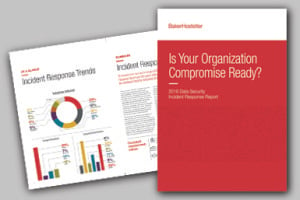
 On March 30, 2016, we released our second annual Data Security Incident Response Report. Key findings show that phishing/hacking/malware was the cause of 31% of data security incidents during 2015, revealing a shift from 2014 when human error was the leading cause. The report also continues the inaugural-year theme that no industry is immune to data security incidents – reinforcing that it is more important than ever that companies take action in advance to become ready for the inevitable incidents to come.
Being ‘compromise ready’ better positions companies to respond to data security incidents faster, contain the threat, and potentially lessen the severity of these events. This year’s report has evolved to include more robust data to raise awareness of how these events take place, and also includes the action items companies should take to their boards of directors to plan for the inevitable data security incident.
The report analyzes data from more than 300 incidents on which the firm advised in 2015. The report looks at causes of incidents, industries most affected, and what happens after a security incident is detected – from containment, to notification, to regulatory investigations and even lawsuits. A final section in the report provides the eight components of being compromise ready and identifies measures companies should take to minimize the impact of an incident.
Notable statistics from the report include:
- Cause of incidents: phishing/hacking/malware (31%), employee actions/mistakes (24%), external theft (17%), vendor-related incidents (14%), internal theft (8%), and lost or improper disposal (6%).
- No industry is immune: the healthcare industry (23%) was affected more than any other. Rounding out the top three are financial services (18%) and education (16%).
- Number of individuals notified: for incidents in 2015 where notification was made, the average number of individuals notified was 269,609 and the median was 190,000.
- 52% of the incidents that BakerHostetler helped manage in 2015 were self-detected.
- Detection time – the time from when an incident first began until it was detected – ranged from 0 days to more than 400 days. The average amount of time from incident to discovery for all industries was 69 days, with healthcare taking nearly twice as long as other industries. Average amount of time from discovery to containment was 7 days.
- Notification – the average amount of time from discovery to notification – was 40 days.
- Not all incidents require notification to individuals or the public at large. In about 40% of the incidents that BakerHostetler helped manage in 2015, notification or public disclosure was not necessary.
- Credit monitoring was offered in 53% of the incidents that BakerHostetler advised on in 2015 and the average redemption rate was 10%.
- Regulatory inquiries resulted from 24% of incidents reported, and litigation commenced after 6% of the incidents were made public.
While healthcare companies again topped the ‘Frequency of Breach Incidents by Industry’ list, our findings show that those incidents are less severe than those that occur in other industries on average. In fact, topping the severity list by number of individuals affected was restaurants/hospitality, mostly due to financially motivated attacker groups moving their focus from grocers and big-box retailers to restaurants, hotels, and casinos.
Compromise Ready
Every company should be constantly focused on preventing, detecting, and having the right capabilities in place to respond to incidents. Accepting that incidents are inevitable does not mean that you stop trying to prevent them. In addition to reducing risk profiles through information governance and implementing preventative security measures, companies must focus on adapting measures to changing risks along with faster detection and containment to effectively respond.
The bottom line is that the key to successful and rapid containment is to plan for the inevitable incident. Companies that have identified the forensic firm they will work with, have a master services agreement in place, and have conducted scenario planning usually reach containment faster and with less impact to business operations and reputation.
The full 2016 BakerHostetler Data Security Incident Response Report can be found here. We will host a webinar on these findings on April 20 at noon EST, and will also be posting weekly blog entries which will take an in-depth look at the findings every Tuesday for the next several weeks.