

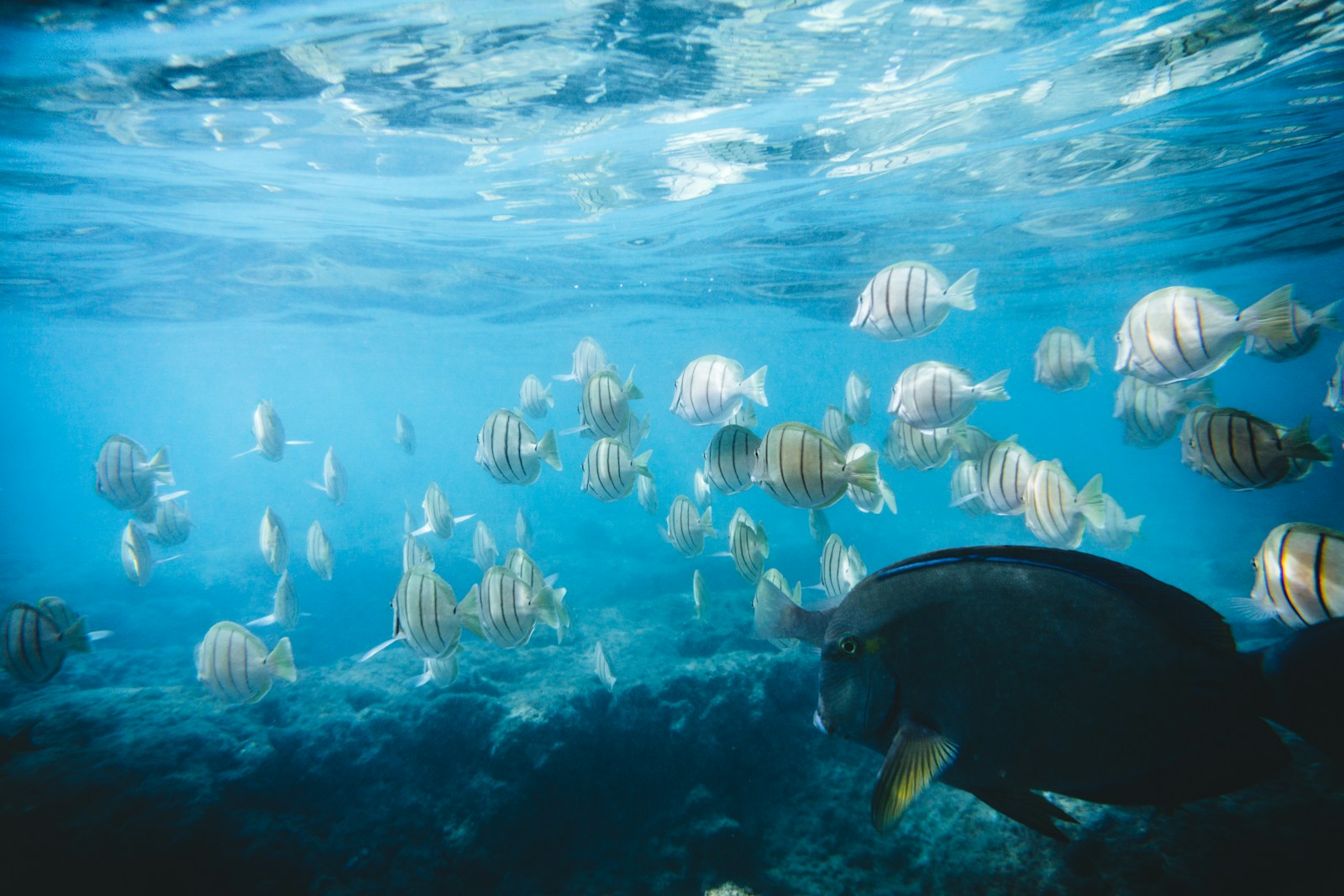
It is a rare day that this dirt lawyer, with an ocean-related blog, gets to blog about environmental law AND the ocean environment. Dear readers – today is the day! In a case certainly bound for the Hawaii Supreme Court, the Intermediate Court of Appeals (ICA) held that aquarium fish permit applications was not sufficient “action” to require the applicants to prepare an Environmental Assessment under Haw. Rev. Stat. Ch. 343.
The case is Umberger v. Dep’t of Land and Natural Resources, State of Hawaii and the ICA’s opinion can be found here.
This is a straightforward case factually. Several individuals and environmental groups brought suit against the State of Hawaii’s Department of Land and Natural Resources (DLNR) seeking a declaration that Hawaii’s environmental policy act, Ch. 343, (HEPA) required the preparation of an environmental assessment prior to issuing permits to take aquarium fish. DLNR is the state agency responsible for managing the State of Hawaii ocean resources, like fish.
Under Haw. Rev. Stat. 188-31, the DLNR has permitting authority over the aquarium fish trade:
(a) Except as prohibited by law, the department, upon receipt of a written application, may issue an aquarium fish permit, not longer than one year in duration, to use fine meshed traps, or fine meshed nets other than throw nets, for the taking of marine or freshwater nongame fish and other aquatic life for aquarium purposes.
(b) Except as prohibited by law, the permits shall be issued only to persons who can satisfy the department that they possess facilities to and can maintain fish and other aquatic life alive and in reasonable health.
(c) It shall be illegal to sell or offer for sale any fish and other aquatic life taken under an aquarium fish permit unless those fish and other aquatic life are sold alive for aquarium purposes.
The department may adopt rules pursuant to chapter 91 for the purpose of this section.
(d) For the purposes of this section:
(1) “Aquarium purposes” means to hold salt water fish, freshwater nongame fish, or other aquatic life alive in a state of captivity as pets, for scientific study, or for public exhibition or display, or for sale for these purposes; and
(2) “Aquarium fish permit” means a permit issued by the board for the use of fine mesh nets and traps to take salt water fish, freshwater nongame fish, or other aquatic life for aquarium purposes.
The reef fish trade has been controversial for the past several years. See media reports: here, here and here.
To trigger the need for an environmental assessment, there must be an “action” which is subject to environmental review. There are three requirements: First, an “action” is a “any program or project to be initiated by an agency or applicant.”
Second, the action must involve an enumerated triggers under Haw. Rev. Stat. 343-5:
(a) Except as otherwise provided, an environmental assessment shall be required for actions that:
(1) Propose the use of state or county lands or the use of state or county funds, other than funds to be used for feasibility or planning studies for possible future programs or projects that the agency has not approved, adopted, or funded, or funds to be used for the acquisition of unimproved real property; provided that the agency shall consider environmental factors and available alternatives in its feasibility or planning studies; provided further that an environmental assessment for proposed uses under section 205-2(d)(11) or 205-4.5(a)(13) shall only be required pursuant to section 205-5(b);
(2) Propose any use within any land classified as a conservation district by the state land use commission under chapter 205;
(3) Propose any use within a shoreline area as defined in section 205A-41;
(4) Propose any use within any historic site as designated in the National Register or Hawaii Register, as provided for in the Historic Preservation Act of 1966, Public Law 89-665, or chapter 6E;
(5) Propose any use within the Waikiki area of Oahu, the boundaries of which are delineated in the land use ordinance as amended, establishing the “Waikiki Special District”;
(6) Propose any amendments to existing county general plans where the amendment would result in designations other than agriculture, conservation, or preservation, except actions proposing any new county general plan or amendments to any existing county general plan initiated by a county;
(7) Propose any reclassification of any land classified as a conservation district by the state land use commission under chapter 205;
(8) Propose the construction of new or the expansion or modification of existing helicopter facilities within the State, that by way of their activities, may affect:
(A) Any land classified as a conservation district by the state land use commission under chapter 205;
(B) A shoreline area as defined in section 205A-41; or
(C) Any historic site as designated in the National Register or Hawaii Register, as provided for in the Historic Preservation Act of 1966, Public Law 89-665, or chapter 6E; or until the statewide historic places inventory is completed, any historic site that is found by a field reconnaissance of the area affected by the helicopter facility and is under consideration for placement on the National Register or the Hawaii Register of Historic Places; and
(9) Propose any:
(A) Wastewater treatment unit, except an individual wastewater system or a wastewater treatment unit serving fewer than fifty single-family dwellings or the equivalent;
(B) Waste-to-energy facility;
(C) Landfill;
(D) Oil refinery; or
(E) Power-generating facility.
Third, the action must not be exempt under Haw. Rev. Stat. 343-6 (authorizing the Environmental Council to exempt specific types of actions).
In this case, the alleged action was the “directed intentional, large-scale commercial removal under each permit, and collectively under the dozens of permits DLNR issued.” Opinion at 11. The challengers did concede that their interpretation of Haw. Rev. Stat. Ch. 343 would equally apply to recreational aquarium fish permits.
The ICA then turned to the prior cases where Hawaii courts have reviewed “programs” or “projects” and determined them to be “actions.” Think – Koa Ridge, Superferry. The ICA stated, “The projects or programs described in these cases also exemplify the essential nature of HEPA’s intended reach and that the definition of “action” as “any program or project” – as opposed to, for example, “any activity whatsoever” – reflects that not every level of regulated activity is meant to be swept into HEPA’s reach. [Whew – can you imagine having to do an EA before you obtained a driver’s license or, as the ICA pointed out, a parent netting one or two fish from a stream for their child’s fish tank].
The ICA pointed out the wide array of conservation statutes designed to regulate fishing in Hawaii as well as those permits that regulate activities potentially impacting marine environment – none of which require an environmental assessment.
Summing up, the ICA held, “We conclude that to interpret “program or project” so sweepingly as to require individual aquarium fish permit applicants to undertake the EA process is not a ‘rational, sensible and practicable interpretation’ of HEPA and would create an unreasonable, impractical and absurd result.”
Stay tuned for further appeal.