

Carrier. UTC. Boeing. Swamp-draining rhetoric. While many ponder what America can expect from the next administration, one thing is clear – it appears to have its eyes on government contractors. However, it is important for those eyes to study the volumes of acquisition regulations under which the government is required to operate when contracting with commercial companies. Accordingly, we thought it would be helpful to describe – through a series of explanations of 140 or fewer characters – why recent tweets about Boeing’s Air Force One contract do not reflect the current state of government contracts law and, in particular, the provisions governing termination of contracts.
As seasoned government contractors know, the government’s right to terminate a contract for its convenience is straightforward, simple and codified in appropriately tailored Termination for Convenience (“T4C”) clauses and related requirements that ripple through the Federal Acquisition Regulations (“FAR”). Although the government’s right to terminate a contract is omnipresent, the Termination for Convenience clause is not a “Get Out of Contract Free” card. On the contrary – such a termination is often an expensive and protracted endeavor for the government and the contractor alike. The concern, of course, is that President-elect Trump’s bold “Cancel order!” tweet of Boeing’s in-process contract may have a chilling effect on the willingness of companies to work with the government. But concerned businesses should rest assured that the FAR still applies – especially FAR Parts 12, 13, 31, 49, and 52. These provisions individually and collectively form the fundamental regulatory blueprint that governs the termination and settlement of government contracts.
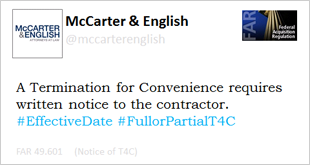
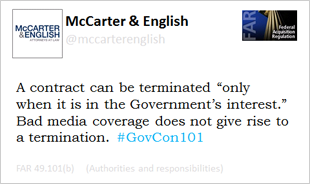
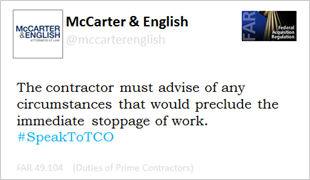
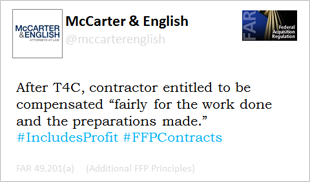
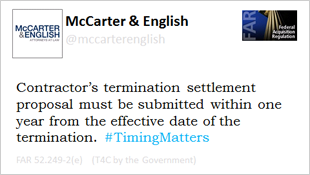
Now, we suspect the recent headline-grabbing tweet was not preceded by a deep dive into the FAR. Accordingly, in the spirit of communicating through the use of 140 or fewer characters, we’ve decided to reassure contractors and help the incoming administration better understand the intricacies inherent in the termination of federal contracts:
 |
 |
 |
 |
 |
 |
 |
 |
 |
 |
 |
 |
Obviously, these excerpts are not a comprehensive distillation of every regulatory requirement pertaining to the termination of government contracts, and they do not address the many decades of cases that have construed and established the rights and remedies afforded businesses when the government improperly terminates a contract. But they are a reminder to commercial companies who contract with the government that the world of federal procurement remains highly regulated. Government contractors have rights, and we hope that – sooner or later – the incoming administration comes to that realization. If it doesn’t, as one of our mentors used to say, “That’s why God invented the courtroom.”
Please feel free to retweet as necessary.