

If you attended our successful advertising law symposium last week, you may recall that we talked through a series of mobile app designs – including dos and don’ts – for creating enforceable terms of use. Recall this slide in particular:

If you weren’t able to join us, let me catch you up. I suggested that a mobile app design that allowed the user to interface with the application without viewing the relevant consent language (i.e., “I consent to the terms of use”) would result in terms of use likely being held unenforceable. In other words, it isn’t enough that it is possible that a user might have seen the operative language, because they also might not have. Instead, I told you, your design needs to ensure that they see the operative language and affirm their consent before being allowed to proceed with use of the application. I also told you that we had not yet seen case law confirming this best practice.
Well, now we have. The Northern District of California found a ride-sharing mobile application’s terms of service unenforceable. Why? Because in some instances a pop-up appeared that covered the operative consent language on a user’s mobile phone. “When such a registrant presses ‘REGISTER’ without having seen the alert, he does so without inquiry notice of [the] terms of service and without understanding that registering is a manifestation of assent to those terms.” That obstruction in the process effectively turned the terms of service into an unenforceable browsewrap agreement.
What should you do? Delete your mobile app from your phone and tablet, download it again, and play with it. If there is any instance in which a user can proceed into the application without seeing language of consent, then consider design changes. A standalone page, such as this, is a good practice:
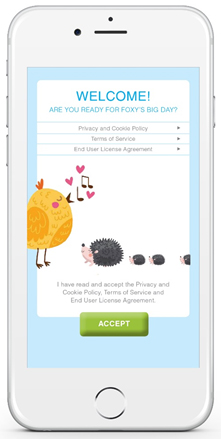
Of course, you can always use an opt-in check box too. But, as we have mentioned before, the design should allow you to demonstrate that you obtained consent from your users.