

As President Trump’s administration attempts to dismantle President Obama’s Climate Action Plan, one action may be removing funding from the Securities Exchange Commission (SEC) for enforcement of the 2010 Commission Guidance Regarding Disclosure Related to Climate Change. So, should public companies continue to disclose climate change-driven risks and benefits?
Yes – according to the SEC, the climate change disclosure guidance merely “assists companies in satisfying” their pre-existing requirements concerning disclosure of environmental issues, affirming disclosure obligations in place since the 1970s. By following the guidance, companies merely will be supplying information about climate change that may impact investors’ decision-making.
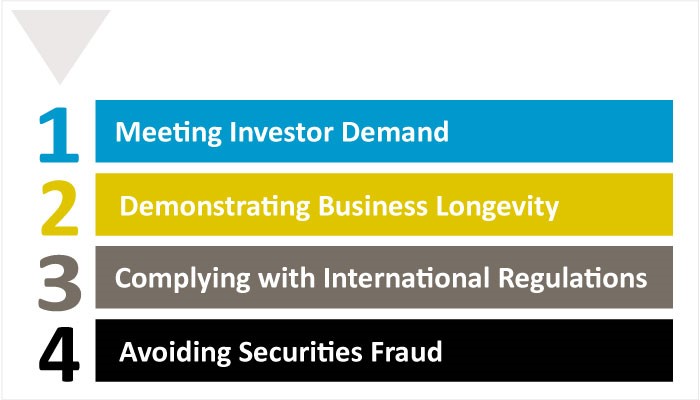
Four issues will be addressed:
- Meeting Investor Demand
As annual meeting season heats up, companies can expect to hear louder shareholder requests for more robust climate disclosure. Investors are, in fact, clamoring for more data on the physical risks posed by climate change. For example, has the company examined its assets to determine if these facilities may be subject to extreme storms, wildfires, or sea level rise? Has the company examined its supply chain to determine if the necessary raw materials for its products will be affected by climate risks?
- Demonstrating Business Longevity
Investors also want to know if the business itself will be viable in the future, and for how long. For example, stark discrepancies exist between the pictures painted in financial projections concerning public adoption of zero-emission vehicles (ZEVs). The financial statements of car companies, for which Corporate Average Fuel Economy standards require the development of ZEVs, show adoption on the near horizon. Alternatively, petroleum companies, who want to continue selling gasoline long into the future, do not reflect the same timeline for adoption of ZEVs in their financial projections as the car companies. The basis for the financial projections that each paint can affect how long an investor wants to hold onto a particular stock. In this example, understanding the assumptions for adoption of ZEVs, and how those are reflected in the financial statements, would be an important piece of an investor’s analysis.
- Complying with International Regulations
For international companies or companies selling their products into international markets, understanding their carbon footprint is often essential. Regulations in Europe and other parts of the world require disclosure of the carbon intensity of a company’s product. In many investors’ eyes, setting goals for carbon reduction and carbon intensity reduction are an essential part to demonstrating climate impact.
- Avoiding Securities Fraud
Investors continue to threaten to sue companies who they claim are failing to properly disclose material risks and benefits. For example, the New York and Massachusetts state attorneys general are currently investigating Exxon Mobil Corporation to determine whether the company failed to disclose climate risks to its business, and, by doing so, has overstated the value of the assets.
At least for now, climate change disclosure is still the law of the land. Regardless of uncertainty over the United States’ future approach to climate change, public companies still will see demands for climate change disclosures beyond the SEC guidance.