

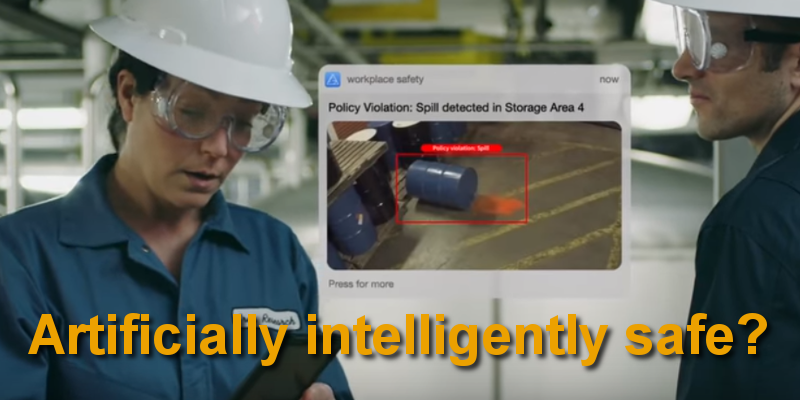
At last month’s Microsoft developer conference, the software maker previewed developing software that can track people, tools, and activities in real-time to prevent workplace accidents.
It’s unclear how many workplace safety experts were in the room when Microsoft’s Director of Commercial Communications, Andrea Carl, unveiled the developing tools at the company’s Build 2017 conference in Seattle in May. But, the potential to dramatically impact workplace safety was clear.
The demonstration (see video below) showed a system of cameras, software, and networked devices, including smartphones, that can work together in real time to be sure that people on a job site are trained, equipment is stored safely, and work is done correctly. The system performs 27 million “recognitions” per second of people, objects, and activities.
In the demo, Carl showed how she could search “where is a jackhammer?” and the system would identify its location. It could also tell her who was trained to use the tool and who last used it. After tagging images to train the system to recognize both safe and unsafe tool positions, the system could send an alert to the nearest trained worker when the jackhammer was unsafely perched on its end.
The software keeps track of individual workers, too. Carl was able to simply ask her phone to show her non-employees on the job site, and the system provided a list with photos and locations. To “on-board” one of them to be recognized as an employee, she simply had to click and enter the person’s information.
It can also track compliance with regulations and policies in real-time. If an untrained worker picks up a tool that requires training, the system will issue an alert, potentially to the closest trained employee. If an accident or spill occurs, the system presumably can initiate an emergency response protocol, alerting first responders, implementing an evacuation, and identifying the location of emergency resources.
Legal complications?
Of course, from a legal perspective, rolling out such a system will not be without complications. How would it impact workers’ privacy? How accurate is it? Does it cause employees to let down their guard and be less vigilant themselves because they come to rely on the computer? What if the system gives bad information (perhaps based on faulty training) that actually leads to an injury? How is data retained? Does it become a treasure trove of evidence against you when something goes wrong?
Carl described the system as a work in progress and glimpse of the future, but its promise and perils seem to be just on the horizon.