


We’ve posted before about the availability of appraisal rights in the Cayman Islands. In this post, we focus on a specific merger involving a Cayman Islands company to highlight some of the important considerations in Cayman appraisal.*
A number of Cayman companies are listed in the United States, a subset of which are companies with their headquarters in the People’s Republic of China. Chinese companies may use the Cayman Islands as a “bridge” between mainland rules and listing rules, taking advantage of certain legal structures, such as variable-interest entities (VIEs) or similar, in order to comply with their legal obligations in China and in whatever market they list in–such as the New York Stock Exchange or London Stock Exchange.
For our example today, we focus on just one way Chinese-qua-Cayman companies may operate: issuing American depository shares, or ADS. ADS are not, per se, shares of the Cayman company itself–even if, by contract, an ADS holder receives the economic benefits of share ownership. Rather, ADS are issued by depository institutions (such as U.S. banks), in U.S. dollars. In turn, the depository institution has a contractual arrangement with the Cayman company, whereby the depository institution itself holds the Cayman company shares.
While this arrangement may seem confusing, it actually is not all that different from the share ownership arrangements in the United States, which involve the Deposit Trust Clearing Corp., its nominee Cede & Co., and a network of brokers (depository institutions) who hold stock in “street name.”
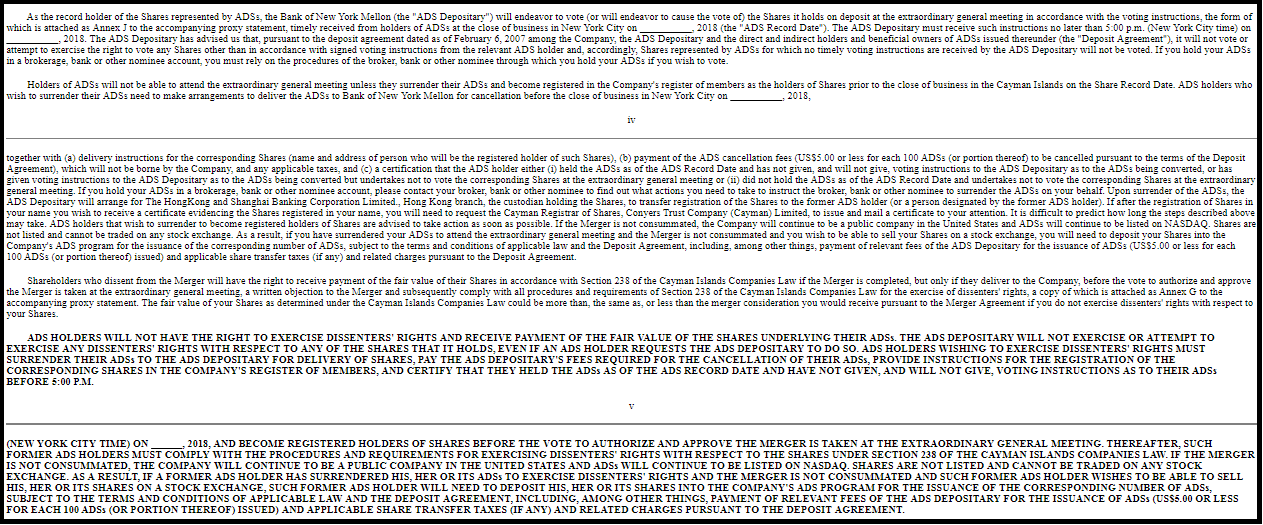
For our example, the merger at issue contained the following announcement**:


Critically, the Cayman company tells ADS holders–effectively any U.S. shareholder–that in order to perfect their appraisal rights in the Caymans, they will need to execute a few steps. In particular, they will need to surrender their ADS to the depository institution, convert the ADS into company stock (i.e., Cayman stock), register the Cayman stock, pay a fee to the depository institution, and then certify its instructions (or lack thereof). And that’s just the procedure to get to a point where investors can potentially exercise their rights!
While this may seem like a tall order, these steps are fundamentally ministerial–but this can take a very long time.***
Nonetheless, after conversion, a dissenter does have Cayman appraisal rights, something the announcement confirms:


Like in Delaware, merger dissenters in Cayman can seek appraisal of their shares. It just may take a few additional steps–and more time–to get there.
* Lowenstein Sandler LLP does not practice law in the Cayman Islands and does not advise on issues of Cayman law. This blog post is for informational purposes only, summarizes an existing, publicly available merger announcement, and should not be taken as legal advice as to the specifics of Cayman law.
** All images herein are taken from the publicly filed merger announcement of JA Solar Holdings Inc. For a fuller statement of the ADS portion of this announcement, see here.
*** We thank Ben Hobden of ConyersDill for his input.