

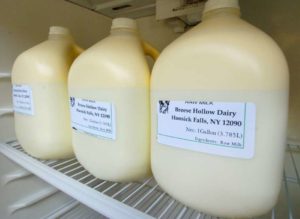
 New York Agriculture Commissioner Richard Ball today warned consumers in Rensselaer County and the surrounding area not to consume unpasteurized raw milk from the David Phippen Farm, which does business as Breese Hollow Dairy, due to possible Listeria monocytogenes contamination. Breese Hollow Dairy is located at 454 Breese Hollow Rd. Hoosick Falls, NY 12090. To date, no illnesses are known by the Department to be associated with this product.
A sample of the milk collected by an inspector from the Department of Agriculture and Markets on January 30, 2018 was discovered to be contaminated with Listeria monocytogenes. On February 2, 2018 the producer was notified of a preliminary positive test result. Breese Hollow Dairy voluntarily suspended sales of the product upon being notified of the preliminary positive test result. Further laboratory testing completed on February 6, 2018 confirmed the presence of Listeria monocytogenes in the raw milk sample. The producer is now prohibited from selling raw milk until subsequent sampling indicates the product is free from harmful bacteria.
The Department recommends that any consumers who purchased raw milk from Breese Hollow Dairy immediately dispose of it and call the Department at 518-457-1772 if they have questions.
Listeria monocytogenes causes listeriosis, which can be a serious and sometimes fatal infection in young children, cancer patients, elderly people and others with weakened immune systems. Otherwise healthy persons may suffer short-term, flu-like symptoms such as high fever, severe headaches, stiffness, nausea, abdominal pain and diarrhea. Listeriosis can cause also miscarriages and stillbirths in pregnant women.
It is important to note that raw milk does not provide the protection of pasteurization. Pasteurization is a process that heats milk to a specific temperature for a period of time to kill the bacteria responsible for numerous illnesses and diseases such as listeriosis, salmonellosis, campylobacteriosis, typhoid fever, tuberculosis, diphtheria, and brucellosis. Pasteurization of milk is recognized internationally as an effective means of preventing outbreaks of foodborne illnesses, including listeriosis.