

A Federal Magistrate Judge for the United States District Court of Oregon recently issued findings and recommendations in Chief Wilder Slockish, et al. v. U.S. Federal Highway Administration, et al., concluding that federal highway construction work did not impose a substantial burden on plaintiffs’ religious exercise. Plaintiffs, including members of the Confederated Tribes of the Yakama Nation, alleged that defendants substantially burdened “their right to exercise religion by ‘damaging and destroying a historic campground and burial grounds through tree cutting and removal, grading, and ultimately burying the campground and burial grounds,’ and ‘by blocking off access to these by installation of a new guardrail.’” Specifically, the plaintiffs objected to the Wildwood-Wemme highway widening project on U.S. Highway 26, in an area traditionally known to plaintiffs’ tribes as Ana Kwna Nchi nchi Patat (the “Place of Big Big Trees”) near Mount Hood. Plaintiffs’ allegations are further detailed in their complaint.
The Court concluded that plaintiffs’ RFRA substantial burden claim was foreclosed by the Ninth Circuit’s decision in Navajo Nation v. U.S. Forest Serv., 535 F.3d 1058 (9th Cir. 2008). In Navajo Nation, the Ninth Circuit noted that RFRA was passed in order to restore the free exercise “compelling interest” test of pre-Employment Division v. Smith cases, wherein a substantial burden was evident when a plaintiff was forced to choose between following the precepts of her religion and forfeiting a governmental benefit (Sherbert v. Verner), or violating state law and following religious convictions (Wisconsin v. Yoder). In Navajo Nation, plaintiffs contended that the use of wastewater to produce artificial snow on a scared mountain substantially burdened their religious exercise. The Ninth Circuit rejected this claim and held that
a government action that decreases the spirituality, the fervor, or the satisfaction with which a believer practices his religion is not what Congress has labeled a ‘substantial burden’—a term of art chosen by Congress to be defined by reference to Supreme Court precedent—on the free exercise of religion…. Where …. there is no showing the government has coerced the Plaintiffs to act contrary to their religious beliefs under the threat of sanctions, or conditioned a governmental benefit upon conduct that would violate the Plaintiffs’ religious beliefs, there is no ‘substantial burden’ on the exercise of their religion… The presence of recycled wastewater on the Peaks does not coerce the Plaintiffs to act contrary to their religious beliefs under the threat of sanctions, nor does it condition a governmental benefit upon conduct that would violate their religious beliefs, as required to establish a ‘substantial burden’ on religious exercise under RFRA…
In light of this holding and its progeny, the Court concluded “that plaintiffs have failed to establish a prima facie case that their right to exercise religion has been substantially burdened.” Although na Kwna Nchi nchi Patat / Place of Big Big Trees is located on federal land, plaintiffs did not demonstrate that they are “being coerced to act contrary to their religious beliefs under the threat of sanctions or that a governmental benefit is being conditioned upon conduct that would violate their religious beliefs.”
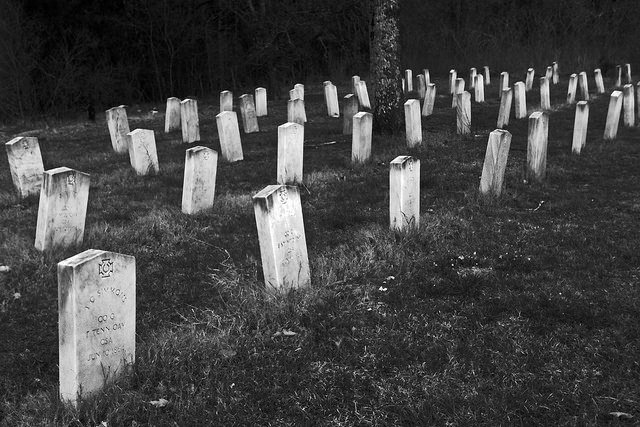
Original photograph by Whatknot, some rights reserved.