

While many federal contractors operate on a fiscal year that coincides with the calendar year, the federal government’s fiscal year is the 12-month period beginning on October 1 and ending on September 30 of the following year. Understanding the federal government’s fiscal year—and, in particular, the effects of the government’s fiscal year cycle on its spending and planning tendencies—is essential for all federal contractors.
Spending
A 2010 study by Harvard’s Kennedy School of Government found that, by “pooling data from 2004 through 2009,” one can see “a clear spike in spending at the end of the [government’s fiscal] year with 16.5 percent of all spending occurring in the last month of the [government’s fiscal] year and 8.7 percent occurring in the last week [of the government’s fiscal] year.” Understanding this spending pattern is critical for federal contractors, as it allows them to predict, with some degree of certainty, when the federal government will award certain contracts on which they—or their competitors—have bid.
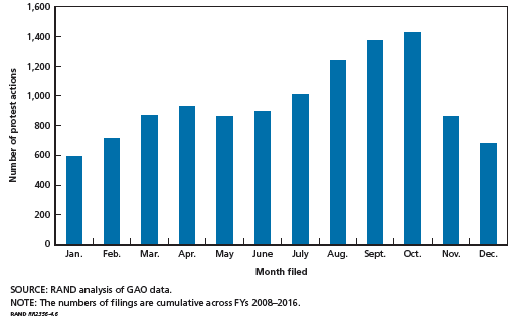
Further, understanding this pattern of spending helps federal contractors to be better prepared in the event of a bid protest—whether by the contractor itself, or by a competitor challenging an award to the contractor. In this regard, the following chart from a recent report by RAND Corporation shows that the number of bid protest filings at the Government Accountability Office peaks in October as a result of increased government spending at the end of the government’s fiscal year:
Planning
In addition to having a better understanding of the federal government’s spending tendencies and the consequences thereof, understanding the government’s fiscal year cycle can give federal contractors an advantage on the planning front. Specifically, understanding that most federal agencies begin significant acquisition planning early in the fiscal year allows contractors to be proactive—rather than reactive—when it comes to pursuing contracting opportunities (e.g., identifying upcoming solicitations, identifying potential teaming partners, preparing proposals, etc.). Additionally, understanding that most federal agencies begin significant acquisition planning early in the fiscal year can also allow contractors to be proactive in terms of shaping the government’s requirements (e.g., educating the government about specific goods/services, participating in market research, responding to government requests for information, providing input on procurement planning, etc.). Indeed, proactive and smart measures by federal contractors at the beginning of the government’s fiscal year can, and often do, mean the difference between winning and losing a contract at the end of the government’s fiscal year.
If you have any questions about the topics discussed in this article or about any related issues, please do not hesitate to contact Aron Beezley.