

LIENING IN: Best Practices for Suppliers Navigating CIMLA – Part 1
Under the Commercial Instruments and Maritime Liens Act (“CIMLA”), 46 U.S. Code § 31342 et. seq., “a person providing necessaries to a vessel on the order of the owner or a person authorized by the owner – (1) has a maritime lien on the vessel; (2) may bring a civil action in rem to enforce the lien; and (3) is not required to allege or prove in the action that credit was given to the vessel.” This post is the first installment in a series examining the elements suppliers of maritime goods or services must prove to establish and enforce the supplier’s potential maritime lien.
The term “necessary” applies not only to goods and services that are required for the vessel to operate, but also “includes most goods or services that are useful to the vessel, keep her out of danger, and enable her to perform her particular function…. What is a ‘necessary’ is to be determined relative to the requirements of the ship.” Equilease Corp. v. M/V SAMPSON, 793 F.2d 598, 603 (5th Cir.) (en banc), cert. denied, 479 U.S. 984 (1986). Goods or services that are essential for the vessel to perform its mission should be considered necessaries. Items that courts have found to constitute necessaries under CIMLA include: fixed gas detection systems required for subsea pipe repair activities conducted from a vessel; bunkers/fuel; insurance; payments which stevedoring companies are required to make to longshore employees under collective bargaining agreements; services to secure, prepare, and file documents in connection with marine mortgages; and, transporting drilling equipment to a drilling vessel via supply boat.
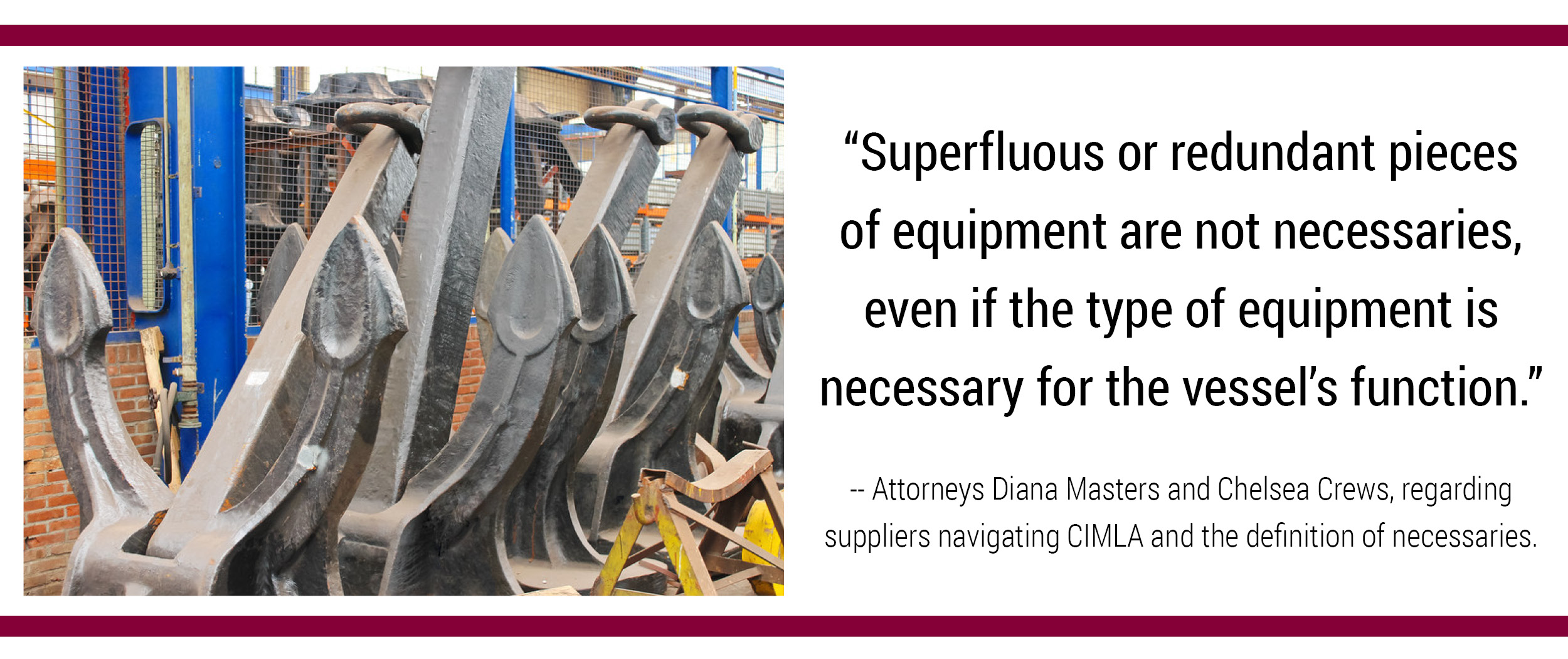
Thus, if a supplier can establish that its goods or services were related to the purpose for which the vessel was operating, then they should qualify as necessaries. One cautionary note: once the vessel ceases operating for the purpose for which the supplies are provided, the supplies may no longer constitute necessaries. Similarly, superfluous or redundant pieces of equipment are not necessaries, even if the type of equipment is necessary for the vessel’s function. See Equilease, 793 F.2d at 604 (“Anchors and cables are generally considered to be necessaries, but if the vessel is fully supplied with them, the furnishing of another anchor or cable is not ‘necessary’.”).
In the upcoming installments, we will analyze the remaining substantive requirements for a necessaries lien under CIMLA as well as defenses to and priority of the maritime lien for necessaries.
Read Part 2: Explicit Designation of Vessels Key for Suppliers Navigating CIMLA