

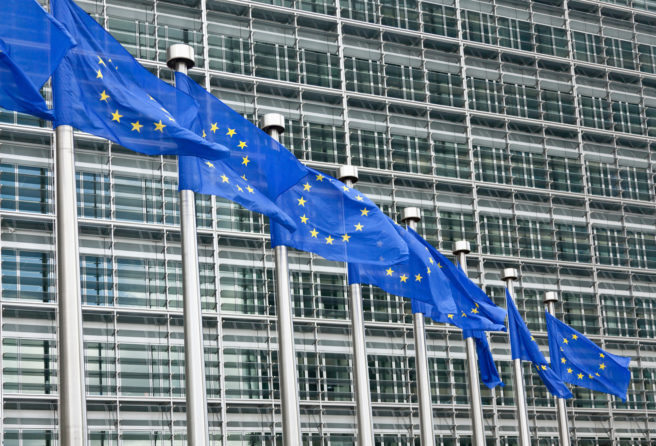
As we have blogged (here and here), the United States – despite its self-perception as a global financial cop and “good guy” – is often regarded by the world as a haven for money laundering and tax evasion. The U.S. just took another black eye in the arena of global perception: the European Commission (“EC”) has placed the U.S. Virgin Islands, Puerto Rico, Guam and American Samoa on a list of 23 high-risk jurisdictions which it says are “posing significant threats” to the European Union’s financial system as a result of deficiencies in their Anti-Money Laundering (“AML”) and Countering the Financing of Terror (“CFT”) systems. Specifically, the EC perceives these jurisdictions as being attractive to money laundering and tax crimes. The listed United States’ territories and Commonwealths are not alone; they dubiously share space on the EC’s blacklist with Saudia Arabia and Panama.
Not surprisingly, the U.S. reaction was swift and angry: the U.S. Department of Treasury released a statement declaring that the list was flawed; the list was created without any meaningful input from the United States; and that the list contradicted the more careful analysis conducted by the Financial Action Task Force. Further, the Treasury Department stated that U.S. financial institutions should ignore this blacklisting, and did not need to apply any greater scrutiny to implicated transactions.
Nonetheless, the blacklisting, which still must be formally approved by the EC, presumably could create real-world consequences. At the very least, European banks will be more cautious when transacting within these U.S. holdings. Unfortunately, Puerto Rico in particular is suffering and does not need to face more financial obstacles from any quarter, as it attempts to recover from Hurricane Maria and other issues.
Arguably, this EC list is not without irony. Needless to say, Europe – and Northern Europe in particular – is undergoing its own recent high-profile problems involving massive money laundering scandals. Further, this EC list has some notable and curious omissions, such as Russia.
The U.S. Also Falters in the Annual Corruption Perceptions Index
This blacklisting of U.S. territories follows on the heels of the late January 2019 release of the Corruption Perceptions Index 2018 (“2018 Index”) by the European corruption and human rights watchdog group Transparency International. The group describes the 2018 Index as follows:
The index, which ranks 180 countries and territories by their perceived levels of public sector corruption according to experts and businesspeople, uses a scale of 0 to 100, where 0 is highly corrupt and 100 is very clean. More than two-thirds of countries score below 50 on this year’s CPI, with an average score of just 43.
It reveals that the continued failure of most countries to significantly control corruption is contributing to a crisis in democracy around the world. While there are exceptions, the data shows that despite some progress, most countries are failing to make serious inroads against corruption.
According to the 2018 Index – the methodologies of which could be questioned as being subjective, not immune to bias, and possibly skewed in favor of northern Europe (Denmark continues to top the list of transparent countries, despite the colossal Dankse Bank scandal; Transparency International stresses that its indeces merely measure “perceptions”) – the situation in the United States is degenerating. Describing the United States, along with Brazil and the Czech Republic, as a “country to watch,” the website describing the 2018 Index declares the following:
With a score of 71, the United States lost four points since last year, dropping out of the top 20 countries on the [Corruption Perceptions Index] for the first time since 2011. The low score comes at a time when the US is experiencing threats to its system of checks and balances as well as an erosion of ethical norms at the highest levels of power.
. . . .
“Our research makes a clear link between having a healthy democracy and successfully fighting public sector corruption,” said Delia Ferreira Rubio, Chair of Transparency International. “Corruption is much more likely to flourish where democratic foundations are weak and, as we have seen in many countries, where undemocratic and populist politicians can use it to their advantage.”
Regardless of critiques which might be leveled against reports which attempt to reduce incredibly complex and fluid systems to seemingly clear and simple numerical lists, the above echoes basic concerns about creeping corruption which appear to be cropping up with distressing frequency – particularly in regards to the apparent link between increasing corruption and growing assaults on a free press. For example, and as we have blogged, the Basel Centre for Asset Recovery released its seventh annual Basel Anti-Money Laundering Index (“AML Index”) for 2018. The AML Index bemoaned a lack of progress in the global fight against corruption, and in particular cited the lack of enforcement of existing laws and, unfortunately, declining press freedom across the globe.
If you would like to remain updated on these issues, please click here to subscribe to Money Laundering Watch. Please click here to find out about Ballard Spahr’s Anti-Money Laundering Team.