


One change that some law libraries have seen in the last few decades is the new to go to a single primary fee-based provider. Sometimes called sole provider (although not by everyone), it is when we license one of the two largest legal publishers. A recent blog post by Joe Hodnicki – on using license churn to manage license cost – has me thinking about the licensing spectrum. Outside of library-staffed law firms, the variety of licensing extgends all the way down to those lawyers who have no library resources.
Joe’s post was itself inspired by a recent whitepaper aimed at large U.S. law firms and involving a survey of some number of the firms within the American Lawyer (AmLaw) 100 and 200. The paper appears to be an update of a 2017 version captured in this preview (PDF). The comment to Joe’s post was really got me thinking: what data do we have that talks about legal publisher selection?
I don’t have to tell law librarians that our operational contexts are widely varied, and so research focused on 200 large law firms will describe a particular set of variables which may not even be homogeneous across those firms.
What Do We Know?
I’ll be frank that I don’t know of any data that:
- clarifies whether law firms are making a sole provider choice only between the duopoly of Thomson Reuters Westlaw or RELX’s LexisNexis, or from a broader menu from which the law firm is selecting only one and perhaps neither Westlaw or LexisNexis
- clarifies to what extent lawyers are making sole provider choices by using other providers that they may not be paying for.
In other words, would an American law firm choose Bloomberg Law and not either Westlaw or LexisNexis? I totally understand they might license 2 or more fee-based services including Thomson Reuters or RELX.
Or have they opted out of the fee-based market in part because they have free-to-them access to another resource?
One reason I’d be curious about data that stretches out across more of the legal profession is that I’m not at all confident that lawyers are being that innovative with their legal research choices.
I Don’t Think We Know Enough
In lieu of any data, most of my thoughts about fee-based services rely on a couple of assumptions. The key one is that if a law firm is licensing any fee-based content, it is probably starting with Thomson Reuters or RELX products.
Another is that most lawyers do not employ a law librarian. The North American legal profession is primarily solo and small firm lawyers and so legal research acquisition is hard to gauge. But many lawyers have free or free-to-them access to legal research products and it is not clear how they would describe them.
I used to call these products mid tier legal research. I’m not sure the label is accurate any longer but we’ve seen a bit of change in the last decade. There may be a better label (not emerging) for this set of legal publishers who provide a commodity- or commodity-plus level of primary legal research information. There are gradations of legal research need, too. The providers are trying to meet their audience, not emulate some other product or content set.
It’s not a value descriptor – it has to do with the way I think of product scope:
Fastcase and Bloomberg are good examples of how fluid this world is. If we’re licensing a content spectrum, then we need primary law and secondary commentary. It is easiest to select (and pay or not) a single provider that has most of what you need.
I have wondered how much of the legal profession’s preference for Thomson Reuters and RELX products has to do with choice-supportive bias. It might explain why some decision-makers denigrate products on a different “tier” (for lack of better term) that are not ones they’ve bought in the past.
Fastcase’s Full Court Press books and bankruptcy tool TopForms and Bloomberg’s BNA partnership show how the lines have blurred between products that provide solely commodity primary law and those who have attempted to integrate practice-specific content. A discerning US lawyer might balance a full Thomson Reuters or RELX subscription against a Fastcase or Bloomberg, or even against a shopping basket that included a “free” resource matched to a commentary legal publisher like Wolters Kluwer. A Canadian lawyer might swap in vLex or Irwin Law.
Any of these decisions are muddied a bit by the fact that, in North America, at least, a substantial majority of lawyers have access to a non-governmental primary law provider. Canadian lawyers pay an annual fee to their regulators to fund CanLII and U.S. bar associations provide member benefits of Fastcase or Casemaker.
The Lawyer Who Opts Out
The interesting end of this spectrum is the lawyer that indicates they have neither a fee-based subscription nor do they carry a print law library. We may not be able to identify how many law firms have only one fee-based subscription, and whether it is or isn’t Thomson Reuters or RELX, but sometimes it seems as though the conversation stops there.
It may be because, outside of that space, there’s not much money to be made. Some research was done in our jurisdiction a couple of years back that highlighted one side of this – how many lawyers had a fee-based subscription and how many didn’t.
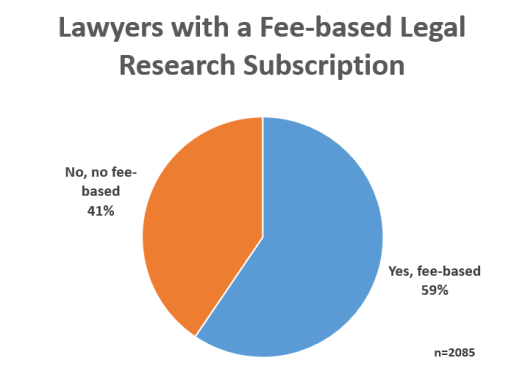
A 60% / 40% split isn’t really that astonishing when you consider that the 40% can rely on a free resource that may be good enough for their research. What is more interesting to me is that, of that same pool of respondents, a chunk have neither a fee-based subscription nor a “basic library”. Here’s what that subset (same survey) looks like:
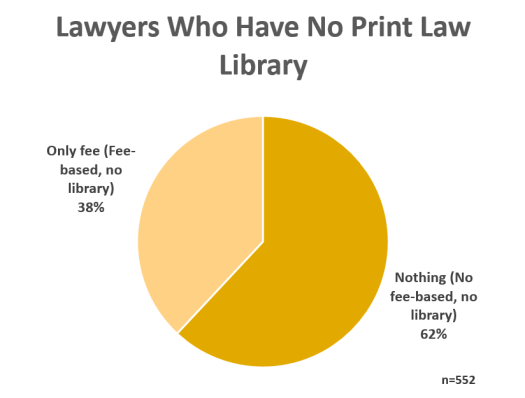
If we think about access to legal information for lawyers, the sole provider describes content scope licensing. If you’ve opted for a sole source, you will find one that has the greatest range of resources for you. That will be highly dependent on the law firm’s practice context, size, and, for solos and smalls, may be impacted by time spent in the profession. I might opt out of a legal research purchase if I felt my 20 years of legal experience informed me as well or better.
And what’s a basic library? 2 nutshells, a hornbook from law school, and a 3 volume looseleaf updated skip years? 5 annual texts? I don’t know. I only know what no library suggests.
If you’re not a legal publishing content expert (I consider librarians to be experts or potential experts), you may go for the easiest option (Thomson Reuters or RELX) rather than investigate alternatives. That could be a law firm partner, an elected clerk of courts, or a governance board chair who has been on the bench without making purchasing decisions.
Since my law library is embedded in a lawyer and paralegal regulator, it’s the competency aspect that is most interesting to me. Sole provider discussions are often more to do with “how do we save money like THAT [law firm | municipality | agency] did” and they’re good discussions to have. Are you licensing overlapping content? And if you are, is there a stakeholder reason (true comparative need for both, a particularly squeaky partner, etc.) to continue doing so?
It’s probably fair to assume we would think that, as long as a lawyer has access to some legal information, they’ll be able to practice competently. I mean, that’s the only reason to license legal research information. But the spectrum extends a lot further out than I had really thought about. It makes me wish – again – that there was a better way to get at data around the use and licensing of legal information.