

One perception a law library conference can create is that there are environments where unicorns abound, where everyone gets along, and strategy and innovation are commonplace. That clashes with reality: I’m micromanaged. Failure is punished so I avoid risk. Change is avoided. Initiative isn’t valued so I keep my head down. Not that the environment is toxic, but more that it’s a garden that is lacking in nutrients. Your flowers grow, but they’re not going to reach their full potential. How do you navigate the realities of working somewhere that isn’t a law library paradise?
One of my personal goals, renewed daily, is to try not to make my law library a hell hole. Okay, I aim a little higher. But a panel at the AALL innovation bootcamp – me, BU’s Anna Lawless-Collins, and Littler Mendelson’s Allison Reeve – gave us an opportunity to talk about the good things in our environment. We touched on some failures too, but then Stanford’s Beth Williams asked: what if a law librarian’s environment isn’t one that enables all the goodness (I’m paraphrasing)?
We answered in the moment but it’s been nagging at me, because it gets at a common theme: we tell law librarians who may have no decision-making power that they can be leaders, project managers, innovators, etc. But the context of one’s position still has a lot of impact on whether that is achievable.
Two Way Street
There are two aspects that I’ve been thinking about. First, your perception may be different depending on whether you’re managing a law library or not. Second, if you are a solo law librarian, your challenges are probably doubled.
There is the law library and there is the organization that contains the law library. Alignment means keeping the law library in step with the organization. As became clear in the innovation discussions, however, not every organization is championing the values that we might want them to champion.
Whether you’re in a one-person law library or manage teams, if you are the interface with the rest of the organization, you’ll feel this impact. How do you create a law library strategy if the corporation doesn’t have one? If the law firm’s culture is to squelch new ideas, how do you innovate? Even a respected law library team may not have the social capital to move the needle on an organization’s ability to change.
As a decision-maker, I have some latitude. It generally means taking two approaches. The first is to stay connected and communicate a lot with those above me and with peers in both client-facing teams as well as business support teams. There will be opportunities to coordinate with teams who are talking to the same people you are. And there will be projects that your IT or HR or Finance teams want to accomplish that need business partners.
Some people use the term managing up. I don’t care for it, because it implies a manipulation. Tiered management – chain of command – requires information and accountability flow. You’re not managing up, you’re being responsive and proactive.
The other side of that coin is that you are a shield for your teams. We work in environments where we are surrounded by subject matter experts. They may have the confidence that, because they have mastered one knowledge domain, that they are also masters of law library operations and management. This seems particularly true when they have used a law library or done legal research.
In order to create an environment where your teams can thrive, you need to be able to intercept issues. Sometimes that means saying no to opportunities. Sometimes that means absorbing an activity yourself. Your context will impact what and how you create an environment that enables your staff to succeed and flourish.
And this assumes that you are also contributing positively to that environment for your team. I participated in a meeting recently with peers and senior managers, the point of which was idea sharing and discussion. But when I attempted to contribute, the response was defensive and not one of openness. It created a perception that input was invited but not welcome.
If you’re listening, be sure you’re hearing and not just preparing to respond. If you’re asking for input, be prepared to receive it. You take risks when you do so, but you are asking people to take risks to help you achieve your goals as well.
It may seem counterintuitive, but when other people offer ideas and input, that investment can mean they’re willing to help. You can find champions and project leads by letting people express the energy or excitement they have for an idea. Then delegate and let them own the idea.
You may also need to change the language you use. If people fear the repercussions of failure, talk more of experimentation and reward attempts. If you’re like me and often have a negative first reaction, internalize it and see where other people’s ideas take your team.
I’m Just a Person
I asked one of the innovation bootcamp speakers about how you adapt some of the processes if you’re a solo librarian?
Take design sprints (which is what I asked about). They involve teams of people. A solo law librarian may be a subject matter expert and a decision-maker so it can be tricky to adapt techniques to your context.
It’s all well and good to say “act like an [innovator | leader | whatever]” but it can feel awkward and artificial when you don’t have people to lead, responsibility for making decisions, etc. Ideally, if you’re not a solo law librarian, you at least work in an environment that gives you the opportunities you need.
But what if you don’t?
Work on Communication
A law librarian I respect once said that, whenever she started a project, she always drew up a list of all the people who should know about it. A couple of the panelists at the bootcamp commented that communicating early and often was often helpful in creating – and maintaining – an environment that allowed experimentation.
I’m not a fan of the Grace Hopper approach about permission and forgiveness. In our environments, taking an action can create risk. It’s only fair to let people know that. And to let them know you’ve assessed the risk, you’ve communicated with people it will impact, and you’re moving forward.
It’s not that easy. It takes iterations and it takes respect for the law librarian by those in the chain of command. But it’s possible with time.
Model Your Leadership
This is particularly hard. It may make us feel good to say everyone can be a leader but, definitionally, it’s not true. If you don’t have control (through decision-making, supervision, authority), you’re missing key ingredients.
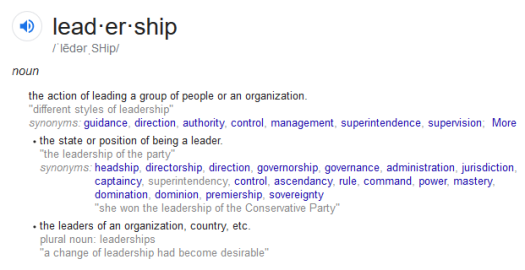 Screen capture of the definition of leadership
It can be particularly fraught if you work for someone who isn’t a good leader. Someone who might misinterpret your approach as a challenge to their authority.
But you can start to think about what you would do if you were given the latitude. Some of the skills of the leader require no power and can be modeled. Listening. Empathy and EQ. Doing what you say you’ll do and expecting the same from others.
You may find that your managers or others respond well to your approach. And you may find that you’re better off moving to an organization that allows you to grow, if they don’t. Law library roles often don’t allow for a lot of hierarchical growth: flat structures, and very difficult to break out of the law library hierarchy into the broader organization, even if you’d want to.
DIY Professional Development
I’m loathe to suggest that you work on your own time. It’s like unpaid internships. But the reality is that some of our organizations pay lip service to professional development. Or they provide opportunities that don’t allow you to grow the way you want.
One reason I run this blog – and have tinkered with web-related technology for decades – is because I like to. Another reason is that it helps me stay connected to how an area I’m interested in is changing. It also gives me a parallel skill set that I can’t develop at work. It allowed me to help a couple of non-profits get web sites up and re-worked.
This mattered in 2010 when our corporate web site was unveiled and it was a catastrophe of poor design and architecture. Because I had a lot of experience with web content management systems, accrued on my own outside work, I was a candidate to take over the web site when the CEO was looking for help.
I didn’t leave the library; I absorbed a new team of developers and adapted. I turned the team back over to IT after they had stabilized 6 or 7 years later. But I wouldn’t have had the opportunity to be in that mix without making the investment outside of work.
Consider whether there are things you want to do in the future as part of your career. And whether any of them are things you can do on your own time, so that you’ll get enjoyment from them and not create a new work onus.
Sometimes that will convert into a new resource in your current job, or a new opportunity elsewhere within your company. Or impetus to move on to a company that can take advantage of all of array of skills you’ve developed.
No workplace is perfect. We can all learn and grow, even in the weakest soil imaginable. And while you grow professionally, you can determine whether you’re in the right garden or not.