

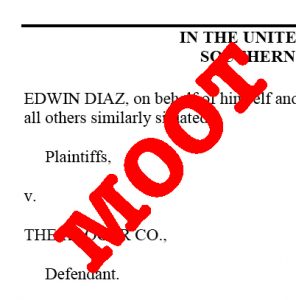
On Tuesday, June 4 Judge Katherine Failla of the Southern District of New York issued a critical decision finding that a website accessibility case could be mooted by simply fixing the website. Diaz v. Kroger Co., Case No. 1:18-cv-7953 (June 4, 2019). She also found that Kroger was not subject to personal jurisdiction in New York on more conventional grounds, but the mootness holding is critical.
As is often the case in mootness decisions the facts were critical. Kroger’s affidavit specifically said both that the website was WCAG 2.0 compliant and that every barrier to access identified by the plaintiff no longer existed. It relied, in other words, on the present state of the website rather than plans for future remediation. This left the plaintiff with only one argument; that because websites constantly change mootness is impossible. What is accessible today, according to this argument, may easily fail to be accessible tomorrow. Judge Failla rejected this claim, holding that:
it cannot be said that an ADA claim involving a website can never be mooted, solely because of the technological characteristics of websites. Such limit is both unnecessary and would insert a brittle, technology-specific exception into the mootness doctrine that would itself become obsolete in an era of rapidly changing technology.
Although Judge Failla did not say it, the plaintiff’s argument for a lack of mootness was based on speculation rather than facts. While it is true that in general websites are likely to be constantly changing, mere change only creates the possibility that a website will stop being accessible. Kroger’s evidence was that it had adopted a policy requiring the website to remain WCAG 2.0 compliant and the plaintiff apparently did not present any evidence that Kroger was somehow incapable of adhering to that policy. Of course if Kroger was incapable of adhering to its own policy then it would be equally incapable of adhering to a court order requiring accessibility, even assuming an enforceable order could be crafted in the absence of binding accessibility standards. If mootness is genuinely impossible then injunctive relief is futile.
The case will certainly go to the 2nd Circuit, which now has an opportunity to take a hard look at mootness when what has been fixed can be unfixed on purpose or by accident. It can also take a hard look at the ADA litigation machine created by uncertainty concerning just what the ADA requires for accessible websites. Judge Failla’s decision points toward a jurisprudence that would allow those who make their websites accessible in fact to escape from the litigation machine that enriches lawyers but does no real good for the disabled.