

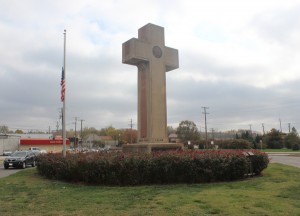
In a widely-anticipated decision, the U.S. Supreme Court ruled late last month that a large concrete cross located on public property at a major intersection in Bladensburg, Maryland, could remain in place. The nearly 90-year-old cross, which was placed to honor victims of World War I, had been challenged by an atheist organization as a violation of the First Amendment’s prohibition on establishment of religion.
In a fractured decision, seven of the Justices agreed that the cross could stay. Writing for a plurality of the Court, Justice Alito argued that, although the Latin cross has a religious meaning, its longtime placement at a major intersection as a war memorial meant that it had taken on a secular meaning as well. In light of this longstanding history, he concluded that the cross was not a violation of religious liberty. In rendering his opinion, Justice Alito eschewed use of the widely-criticized Lemon test, developed by the Supreme Court in 1971, which looks at the government’s purpose and the effect of a regulation to determine whether an unconstitutional establishment of religion is created. Justices Breyer and Kagan concurred in the opinion, noting that each Establishment Clause case must be reviewed individually and observing that no particular judicial test works in every situation.
Writing separately, Justice Kavanaugh agreed with the Court’s opinion, but argued that the Court should adopt a clear “history and tradition” test for longstanding religious symbols that come to have secular meaning. He also argued for overruling the Lemon test. Justice Thomas concurred in the judgment, but asserted that the Establishment Clause is not incorporated as against the states, and further posited that the appropriate test for determining whether a constitutional violation occurred should consider whether coercion is involved. Justice Gorsuch also concurred in the judgment, but argued that the plaintiffs in the case lacked standing to bring their claims because simple offense as an observer is not sufficient to establish standing
The only two justices who dissented from the decision were Justices Ginsburg and Sotomayor, on the premise that the placement of a Christian religious symbol at a major intersection endorses religion.
While the Bladensburg cross case is not a free speech case, it is highly relevant to sign issues. The Court’s decision in the case makes clear that longstanding public monuments, even those with some religious meaning, are likely to be allowed to remain in place so long as they have some secular meaning as well. War memorials, civic group symbols, and other monuments with religious and nonreligious messages are more likely to survive scrutiny after this and other cases.
Am. Legion v. Am. Humanist Ass’n, ___ S. Ct. ____, 2019 WL 2527471 (June 20, 2019).