

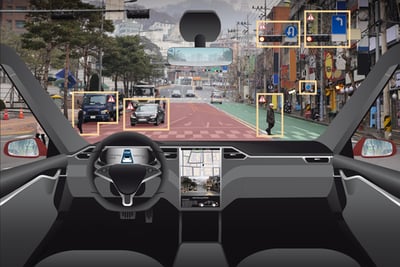
The good news is that improved safety is far and away the predominant force behind development of advanced driving technologies. This is evident from the NHTSA’s latest Automated Vehicles 3.0, in which the word “safety” appears no less than 318 times. Industry has also prioritized safety as the race to commercialize autonomous driving technology will require, as a threshold matter, broad acceptance from the public in order to realize investment returns. Driverless vehicles promise other benefits too. The simple convenience of reading a book or taking a nap while commuting home from the office sounds wonderful. But until the technology is considered safe enough for our shared roads, such ancillary perks are merely hypothetical.
The bad news is that determining when autonomous vehicles are safe enough is a tricky proposition. As one guidepost for consideration, the German government empaneled an Ethics Commission on Automated and Connected Driving, which in a 2017 report published “Ethical rules for automated and connected vehicular traffic.” Among these 20 rules, the Commission cautioned that, at a minimum, the technology is not ready until driverless vehicles are safer than human drivers:
Guideline 2
The protection of individuals takes precedence over all other utilitarian considerations. The objective is to reduce the level of harm until it is completely prevented. The licensing of automated systems is not justifiable unless it promises to produce at least a diminution in harm compared with human driving, in other words a positive balance of risks.
This guideline presents an admirable goal, but there are still unanswered questions. First, most stakeholders firmly believe the “promise” of improved safety relative to human driving is already realized. Instead, perhaps the condition for deployment of automated vehicles should be actual, verifiable gains over human driving. Regulators and industry must seek solutions for quantifying and documenting the safety improvement promises of this technology.
The second problem with conditioning deployment of automated vehicles on improvement over human driving is that “human driving” varies considerably. For example, consider how the auto insurance industry sets rates for different driver cohorts. Young drivers, especially males, are among the riskiest. According to an Insurance Institute for Highway Safety report, in 2017 males ages 20-24 died in motor vehicle crashes at a rate of 26.3 per 100,000 people. By comparison, the death rate for women ages 60-64 was only 6.2. This doesn’t mean that every middle-aged woman is a safe driver. But in relative terms, getting home after bar close in an autonomous vehicle might be a much safer option for younger drivers. Given that some of us are less risky than others behind the wheel, who must the driverless vehicle be safer than? Our riskiest human drivers or our safest human drivers? Because we all share the same roads, this will be an important question to answer before widespread deployment of automated driving systems.
Finally, while we should demand improved safety from new autonomous vehicle technologies, we also shouldn’t expect perfection. For perspective, think about the traditional three-point lap and shoulder belt harness seatbelt system in your car. Now think about a NASCAR driver. They buckle into five- or six-point harnesses attached to wrap-around custom seats with separate neck and head restraints coupled to specially certified helmets. They also wear flame retardant suits, gloves, shoes and even underwear. Ordinary drivers would be safer if we took the same precautions, but we’ve collectively decided to accept a certain degree of injury risk in favor of comfort and convenience. Examples of this safety/convenience trade-off pervade the driving experience. Cost considerations also go into every aspect of vehicle design. Thus, when it comes to driverless vehicles, “safe enough” doesn’t mean elimination of all injury risk, but it is reasonable to accept the technology only when there are definite and quantifiable improvements over the human driver.
To sign up for The Open Road: Automotive Law Blog e-mail updates, please click here.