

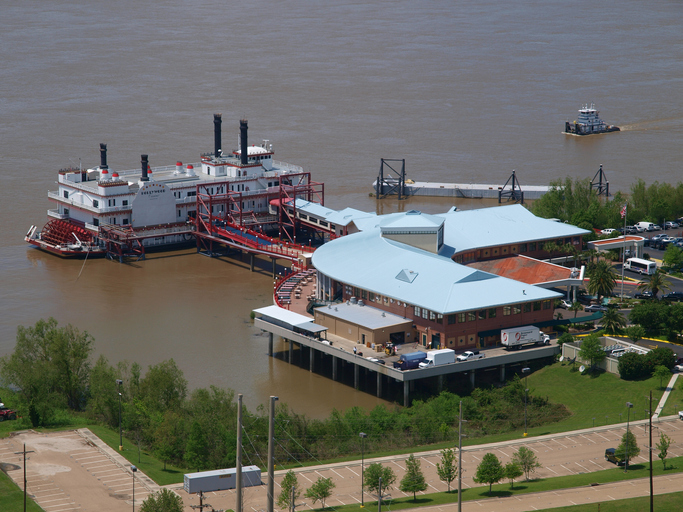
In Caldwell v. St. Charles Gaming (No. 2019-CC-1238), the Louisiana Supreme Court ruled that a permanently moored riverboat casino engaged in dockside gaming is not a “vessel” under either the Jones Act or the General Maritime Law. Caldwell was employed as a technician by the Grand Palais Casino in Lake Charles, Louisiana, and was allegedly injured when the gangway attached to the riverboat casino collapsed. The casino had been moored in the same location since 2001 and operated using shoreside utilities.
The lower court’s determination that the casino was a vessel was reversed by the Louisiana Supreme Court. The lower court’s decision raised the possibility that casino employees might qualify as Jones Act seamen and be entitled to traditional remedies granted to seamen, including maintenance and cure, the warranty of seaworthiness, and the right to sue their employer for negligence. The lower court’s decision also conflicted with other Louisiana decisions holding that permanently moored riverboat casinos are not vessels and with the US Supreme Court’s decision in Lozman v. City of Riviera Beach, Florida, 568 US 115 (2013), which recognized that “a water craft is not ‘capable of being used’ for maritime transport in any meaningful sense if it has been permanently moored.”
In Caldwell, the Louisiana Supreme Court focused on the US Supreme Court’s decision in Lozman and examined the primary purpose of the casino, i.e., gaming. The Court recognized that the casino’s primary purpose was not maritime navigation or the transportation of people or things over water. Although the casino was originally designed for navigation, it was no longer used in maritime transportation. The Court found it significant that the casino had been “moored indefinitely to provide and maintain its primary purpose of gaming activities.”
Caldwell is significant because it resolves the classification of permanently moored Louisiana riverboat casinos under federal maritime law. Although such a riverboat casino is not a vessel for purposes of federal maritime law, it nevertheless qualifies as a vessel under the Louisiana Gaming Control Law. While not expressly stated in Caldwell, the Court’s classification of a riverboat casino as a vessel under the Louisiana Gaming Control Law apparently had no bearing on whether that casino qualifies as a vessel in navigation under federal maritime law.