

Indictable Offense: What Is It?
An indictable offense is the most serious type of crime
Indictable offenses are felony crimes.
If you are charged with an indictable offense, you will face prison time.
New Jersey has four categories of indictable offenses.
These categories are organized by degree.
For example, First-Degree, Second-Degree, Third-Degree & Fourth-Degree crimes.
Here’s an easy rhyme to remember which degree is the most severe.
First is the worst! See how it rhymes?
First-degree indictable offenses start with a minimum mandatory sentence of ten years in prison.
Check out this New Jersey Indictable Offense Chart
Indictable offenses and the grand jury
Before your indictable offense can move to trial, the government has to show the evidence they have against you to a grand jury.
The grand jury is made up of a group of “regular” people who will examine the evidence for your arrest and decide whether the government has “enough” of a basis (evidence) to bring “formal charges”.
A grand jury does not decide guilt or innocence.
Their role is to make sure that the government isn’t harassing citizens & making arrests willy nilly.
The grand jury is simply asked to answer the following question:
Does the government have enough evidence to make the arrest?
This standard is called “Probable Cause”.
In other words, the grand jury must determine if enough probable cause exists to charge you with the crime(s) that the government believes that you committed.
Once the grand jury votes in the government’s favor, your felony charges become official.
When the grand jury approves the indictment, this is called a “True Bill”.
When the grand jury rejects the indictment, this is called a “No Bill”.
If the grand jury No Bills the indictment in your case, the government can try again.
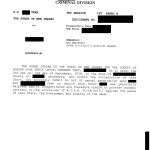
Show me an example of an Indictment
If the grand jury “True Bills” your indictable offense, it will return a document called an “Indictment”.
An indictment is the formal charging document in your case.
It will contain the following:
- Jurisdictional information about where you committed the alleged crime;
- Your first and last name;
- The date(s) when you allegedly committed the crime;
- The complaint number, prosecutor file number, and indictment number;
- The elements of the crime that you are alleged to have committed;
- The section of the criminal code where the crime can be found;
- The number of crimes you are being charged with referred to as counts.
Sample New Jersey Indictment
important Fact:
Grand jury proceedings are closed proceedings.
You cannot participate and tell your side of the story.
Under New Jersey law, the government needs to
provide “exculpatory” evidence for the grand jury to consider.
This means that good evidence about you or weak government evidence
must be presented for the grand jury to consider.
How long does the government have
to charge me with an Indictable Offense?
In the legal world, the time limit is called a criminal statute of limitations.
Under New Jersey law (NJSA – 2C:1-6), prosecutions must start within a certain period of time.
Below please find the time limits as they apply to each crime:
- murder, manslaughter, sexual assault, terrorism, widespread injury or damage
No statute of limitations - Bribery of government official, official misconduct, other related offenses:
7 years - Every other indictable offense:
5 years - Disorderly offense or petty disorderly offense:
1 year - Criminal sexual contact or endangering the welfare of a child with the victim under 18:
within 5 years after victim turns 18 or 2 years of discovery of the offense by the victim, whichever is later
Non-Indictable Offenses
In New Jersey, indictable offenses are crimes.
Non-indictable offenses are called Disorderly Person (DP) offenses, & Petty Disorderly Person (PDP) offenses.
An indictable offense is referred to as a felony in other jurisdictions & usually involves a prison sentence.
A disorderly persons offense is called a misdemeanor in other jurisdictions and the maximum jail time is 6 months and a fine up to $1,000.
Examples include:
Petty disorderly person offenses are punishable by up to 30 days in jail and a fine up to $500.
Read more:
Disorderly Persons Offenses & Municipal Ordinances: What’s The Difference?
-
Get Help With Your Indictable Offense
If you would like to meet with us to discuss your case, we offer FREE consultations.
About the Author

Attorney At Law
-
201-766-4800
-
200 Passaic St. Hackensack, NJ 07601
Mr. Peyrouton is a Criminal Defense Attorney located in Hackensack, NJ.
His articles in the areas of Criminal Law have been published in The New Jersey Law Journal.
He is a distinguished author, trial attorney, and has had the privilege of arguing before the New Jersey Supreme Court.
Prior to becoming an attorney, Mr. Peyrouton was a world-class, competitive tennis player.
He is perfectly fluent in Spanish.
More Helpful Articles
Plea Bargains What Are They & How Do They Work?
Plea bargains run our criminal justice system. 90% of cases are settled by way of plea deals. When you’re charged with a crime, your lawyer will negotiate a plea bargain. But is a plea bargain your only way out?
Plea Bargains What Are They & How Do They Work?
NJ PTI: Everything You Need to Know in 5 Minutes!
Everything you need to know in five minutes
Think of Pre-Trial Intervention (PTI) as your ONE & ONLY Get-out-of-Jail-Free card. It’s the QUICKEST way to be done with your Felony arrest.
NJ PTI: Everything You Need to Know in 5 Minutes!
How To Get Criminal Charges Dismissed
Getting your criminal charges dismissed is possible.
If you’ve been arrested, then you’re interested to know how your criminal lawyer can get your charges dismissed.
Of course, you understand that you are innocent until proven guilty.
How To Get Criminal Charges Dismissed
NJ Felony Charges: 5 Steps To Start Fighting Back!
New Jersey felony charges are termed “Indictable Offenses”. These are the most serious charges that you can face. If you plead guilty, or are found guilty, the judge has no choice but to sentence you to prison.
NJ Felony Charges: 5 Steps To Start Fighting Back!
The post Indictable Offense: Complete Guide with Sample Indictment appeared first on Jersey Criminal Attorneys.