

Michigan reported a reduction of confirmed coronavirus cases over the weekend. But the State cautioned the reduction may be attributed to low testing over holiday weekend rather than an actual reduction in cases.
Here’s the statement from the Michigan Department of Health and Human Services (MDHHS):
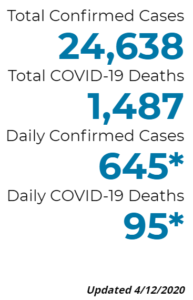
Although a reduced number of COVID-19 cases are being reported today, 645 cases compared to 1,392 reported on April 11, and deaths, 95 compared to 111 on April 11, we cannot say if this represents a true decline in COVID-19 cases and deaths in our state.
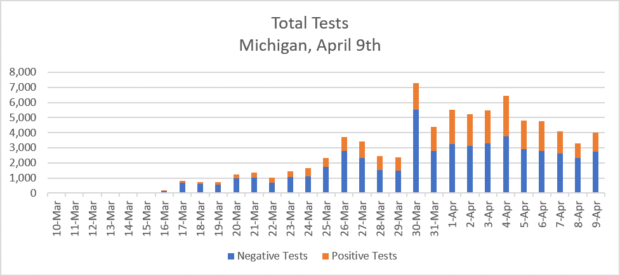
Reported case counts may reflect a reduction in the amount of laboratory testing performed over the weekend and holiday. Single day fluctuations in the number of confirmed cases may not be significant, as a number of external factors can affect data reporting.
The testing date from previous weeks appears to support this conclusion. Still, Michigan’s coronavirus cases remain staggering.
Even so, many businesses are and will need to start planning for what happens when they’re allowed to reopen and bring employees back to work.
Recent CDC Guidance for Returning People to Work
On this point, the CDC recently issued some guidance for making this transition as to “essential workers.” Still, the reasoning could be extended to non-essential workers when federal and Michigan health professionals deem it appropriate.
As to “essential workers,” the CDC explained such workers who have been exposed to coronavirus could keep working as long as they are asymptomatic.
But the CDC continues to recommend employers to regularly take exposed workers’ temperatures, require them to wear masks and social distance “as work duties permit,” and routinely clean workspaces. Employers should be especially cautious about following the CDC’s guidance for when workers exposed to the virus may return to work.
- First, according to the CDC, people who have the virus may remain asymptomatic for 2-14 days after exposure while continuing to spread it. Other studies have reported
- Second, Propublica (by Caroline Chen) explained an asymptomatic carrier of the virus poses the greatest risk for employers, co-workers, and customers. The increased risk is because the period when a person does not show any symptoms, or only mild symptoms coincides with the viral load — the amount of virus being emitted from an infected person’s cells — may be the highest.
These two points are equally concerning and make for confusion in applying the CDC recommendation. This is because employers are getting CDC recommendations that do not necessarily line up with what the scientific facts when it comes to bringing people back to work.
As with many assertions from the federal government about the coronavirus, they have not always been based on the best information, consistent with the scientific community, or proven to be accurate. We will continue to follow the CDC’s recommendations for returning individuals to work and other employment issues related to COVID-19.