

Last week I had the chance to interview Anand Babu, founder of the soon-to-be-launched Koncord Law and co-founder of Surukam Analytics, one of India’s foremost AI-powered contract management solution.
Many in the legal and corporate fraternity are already familiar with Surukam through its Legal AI platform ‘CruxIQ’.
Back in the day, CruxIQ was credited as the first legal AI contract review to come directly out of India, and had soon achieved commercial success in the developed markets – taking contract management beyond the traditional keyword-based technologies to the world of ‘intelligent’ NLP-based predictive analytics.
CruxIQ was designed to read, analyse, manage and monitor contracts with minimal human intervention and has been successful in yielding powerful results with surprising accuracy. Surukam was acquired in 2018.
For the past year, Anand and his team has arduously worked to develop yet another moonshot project – with a very exciting value proposition.
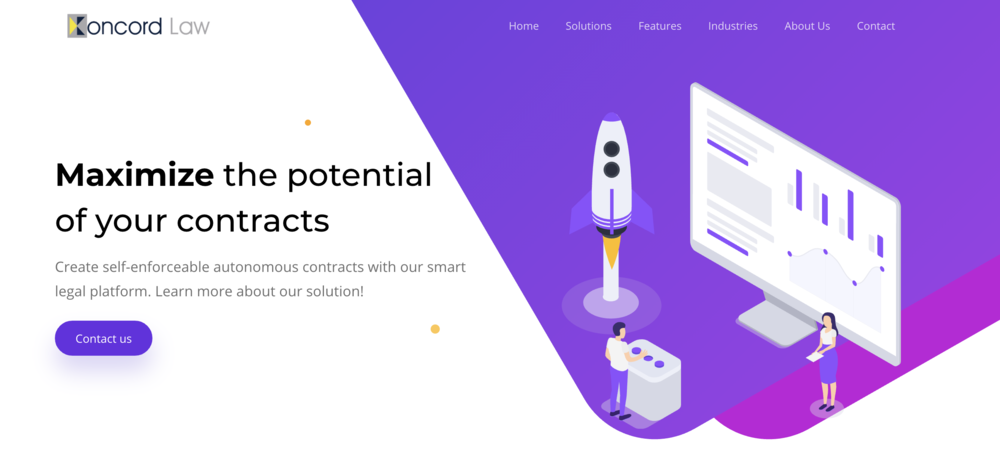
Koncord Law, his latest brainchild, intends to bring to the world completely autonomous contracts as a smart solution to enable automated contract enforcement – a machine that has the ability to analyse & interpret. The platform heavily leverages blockchain and smart contracts technologies.
Read on to find out more about Anand’s evolution into his present role, the vision behind Koncord Law, on the application of smart contracts, and what he thinks of the Indian market demand for legal tech.
Namit: Hi Anand. What a pleasure to speak to you.
Before I delve into your work over the past few years and your newest venture, I am curious to know – how did you start out your professional career? Is your academic background in technology, law, or some other discipline?
Anand: Hi Namit. Sure. To answer your question, my formal (academic) training has been in law.
I worked in the LPO industry for 7 years. Though I started out with a concentration in law, working in LPOs allowed me to see the legal service delivery process more holistically – realizing soon the role of technology and process innovation. These things go hand-in-hand, especially in today’s world where ‘legal service’ cannot be an echo chamber separate from the technology that powers it and the process that it runs through.
For the first few years of my career, I was managing marketing strategy and sales enablement for the legal solution offerings. These included a bunch of activities: market research, positioning, strategy, developing RFP responses, and making sure the service offerings are articulated as best as possible to the potential clients.
Namit: Your early experience in client-facing roles must have given you a pretty good insight into the needs of the market. Was that helpful in shaping the next steps for you?
Anand: Absolutely. My earlier experience was tremendously useful, foundational rather. Apart from being able to clearly understand the clients’ needs directly, it also helps in spotting latent needs – needs that haven’t been expressed or articulated yet but become obvious to us as suppliers that they exist and need addressing.
Within a couple of years, I had taken on more advanced/managerial roles and started managing the work processes of legal teams. I was optimizing the way legal teams doing their work, day-to-day. I was coming up with better tools, processes, workflows to make sure the service quality is increased and their costs are reduced. So yes, overall, this experience was invaluable.
Namit: What kind of problems were you solving for your clients?
Anand: Our clients were mainly large corporates. Most of them were off-shore. What we were solving for them was to maximize the efficiency of their in-house teams, that’s what most of our solutions were really geared towards. Their teams often ran into hundreds, and their needs were sophisticated so that required us to go above and beyond the traditional means.
The goal was to augment their processes through a combination of tech and workflows. These would usually result in more autonomous workflows, better tracking and monitoring, reduced risks, saved time, and minimized costs.
Namit: And then you co-founded Surukam Analytics? What was the core idea behind it?
Anand: Yes. I was already conceiving and designing solutions for corporate legal teams like I just mentioned. So Surukam was a natural step for me in many ways.
Our flagship product CruxIQ is an intelligent technological solution to automate the entire contract management. It all begins with an advanced contract abstraction system, which extracts material aspects of the contract – dates, clauses, trigger events, expiration, renewals, and more – and creates a more digestible “abstract” of voluminous contracts.
From there, once you have a populated contract database, the platform is able to monitor contract performance (or non-performance) with the help of deviation analysis and robust reporting.
The tool reads and interprets all the intricate details of contracts and culls out the specifics of a contract to conduct deviation analysis. This helps contract management in companies become more predictable, manageable, reduces costs and increases efficiency with drastic results.
Namit: What’s the vision behind your new project – Koncord Law.
Anand: We have been working to develop smart and automated contract enforcement, relying largely on blockchain & smart contract technologies. Poor contract performance can end up costing organizations close to 5% to 7% of their entire revenue. That’s a massive cost component to any organization. So, our vision, to put simplistically, is to bring these costs down radically.
Namit: What are the chief causes for such inflated costs? Why does contract monitoring eat up so much of resources?
Anand: For example, think about how a company reconciles the contract clauses with the actual performance of a contract – invoices, milestones, quality, rights and obligations. This is a notoriously labour – intensive exercise, and needs organizations to deploy a lot of resources just to ensure things are on track.
During any contract’s lifecycle, multiple versions of truth pop up. There are different ledgers. This gets multiplied because of data duplication and tampering and leads to overall poor auditability – which again spikes up the costs.
Namit: How is Koncord’s platform able to solve these challenges?
Anand: Well, in order to really solve this problem, any solution needs to tackle the whole contract management process – from start to finish, and cannot really innovate one or two parts of the lifecycle in-silos since they are all interdependent.
So, we make sure that the contracts – themselves – are digitized, self-executable and pre-programmed. This makes sure that is easy to track those contracts as they are performed. Smart contracts allow organizations to be able to view and compare the contract against its actual consumption. In case there is a breach, there is an immediate and automated course of action that triggers itself – saving manual monitoring and chances of human errors or omissions.
Namit: Contract management systems have been around for a while, and to an extent, are becoming more ubiquitous in organizations. What is different about Koncord Law?
Anand: Unlike the existing contract management systems, our platform allows the creation of self-enforceable contracts and auto-reconciliation of those contracts.
Enforced contracts deviating from contractual obligations and actual entitlements ultimately result in revenue loss. Our platform enables customers to identify such deviations in real-time. For organizations struggling to manage their spending and enforce contract compliance, this ability to automate reconciliations can have a transformational effect.
Our novelty really lies in the fact that our system completely aligns with the intended legal effect of the contract; the system will be faithful to the legal agreement.
Namit: Smart contracts are self-executing, self-enforceable, but also entail irreversible responses? They should ideally eliminate the need for any human discretion during the performance, but are there instances when this can be counterproductive? If not, blockchain-powered contracts should be able to – by and large – replace lawyers in various functions. Is that right?
Anand: We never intend to replace lawyers and I think it will never be possible. What we intend to do is aid and assist lawyers so that they can perform better.
And also, autonomous contracts are not magical machines; they rely on and function using the hard sciences of mathematics, data and computer algorithms.
We intend to create a contract framework which is comfortable for organizations to deploy and use a platform which allows business to work with smart contracts.
Namit: When you were at Surukam, you had looked to the US and Europe as your primary markets. Will that be your preferred market with Koncord Law as well, or would you market in India more aggressively as compared to 4 – 5 years ago?
Is the Indian market riper today than it was 4 – 5 years ago?
Anand: In many ways, yes. The Indian market was very nascent 4 – 5 years ago, and it certainly makes sense to look at India as a major market for us today.
That said, from previous experience, I think the demand in developed countries is so much deeper, these are ready markets for us, so it makes sense to cater to a market that is aggressively demanding our solution.
Namit: In your experience of the last ten years, how do you think the legal technology market has evolved? What are the major differences?
Anand: Businesses are sitting on the sidelines, waiting for a proper form of contract system which protects their interests, and also deals with the unexpected. There is an interest to adopt new technologies now, more than ever.
Namit: How do you think India’s legal market will shape up in the coming decade?
Are there any speculations you can make?
Anand: I think Indian Market is not proactive, it tends to adopt technologies that are already been used in other parts of the world. It may take some time to change.
Namit: When is the commercial launch planned for?
Anand: We are very close to the commercial launch, and I’ll have an announcement for you soon. You should hear from us as early as January 2020.
Namit: Thanks for this interview, Anand. Before we finish – what’s the best way for people to contact you?
Anand: I can be reached at anand@koncordlaw.com or at my LinkedIn page.
Namit: Wonderful. All the very best to you and your team.
Anand: Cheers Namit