

The profession of law is one of those few areas where technology has not been able to put in a considerable impact. So far, the profession has been able to resist the changes that technology brings by restricting the access to knowledge to select few. However, that is changing and at a pace faster than ever before.
To start with, a lot of first-year associates and paralegal work can be done through apps. Some of the basic services have now been commoditized and with a rate card available online visible to all, few firms can now charge a premium they could have earlier. In an industry driven by billable hours, there are several tools available that slash hours by many folds.
While such tools seem counter-intuitive, they lead to the classical prisoner’s dilemma. If your organization refuses to implement these technologies in your workflow processes and your competitor does, there is a good chance that they will be able to entice more clients with faster and more economic services.
All that is not to say that technology has all the answers. There are many reasons why lawyers choose not to rely entirely on technology. Some of them have burnt their hands in the past with unreliable technology. For some tasks, the technology has not advanced enough to add value, in some, it may lead to issues with the law (such as client confidentiality, data localisation etc).
However, there now exist multiple technologies that reliable and add substantial value. The real question that remains is what value addition is there, and is it worth it? Instead of giving a theoretical argument, I will illustrate some of the use cases as to how technology could make the lives of lawyers easier.
Re-imagining IP practice: A case for data-driven decision making
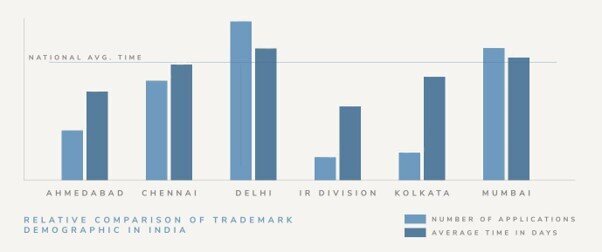
There exists a wealth of data in India but unfortunately very few use it to their advantage. There is a lot of anecdote that is passed as knowledge while strategizing important decisions. Take a look at the bar chart below which we have generated from the data available in all trademark journals published in 2018.
This is just the start. A live tracker can help one process live data of different TM registry and help law firm analyse registry’s performance for the past 30 days and suggest which registry will lead to the best response.
Taking a step further, law firms or Companies with a large TM portfolio can now keep track of their entire IP workflow processes. They can benchmark the processing time of their applications against industry best while adding weights such as class, type of mark, etc to ensure that benchmark is attuned to their category of work. The analysis can further help uncover areas for improvement at both the organization and individual level.
The possibilities for such an analysis are endless and we have found many other uses for this data. Our hat tip to all young practitioners who intend to make IP practice their bread and butter is the pie chart below classifying all marks published in 2018 class-wise, that makes a strong case for them to pick up the pharma lingo if they intend to make it.

State-wise data showing the time taken to register trademarks in India.
Automating routine processes: Incorporating reliable technology
While AI may or may not take over the world, many from the legal fraternity in my circle are of the opinion that AI is out there to snatch their jobs. Truth cannot be any further. AI, as the name indicates, mimics true intelligence. The underlying technology is built around ‘predictive’ models. AI, therefore, by its very nature, due to its probabilistic model cannot guarantee 100% accuracy. Thus, at least for the foreseeable future, AI even at its best remains an assistive technology. However, all is not lost. AI with minimal supervision can automate a lot of routine menial tasks saving your time for critical assignments needing a higher level of thinking.
One such AI offering is Semantic by Veratech, a Software that generates reliable and accurate comprehensive profiles of Indian companies using publicly available data. What used to take days can now be done in a matter of hours.
Document automation, consistency checker, litigation portfolio management are some of the other areas where technology has grown leaps and bounds. I would strongly urge everyone interested in these a try and see the added value in their day to day affairs.
FOLLOW INDIAN LEGAL TECH