

The Federal Circuit’s recent decision in Boeing Co. v. Secretary of Air Force, 983 F.3d 1321 (Fed. Cir. 2020), provides some useful clarity on the contents of the restrictive markings and legends that contractors affix to the technical data they deliver to the Government.
The case arose from two Air Force contracts for engineering and manufacturing development of radar systems needed for the F-15 Eagle. The contracts required Boeing to deliver technical data to the Air Force with “unlimited rights.” While Boeing retained ownership of the data, the unlimited rights license allowed the Air Force to “use, modify, reproduce, perform, display, release, or disclose [t]he technical data in whole or in part, in any manner, and for any purpose whatsoever, and to have or authorize others to do so.” 983 F.3d at 1325 (citing DFARS 252.227-7013(a)(16)).
Boeing marked each of the deliverables with a legend asserting restrictions on the use and disclosure of the documents by entities other than the United States Government:
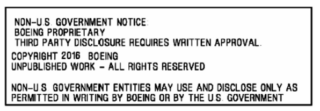
The Air Force contracting officer rejected Boeing’s legend because it was not identical to one of four restrictive legends specified in DFARS 252.227-7013(f). The contracting officer directed Boeing to correct the markings and resubmit the data at its own expense. In a November 2018 decision, the Armed Services Board of Contract Appeals agreed with the Government’s interpretation. See Boeing Co., ASBCA No. 61387, 61388 (Nov. 28, 2018).
Citing the plain language of DFARS 252.227-7013(f), the Federal Circuit reached the opposite conclusion. The Court’s opinion explains that there are two sentences in section 7013(f). When read together, they prescribe the restrictive legends that a contractor can use to identify limitations on the scope of a license granted to “the Government.” Here are the two sentences in question:
(f) Marking requirements. The Contractor . . . may only assert restrictions on the Government’s rights to use, modify, reproduce, release, perform, display, or disclose technical data to be delivered under this contract by marking the deliverable data subject to restriction. Except as provided in paragraph (f)(5) of this clause, only the following legends are authorized under this contract: the government purpose rights legend at paragraph (f)(2) of this clause; the limited rights legend at paragraph (f)(3) of this clause; or the special license rights legend at paragraph (f)(4) of this clause; and/or a notice of copyright as prescribed under 17 U.S.C. 401 or 402.
According to the Federal Circuit’s opinion in Boeing, the plain language used in these two sentences cannot reasonably be read to bar the use of markings that address the rights of parties other than the Government. A legend stating restrictions on third-party rights to technical data is thus not properly deemed a “nonconforming legend.”
The Federal Circuit’s decision itself offers important guidance to contractors delivering technical data to the Government. On remand, the ASBCA will be considering an Air Force argument that Boeing’s legend improperly restricts the “unlimited rights” granted to the Air Force. On its face, Boeing’s legend applies only to “NON-US GOVERNMENT ENTITIES.” And requiring actual Government authorization for third-party use is consistent with the language defining the scope of the unlimited rights license. According to DFARS 252.227-7013(a)(16), “[u]nlimited rights means rights to use, modify, reproduce, perform, display, release, or disclose technical data in whole or in part, in any manner, and for any purpose whatsoever, and to have or authorize others to do so.”