

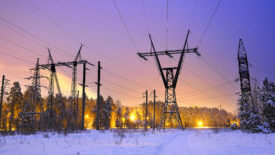
As the cold weather season approaches, the Federal Energy Regulatory Commission (FERC) and the North American Electric Reliability Corporation (NERC) are taking action to prevent a repeat of the devastating electric power outages that rocked Texas and the Midwest at the beginning of this year.
In February 2021, electric power generators and millions of customers experienced unprecedented and extended power outages during freezing conditions in Texas and the Midwest. Additionally, the freezing temperatures caused significant impacts on natural gas production in Texas, Oklahoma and Louisiana where combined natural gas production declined by as much as 50 percent. In total, more than 23,400 megawatts of firm load was shed to avoid “entire system blackouts” and 1,045 generating units experienced 4,124 outages, derates, or failures to start. Freezing issues and fuel issues accounted for 75% of the unplanned generator outages and derates.
In response, FERC approved NERC’s Cold Weather Reliability Standards. Additionally, a team of staff from FERC, NERC, and the NERC regional entities engaged in a joint inquiry. The joint inquiry team released preliminary findings on the primary causes of the outages and recommendations to avoid them in the future.
Cold Weather Reliability Standards: In August 2021, FERC approved NERC’s proposed “Cold Weather Reliability Standards” that require Generator Owners (GOs) to “implement plans to prepare for cold weather and require the exchange of certain generator cold weather operating parameters that would help enhance situational awareness in the operational planning and Real-time operations timeframes.” Specifically, FERC approved the following Reliability Standards:
- EOP-011-2 (Emergency Preparedness and Operations)
- IRO-010-4 (Reliability Coordinator Data Specification and Collection)
- TOP-003-5 (Operational Reliability Data)
These Cold Weather Reliability Standards will be implemented on April 1, 2023. They are detailed in the following FERC Order: N. Am. Electric Reliability Corp., 176 FERC 61,119 (2021). NERC’s developed a webinar and presentation to help the industry comply.
Joint Inquiry Key Findings: On September 23, 2021, the FERC Office of Electric Reliability and the NERC Staff presented preliminary findings and recommendations. The joint inquiry team determined that the unprecedented outages were primarily caused by: (1) freezing issues (frozen generator instrumentation and wind turbine blade icing), (2) natural gas fuel supply issues (at wellheads, gathering facilities, and processing facilities), (3) natural gas and electric reliability interdependency, (4) firm load shed of natural gas production and processing facilities in ERCOT triggering production decline, and (5) difficulty coordinating manual and automatic load shed. Despite these issues, the joint inquiry team found that SPP, MISO, and ERCOT communicated well with each other and “cooperated to alleviate the most critical conditions first.”
Joint Inquiry Key Preliminary Recommendations: The joint inquiry team made twenty eight preliminary recommendations, including revisions to the NERC Reliability Standards that are above and beyond the “Cold Weather Reliability Standards” identified above. For example, the following are some of the preliminary recommendations aimed at future revisions to the NERC Reliability Standards for Generator Owners and Transmission Owners:
- Generator Owners (GOs):
- identify and protect cold-weather-critical components;
- build new generating units, and retrofit existing units, to operate to specific ambient temperatures and weather based on extreme temperature and weather data, and account for effects of precipitation and cooling effect of wind;
- provide annual training on winterization plans;
- develop Corrective Action Plans if the GO experiences freeze-related outages;
- account for effects of precipitation and accelerated cooling effect of wind when providing temperature data.
- Transmission Owners (TOs):
- require load shed procedures to separate circuits that will be used for manual load shed from circuits used for underfrequency load shed (UFLS) or serving critical load, use UFLS circuits only as a last resort, and if necessary, start with the final stage (lowest frequency) to minimize the overlap of manual and automatic load shed.
The joint inquiry also recommended that Generator Owners should have the opportunity to be compensated for the costs of these infrastructure investments. In addition to these preliminary recommendations for Generator Owners and Transmission Owners, the joint inquiry team made several preliminary recommendations for the natural gas industry, including the requirement to have cold weather preparedness plans and implementing measures to mitigate cold-weather limitations. Finally, it made several preliminary recommendations for further study, including: (1) black start unit reliability, (2) additional ERCOT connections, (3) potential measures to address natural gas supply shortfalls, (4) potential effect of low-frequency events on generators in the Western and Eastern Interconnections, and (5) guidelines for identifying critical natural gas infrastructure loads. The joint inquiry team emphasized that these recommendations are preliminary, and final recommendations will be provided in the full report to be issued this winter.
FERC’s press release, staff presentation, and power point on this issue are available here. For more information on FERC’s and NERC’s winter readiness actions, contact Sylvia Bartell, Fred Jauss, or another member of Husch Blackwell’s Wind Energy or Solar Energy team.