

Before Halloween in 2018, the Butts County Sheriff’s Office placed signs in the front yards of registered sex offenders in the County, warning against trick-or-treating there. The next year, three registered sex offenders sued to enjoin County Sheriff Gary Long from placing the signs again, claiming that they constituted compelled speech in violation of the First Amendment. Although the district court granted summary judgment in favor of the Sheriff, the Eleventh Circuit recently reversed, finding the signs to be unconstitutional compelled speech.
Prior to 2018, the Sheriff’s Office had distributed warning fliers to registered sex offenders and asked that they place them on their doors before Halloween. No evidence suggested that any sexual offenses or unwanted contact with minors had occurred in these prior years; on the contrary, the Sheriff admitted that no such incidents had been known in his tenure with the County. However, simply because the Sheriff believed that signs would be more effective than fliers, the County changed its practice. Officers placed signs (depicted below) in the yards of all registered sex offenders and told residents that only the Sheriff’s Office could remove them.
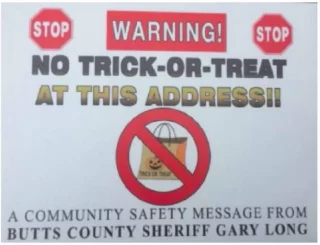
At trial, the district court found that the signs did not constitute compelled speech because a reasonable third party would not view the sign as endorsed by the registrant. That court focused on two major factors: (1) that the signs were clearly government speech, and (2) that registrants were not prohibited from placing their own competing signs. However, as pointed out on appeal, neither of these factors are relevant when determining whether speech is compelled by the government.
The Eleventh Circuit easily found that the signs were a “classic example” of compelled speech because they stated that the warning was “a community safety message from Butts County Sheriff Gary Long,” were placed on yards despite homeowners’ and/or residents’ objections, and could only be removed by the Sheriff’s office. Well-established Supreme Court precedent does not require that a reasonable third party would view the speech as endorsed, and any ability to offer competing speech does not cancel out the compelled speech. Unless narrowly tailored to meet a compelling state interest, the forced display of government speech on private property violates the constitutional right to refrain from speaking.
Here, all parties agreed that preventing child sex abuse is a compelling interest, but the court found that the signs failed strict scrutiny because they were not narrowly tailored to serve this interest. As the Sheriff admitted, no evidence existed to support the need for the signs to prevent child sex abuse on Halloween. Additionally, although the Sheriff’s Office could have limited posting to yards of registrants with a known risk of recidivism, it posted signs on the yards of all registrants–even those determined to be rehabilitated.
The court reversed the district court’s holding as it applied to one plaintiff who owned his residence, with instructions to enter summary judgment and a permanent injunction in that plaintiff’s favor. Because the other two plaintiffs did not own their residences, the court vacated and remanded for proceedings consistent with the opinion, taking into consideration any issues of standing.
McClendon v. Long, No. 21-10092, 2022 WL 165992 (11th Cir., Jan. 19, 2022).