


U.S. Citizenship and Immigration Services (USCIS) announced several new measures including expanding premium processing to additional form types, providing relief to individuals waiting for work permits and setting agency-wide backlog reduction goals. USCIS, a fee-based organization, faced an unprecedented budgetary shortfall and backlog of cases to be processed in 2020 and 2021 due to the coronavirus pandemic and resource constraints. According to data published by the agency, there are approximately 9 million forms pending adjudication.
Expanding Premium Processing
As part of the these efforts, USCIS published a final rule that expands premium processing (expedited adjudication for a fee). The final rule is expected to take effect at the end of May 2022, and USCIS will begin implementation – through a phased approach – as soon thereafter as feasible.
Employers will be able to request premium processing for several new categories, including immigrant petitions (Form I-140) for multinational executives/managers and for members of professions with advanced degrees or exceptional ability seeking a national interest waiver. In addition, expedited processing will be available to individuals requesting a change of status or an extension of stay (Form I-539), as well as certain applications for work authorization (Form I-765). Importantly, certain categories of I-539 and I-765 applications will not be available until FY 2025 due to the potential costs associated with expanding premium processing to these additional categories without adversely affecting the processing times of other immigration benefit requests.
USCIS generally cannot reallocate staff to adjudicate these immigration benefit requests without adversely affecting processing times for other immigration benefit
requests. Therefore, USCIS plans to hire and train new staff to handle the expanded availability of premium processing, requiring time and resources. The final rule also suggests that DHS has no immediate plans to implement premium processing for all categories of EADs.
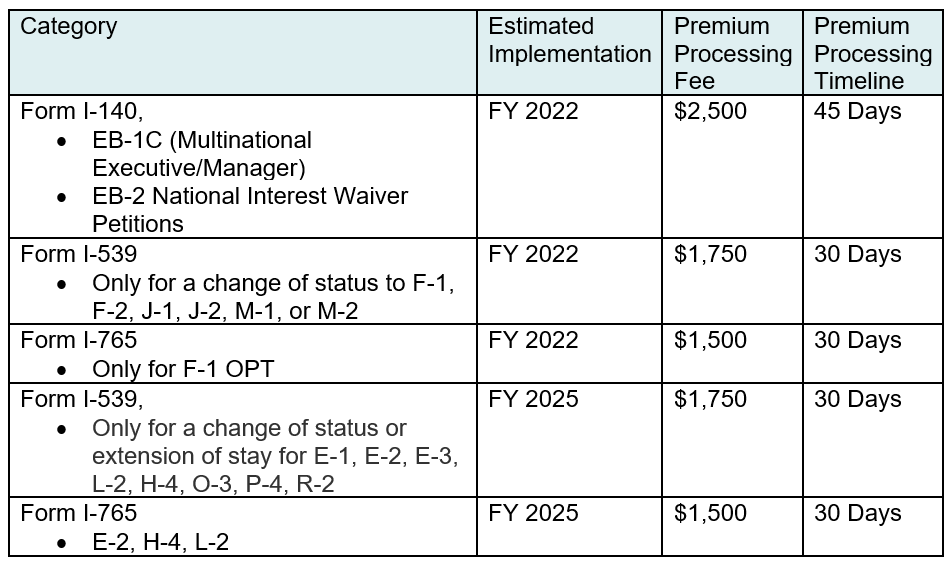
The premium processing fees and timeframes for the expanded categories are consistent with the fees and maximum processing timeframes set forth by Congress.
Improving Access to Employment Authorization Documents
USCIS also announced that it is focusing on a temporary final rule to provide relief to individuals waiting for work permits. The temporary final rule is currently referred to as “Temporary Increase of the Automatic Extension Period of Employment Authorization and Documentation for Certain Renewal Applicants.”
Recently, the agency has attempted to streamline some processes for the issuance of employment authorization documents (EADs), including extending validity periods for certain EADs and providing expedited work authorization renewals for healthcare and childcare workers. The temporary final rule aims to focus on EAD processes to ensure certain foreign workers will not lose their authorization to work in the United States while their applications are pending.
Reducing Processing Backlogs
USCIS is also establishing new internal cycle time goals to be achieved by the end of FY 2023 so that processing times will shorten and decisions will be issued more quickly. The agency plans to expand staffing, increase capacity, and improve technology to meet these goals. The agency will initially focus on form types that have seen some of the most dramatic backlogs in the past several years.
Additional Assistance
USCIS’ announcement follows a spending bill passed by Congress this month for which USCIS received more than $400 million to address processing delays and application backlogs. On Monday, President Biden asked Congress to give USCIS another $765 million in fiscal year 2023 to finance the backlog reduction effort.
These initiatives are intended to increase efficiencies and reduce burdens to the overall legal immigration system. Companies and organizations have significant interests at stake as they must be able to hire and place resources quickly – at the time and location where they are needed. Mayer Brown is working with business and organization leaders to prepare for these changes and devise solutions that fit their needs.