

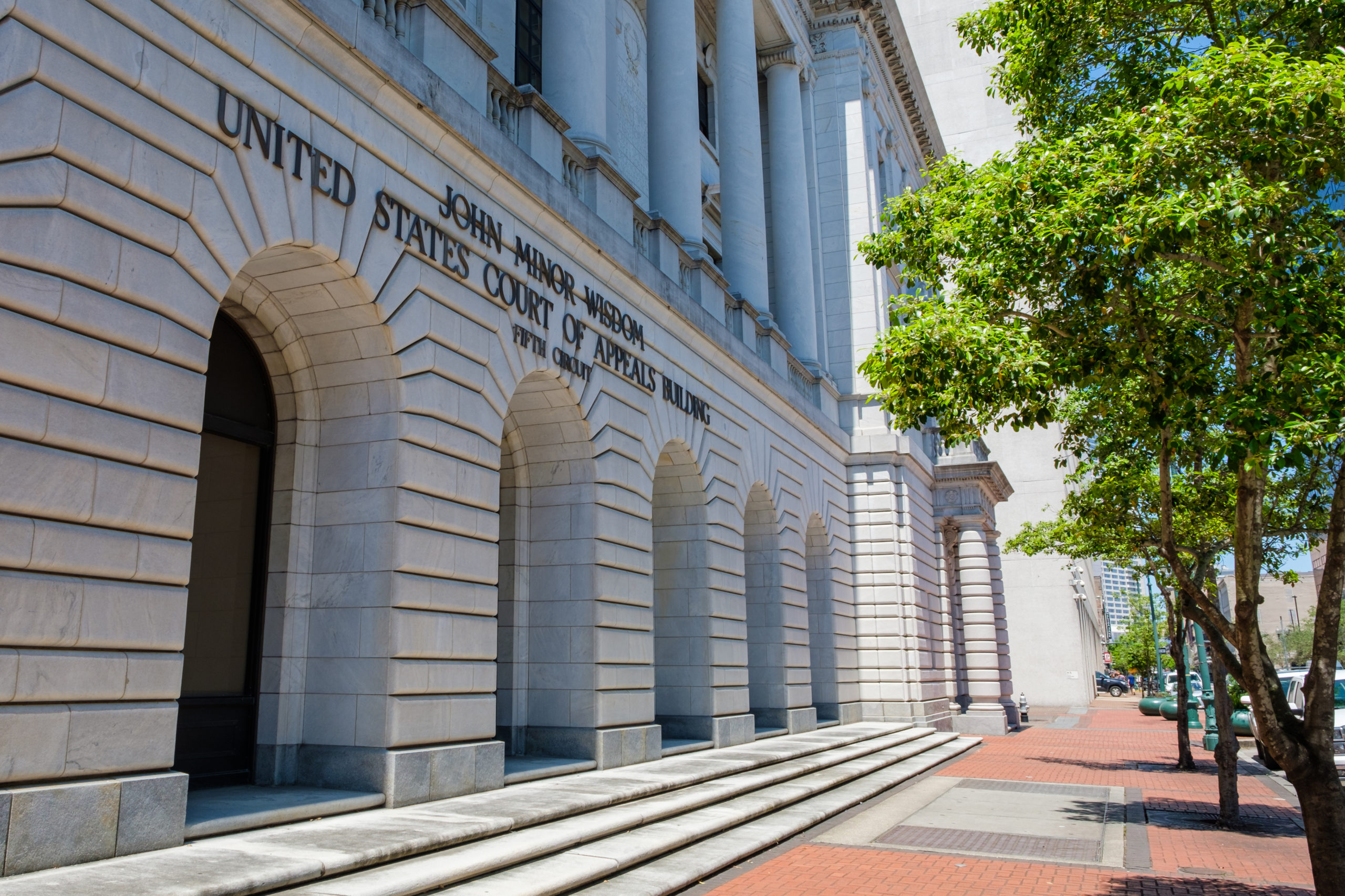
In a recent decision, the United States Fifth Circuit Court of Appeals remanded to state court a case brought by landowners against the Louisiana Department of Environmental Quality (“LDEQ”) and several past and present owners and operators of an industrial facility (“Facility Defendants”), finding that LDEQ was not improperly joined, and therefore the case could not be heard in federal court. In D & J Invs. of Cenla, L.L.C. v. Baker Hughes a G E Co., L.L.C., plaintiffs, forty-eight landowners of property located near the facility, brought a state court action for claims of property damage from groundwater and soil contamination caused by the facility’s improper waste disposal processes. No. 21-30523, 2022 WL 9862487 (5th Cir. Oct. 17, 2022) (hereinafter “D & J Invs. of Cenla, L.L.C.”) With respect to LDEQ, Plaintiffs claim that they sustained damages as a result of LDEQ’s “negligence and misconduct” in failing to timely and properly investigate and warn Plaintiffs of the contamination.
One of the Facility Defendants removed the case to federal court on the basis of diversity jurisdiction, arguing that complete diversity existed between all properly joined defendants and the Plaintiffs. The removing defendant asserted that the only non-diverse defendant, LDEQ, was improperly joined because Plaintiffs failed to state a claim against LDEQ. Plaintiffs responded by filing a motion to remand alleging that LDEQ owed them a duty under Louisiana law to warn about the presence of hazardous materials. The district court denied Plaintiffs’ motion to remand and dismissed LDEQ, finding that Plaintiffs had no legally viable tort claim against LDEQ as it was an improperly joined party. The district court “determined that under Louisiana law, LDEQ did not have a duty “to inform [Plaintiffs] of reported contamination within a particular timeframe or to otherwise oversee remediation in any particular manner.” It further concluded that Louisiana law does not create a cause of action against LDEQ for contamination caused by private industry.”
Plaintiffs asserted several errors on appeal, one of which was “that the district court erred in determining that LDEQ was improperly joined and in denying their motion to remand.” The Fifth Circuit noted that a crucial principle in determining whether there was improper joinder is that any contested issues of material fact, and any ambiguity or uncertainty in the controlling state law, must be resolved in the Plaintiffs’ favor, requiring remand when the state law “is too uncertain to support improper joinder.”[1] The Court found that remand was necessary in the case at issue because of the uncertainty of whether discretionary immunity under La. R.S.§ 9:2798.1 would apply to the Louisiana Environmental Quality Act public notification regulation.[2]
Discretionary immunity requires that liability shall not be imposed on a state department, such as LDEQ, based on the failure to exercise or perform discretionary acts.[3] The public notification regulation, 33 LA. ADMIN. CODE PT. I, § 109, provides a time frame for notification based upon one of two possible “triggering events.” “The first type of notice is triggered when LDEQ ‘becomes aware of information and determines that a release is likely to have off-site impacts that exceed the applicable federal or state health and safety standard and pose a significant risk of adverse health effects.…’ The second type of notice is triggered when the LDEQ ‘confirms off-site impact that exceeds the applicable federal or state health and safety standard and the department determines that the off-site impact poses a significant risk of adverse health effects.’”[4]
In D & J Invs. of Cenla, L.L.C, the Court found that the public notice provision can be subject to alternative reasonable interpretations by state courts on whether the provision requires LDEQ to exercise discretion. The public notification provision contains non-discretionary terms such as “shall” and specific triggering events and timeframes to provide mandatory notice. However, “the triggering events depend on determinations and confirmations made by LDEQ (and to that extent is discretionary).” Improper joinder rules required this uncertainty be resolved in the Plaintiffs’ favor.
Notably, a question posed during oral argument this past June was whether the court should certify the question of LDEQ’s duty to the Supreme Court of Louisiana. A watchful eye will now be on Louisiana Courts for decisions on whether a tort cause of action can be brought against LDEQ, and whether it owes a duty under the Louisiana Environmental Quality Act public notification regulation.
[1] D & J Invs. of Cenla, L.L.C. at *5 (citing Rico v. Flores, 481 F.3d 234, 239 (5th Cir. 2007)).
[2] 33 LA. ADMIN. CODE PT. I, § 109.
[3] La. R.S.§ 9:2798.1(B).
[4] D & J Invs. of Cenla, L.L.C. at *8 (quoting 33 LA. ADMIN. CODE PT. I, § 109).
Disclaimer: This Blog/Web Site is made available by the law firm of Liskow & Lewis, APLC (“Liskow & Lewis”) and the individual Liskow & Lewis lawyers posting to this site for educational purposes and to give you general information and a general understanding of the law only, not to provide specific legal advice as to an identified problem or issue. By using this blog site you understand and acknowledge that there is no attorney client relationship formed between you and Liskow & Lewis and/or the individual Liskow & Lewis lawyers posting to this site by virtue of your using this site. The Blog/Web Site should not be used as a substitute for legal advice from a licensed professional attorney in your state regarding a particular matter.
Privacy Policy: By subscribing to Liskow & Lewis’ E-Communications, you will receive articles and blogs with insight and analysis of legal issues that may impact your industry. Communications include firm news, insights, and events. To receive information from Liskow & Lewis, your information will be kept in a secured contact database. If at any time you would like to unsubscribe, please use the SafeUnsubscribe® link located at the bottom of every email that you receive.