

 This time we’re reviewing the data for new Notices of Appeal in the Court of Appeal for the years 2001 through 2010, tracking the decline in appellate dockets and assessing the impact on the Supreme Court’s work.
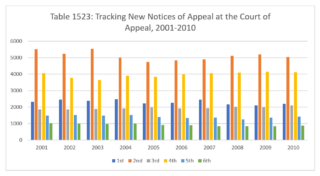
Across the decade, the biggest declines in caseload were in the First and Second Districts, followed by the Sixth.
In 2000, there were 2,716 new notices of appeal filed in the First District. The number never reached 2,500 again across the decade: 2,386 in 2003; 2,260 in 2006 and 2,197 in 2010. The Second District suffered an almost identical decline, from 6,284 new filings in 2001 to 5,531 in the next, 4,753 in 2005 and 5,043 in 2010.
The Third District actually increased its workload between 2001 and 2010. There were 1,975 new notices of appeal in 2000. The number stayed in that general vicinity through 2007 before rising incrementally to 2,021 in 2008, 2,002 in 2009 and 2,094 in 2010.
New notices of appeal in the Fourth District were down, but only slightly. There were 4,284 new filings in 2000. That fell to 3,988 in 2006 before recovering back to 4,065 in 2007, 4,095 in 2008, 4,148 in 2009 and 4,124 in 2010.
New filings in the Fifth District showed a bit of a dropoff with the economic downturn toward the end of the decade, but there were signs of recovery within a couple of years. There were 1,535 new notices of appeal in the Fifth in 2000. That fell to 1,506 by 2004 and to 1,260 in 2008 but was back up to 1,407 in 2010.
New filings in the Sixth District were down across the decade. There were 1,021 new notices of appeal in 2000. The number was down to 911 in 2005 and fell further to 824 by 2009. In 2010, there were 873 new notices of appeal in the Sixth District.
Next time, we’ll be looking at the data for new original proceedings (generally, petitions for writ of mandamus or mandate).
Image courtesy of Flickr by tdlucas5000 (no changes).