

Identity verification has always been a procedure where the end-user is asked to show their biometrics and identity documents to know who they say they are. This frustrates the user and countries have now started to roll out national eIDV (electronic ID verification systems to eliminate the need for document uploading and data entry.
eIDV systems not only help businesses keep cybercriminals at bay but are more than this. According to the research conducted by the McKinsey Digital Institute on 7 countries, it was found that eIDV results in social and economic gains, unlocking more than 13% of additional economic output by the year 2030. The institute found that out of 7.6 billion people, 1 billion lack a legal form of ID verification and 3.4 billion people have no digital ID.
eIDV at a Glance
eIDV is a refined form of KYC (Know Your Customer) that eliminates the need for paper-based and face-to-face identity verification. As the world evolves with the latest AI tools, it is time to expedite the process of onboarding new clients, reducing the time from hours to minutes.
ID verification isn’t something new but has been around for several decades. The biggest obstacle in shifting from manual to digital KYC was the limitation of in-person and paper-based documentation. This is what the EU is focusing on as its top priority right now.
The 5AMLD regulations approved in 2020 put a strong emphasis on electronic ID verification. In the day and age of smartphones, it is no more convenient to perform in-person/face-to-face verification. Other than slow onboarding time, it raises the costs of background checks for institutions and governments.
How is eIDV Different from eKYC?
Many times eIDV and eKYC are used interchangeably, however, the former is an advanced version of the latter. eIDV is about using digital identity methods to verify, whereas eKYC can still be paper-based.
An example could be Pakistan’s CNIC (Computerised National Identity Card), a government-issued ID card by NADRA (National Database Registration Authority of Pakistan), and the Verisys (Digital Verification System) used by banks and financial institutions.
When opening up a new bank account, approving a loan, or verifying a large transaction, banks will input the resident’s CNIC number into the system, which will conduct a search across thousands of data points, and pull up the data from NADRA.
The end user only needs to provide a valid CNIC number, and need not to carry photocopies of an ID card or other utility documents. This is a giant leap in verification, which is at par with India’s Aadhaar, and the EU’s eIDAS.
Similarly, Sweden and Norway use BankID, whereas most Europeans now use an EU ID.
FATF Guidelines on Electronic ID verification
FATF has released the following guidelines to ensure that eID verification can be used productively for Customer Due Diligence (CDD). Here these are summed up:
- Are there any risks of money laundering emerging from the use of digital ID systems for CDD?
- How can those risks be addressed?
- Are there any opportunities to combat money laundering and terrorism financing?
- What information is obtained during authentication for account access or onboarding? Who gets this data?
- How can digital identity systems be used to conduct CDD?
- How can progressive CDD aid financial inclusion?
- Does using digital identity systems for CDD lead to difficulties in implementing the FATF record-keeping requirements?
- What records do businesses keep when they use digital identity systems to perform CDD?
- What are the issues they face in meeting FATF requirements whilst using digital identity systems?
- If businesses keep a number of records to use them in digital ID systems during on-boarding a customer, does this impact Anti Money Laundering and Countering Terrorism Financing (AML/CTF) measures?
These aren’t just mere guidelines, but also a record sheet of questions that a business owner needs to consider before implementing eIDV method, to assure compliance with FATF guidelines.
How Does eIDV Help Mitigate Financial Crimes?
The latest AML tools and regulations require businesses to collect and analyse customer data across multiple touchpoints. Cybercriminals often bypass loopholes and outpace traditional AML laws. This, coupled with manual KYC will only add to the costs and burdens of businesses.
eIDV works by eliminating paperwork, decreasing time using real-time verification, and keeping pace with financial frauds. eIDV also helps in customer risk profiling, to determine the risk of fraud associated with each customer type.
Real-time verification, involving video liveness detection, is indeed a breakthrough that dramatically reduces the chances of fraud. While deep fakes are rampantly used for stealing identities, video liveness cannot be easily manipulated, thereby reducing fraud rates.
By extending the scope of their KYC solutions, real-time verification helps firms achieve global AML/CFT compliance, and so engage with a broader range of customers.
Why Should Businesses Choose Shufti Pro for eIDV Solution?
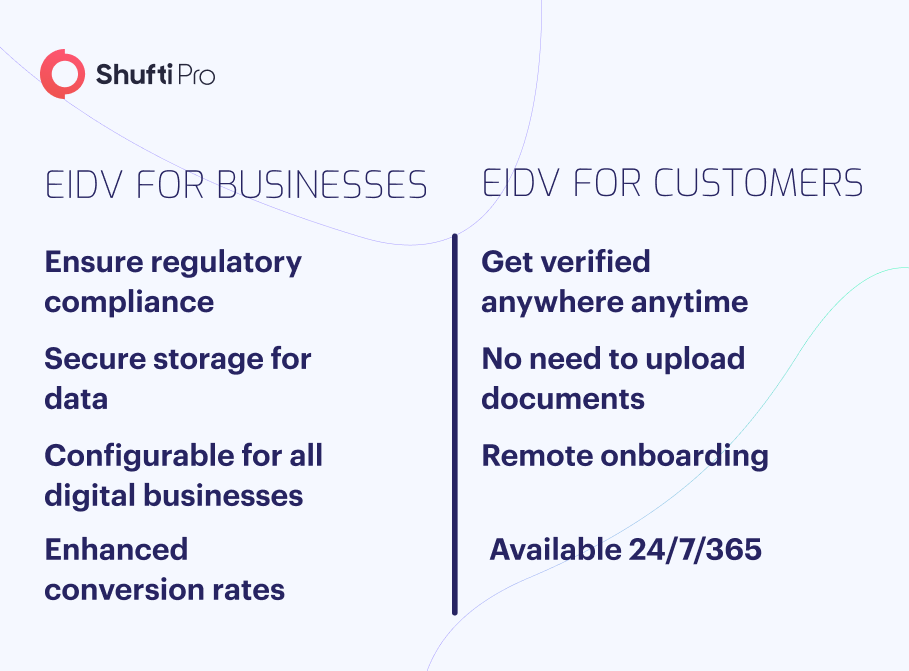
Regardless of the size of every business, digitisation comes with a whole set of new opportunities and challenges. Building and implementing a long-term successful eID verification system will only happen when businesses strike the perfect balance between compliance and user experience. This is where Shufti Pro’s eIDV Solution proves as a ray of hope for businesses. Here is how:
- Verification through a unique personal identifier only
- No need to upload documents
- Accuracy rate of 99+%
- Quickest customer onboarding
- Verification within seconds
- Reduced costs
Still, have questions about how Shufti Pro’s eIDV solution works?
.btn-talk-to-us a:focus {
fff !important;
}
.btn-talk-to-us {
text-align: center !important;
margin-bottom:30px !important;
}
.btn-talk-to-us a {
fff !important;
margin-top: 40px !important;
}
.for-space {
margin-left: 18px;
}
.for-space li {
margin-bottom: 10px;
}
b {
: ‘Graphik-Medium’;
}
The post Stay Ahead of Cybercriminals with Electronic Identity Verification Solution appeared first on .