

On August 9, 2023, Judge Amit P. Mehta of the U.S. District Court of the District of Columbia issued a final Memorandum Opinion in Cigar Association of America et al. v. United States Food and Drug Administration et al., vacating the decision of the Food and Drug Administration (FDA) to deem premium cigars subject to the agency’s regulatory authority under the Food, Drug, and Cosmetic Act, as amended by the Family Smoking Prevention and Tobacco Control Act (TCA)[1].
The decision concludes a seven-year conflict between the cigar industry and FDA. As previously reported, FDA issued a Final Rule on August 8, 2016, deeming all products meeting the statutory definition of a “tobacco product” to be subject to its regulatory authority, including premium cigars (“Deeming Rule”). In the preceding rulemaking phase, the Cigar Association of America (CAA), the Cigar Rights of America (CRA), and the Premium Cigar Association (PCA) had submitted comments to FDA regarding the usage patterns of premium cigar consumers, asserting that premium cigars did not pose the same type of public health concerns as other tobacco products. Nonetheless, in the Federal Register notice for the Deeming Rule, FDA asserted that no data had been provided to support different usage patterns and public health concerns.
The CAA, CRA, and PCA subsequently challenged the Final Rule in federal court. In July of 2022, the Court held that FDA’s decision to deem premium cigars was arbitrary and capricious, insofar as that FDA failed to consider data before it concerning the use of premium cigars and the health effects of such use and requested further briefing from the parties on potential remedies. Since then, Plaintiffs have requested that the Court vacate the Deeming Rule, while FDA has requested that the Court remand the decision without vacating it, a remedy that is typically reserved only for exceptional circumstances. Relevant case law dictates that a court must consider two factors: first, the seriousness of the rule’s deficiencies; and second, the disruptive consequences of vacating the rule.
With regard to the first factor, FDA argued that the Deeming Rule had minimal deficiencies that could be cured by (1) addressing existing record evidence on remand and (2) elaborating further on other rationales supporting the deeming of premium cigars, including concerns about secondhand smoke and usage among young adults. The Court rejected both arguments, finding that FDA’s decision to ignore relevant data in the first instance was a significant enough error to support vacatur, and that FDA could not separate other potential rationales for deeming premium cigars from the fundamental failure to consider relevant data on usage patterns and health effects.
As to the second factor, FDA argued (1) that vacating the Deeming Rule would leave premium cigars entirely unregulated at the federal level, including in terms of sales to youths and false or misleading advertising; (2) that maintaining the status quo would not impose significant burdens on manufacturers of premium cigars; and (3) that vacatur would invite litigation about FDA’s user fee scheme, which funds the regulation of all tobacco products. The Court acknowledged the importance of these concerns, but ultimately found that none of the consequences, alone or in combination, were disruptive enough to warrant remand without vacatur. The Court specifically noted that while premium cigars may not be regulated at the federal level, all 50 states prohibit the sale of premium cigars to individuals under 18 years of age, with the majority of states prohibiting sales to individuals under 21 years of age, and that FDA itself had noted that premium cigars were the agency’s lowest enforcement priority relative to other tobacco products used with greater frequency by youths.
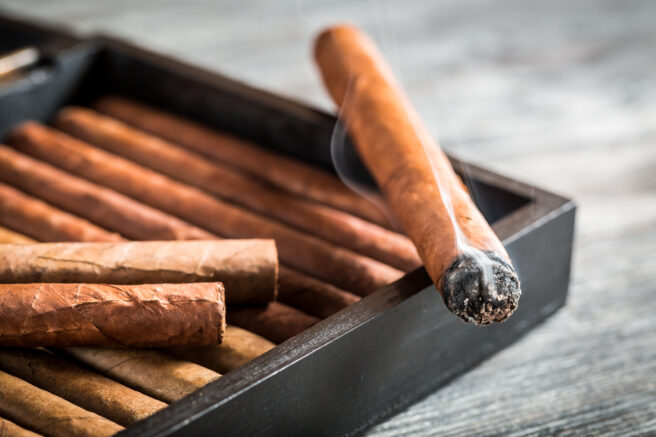
Upon consideration of the two factors, the Court found that FDA had not carried its burden to establish extraordinary circumstances that might displace the default remedy of vacatur. Thus, the Court has vacated the Deeming Rule insofar as it applies to premium cigars, as requested by the Plaintiffs. Significantly, the Court defined premium cigars as those that (1) are wrapped in whole tobacco leaf; (2) contain a 100% leaf tobacco binder; (3) contain at least 50% (of the filler by weight) long filter tobacco; (4) are handmade or hand rolled; (5) have no filter, nontobacco tip, or nontobacco mouthpiece; (6) do not have a characterizing flavor other than tobacco; (7) contain only tobacco, water, and vegetable gum with no other ingredients or additives; and (8) weigh more than six pounds per 1,000 units.
The Department of Justice now has an opportunity to appeal this decision to the U.S. Court of Appeals for the DC Circuit, so stay tuned for further updates.
[1] See Cigar Association of America et al. v. United States Food and Drug Administration et al., Case No. 1:16-cv-01460-APM (D.D.C.) (August 9, 2023).