

What is Form I-485?
Form I-485, officially known as the “Application to Register Permanent Residence or Adjust Status,” is a key document processed by the U.S. Citizenship and Immigration Services (USCIS) for individuals seeking to become lawful permanent residents of the United States. For those applying for a marriage-based green card, Form I-485 helps prove the foreign spouse’s eligibility for U.S. permanent residency. The individual applying is referred to as the “applicant.”
Key Steps:
- After Form I-130: Filing Form I-485 typically follows the submission of Form I-130, “Petition for Alien Relative.”
- Concurrent Filing: If the foreign spouse is already in the U.S., Form I-130 and Form I-485 can often be filed together, a process known as “concurrent filing.”
- Eligibility Requirements: It is crucial to meet all eligibility requirements for the I-485 Adjustment of Status application to ensure the application is well-prepared and sufficiently documented, thereby avoiding potential requests for evidence (RFEs) and denials.
Recent Updates to Form I-485
Important Update (December 10, 2024):
- New Version Released: USCIS introduced an updated version of Form I-485.
- Medical Exam Requirement: Applicants must now submit Form I-693 (medical examination results) alongside Form I-485.
- Streamlined Affidavit of Support: The affidavit process has been simplified.
- Public Charge Questions: Clarified questions related to the public charge rule have been added. Learn more here.
Form I-485 Processing Time
Processing times vary based on factors like application type and USCIS field office, significantly impacting the green card timeline. As of now:
- Average Time: 9 to 14 months for family-based applications.
- Employment-Based Applications: If you filed Form I-140, it must be approved before Form I-485 processing can begin. Typical I-485 processing times for employment cases is 16 to 24 months.
Factors Affecting Timeline:
- Eligibility Criteria: Your relationship with a U.S. citizen or permanent resident affects processing time.
- USCIS Service Center: Processing times differ by service center. Check yours here.
- Form Category: Selecting the correct form category is crucial for accurate processing. Refer to your receipt notice to identify the appropriate form and its processing office.
Form I-485 Approval: I-130 vs. I-485
- Standard Process: Form I-130 is usually approved before Form I-485 to secure USCIS approval. Preparing a well-documented application is crucial to reduce the risk of receiving Requests for Evidence (RFEs) or denials.
- Concurrent Filing: If filed together, USCIS may process both forms simultaneously, especially for immediate relatives.
Expedited Processing Options
- Premium Processing: Not available for Form I-485.
- Expedited Requests: Possible through the USCIS Contact Center. You’ll need your 13-digit receipt number for faster processing.
Form I-485 Cost
- Filing Fee: $1,440.
- Fee Waivers/Reductions: Some applicants may qualify for reduced fees or waivers. Check fee details.
- Fee Calculator: Use the USCIS Fee Calculator to determine exact costs.
Form I-485 Eligibility Criteria
Who Can File:
- Applicants can file under seven categories:
- Family-based
- Employment-based
- Special Immigrant
- Asylum/Refugee
- Human Trafficking/Crime Victim
- Special Programs
- Additional Options
Marriage-Based Green Card Applicants:
- Must be physically present in the U.S.
- Entered the U.S. on a valid visa.
- An immigrant visa must be “immediately available.”
Who Cannot File:
- Individuals not present in the U.S.
- Those who entered as crewmen, in transit, as informants, or are “deportable” due to terrorism.
Inadmissibility Grounds:
- Health issues (e.g., communicable diseases)
- Criminal convictions
- Security threats
- Immigration violations
- Public charge risks
Waivers: Available for certain disqualifications, depending on the case.
Required Supporting Documents for Form I-485
Essential Documents:
- Proof of lawful entry (visa and I-94 record). Get your I-94 here.
- Proof of nationality (birth certificate, passport).
- Financial support proof (tax returns, pay stubs).
- Medical exam results from a USCIS-approved doctor. Find a doctor.
- Criminal records (if applicable).
Secondary Evidence:
- If documents are missing, provide alternative evidence like school or baptism records.
- If unavailable, submit sworn affidavits from people with personal knowledge of your situation.
Common Mistakes to Avoid
- Incomplete Information: Double-check all fields.
- Missing Documents: Ensure all required documents are included.
- Unsigned Forms: Forms without signatures are rejected.
- Outdated Forms: Use the latest version from USCIS.
- Incorrect Fees: Confirm the correct fee before submitting.
- Skipping the Medical Exam: Submit Form I-693 with your application.
- Not Updating Address: Notify USCIS of any address changes within 10 days.
Form I-485 Processing Time for Each Step
Applying for a green card through Form I-485, also known as the Application to Register Permanent Residence or Adjust Status, involves several key steps. Understanding the immigration process can help you avoid delays and ensure a smooth journey towards permanent residency.
1. Receipt of Application
Timeline: 2 to 4 Weeks After Filing
Once you correctly file Form I-485 with all required documents, USCIS will send a receipt notice (Form I-797C, Notice of Action) within 2 to 4 weeks. This notice confirms they received your application and provides a 10-digit receipt number to track your case status online via the USCIS Case Status Tool.
Key Points:
- Proper Filing: Ensure all forms are complete and accurate to avoid rejection.
- Rejections: If your application is incomplete or incorrect, USCIS will reject it, delaying your process significantly.
- Statistics: In FY2024, USCIS received 954,214 applications but rejected 104,964 due to filing errors.
2. Biometrics Appointment
Timeline: 5 to 8 Weeks After Filing
USCIS will schedule a biometrics appointment to collect your fingerprints, photo, and signature for a background check. This will typically take place at the nearest Application Support Center (ASC).
What to Bring:
- Appointment notice
- Government-issued photo ID (passport, driver’s license, military ID)
Important Tips:
- Don’t Miss It: Rescheduling will delay your processing time.
- Criminal Records: If you have a criminal history, consult an immigration attorney before attending.
3. Employment Authorization (EAD) and Advance Parole
**Timeline:**8 to 20 Weeks After Filing
If you applied for work authorization (Form I-765) or advance parole (Form I-131), you may receive a combined employment authorization document (EAD) and travel document known as a combo card.
Key Facts:
- EAD: Typically issued within 8 weeks.
- Advance Parole: Processing may take longer.
- Combo Cards: While previously common, USCIS may now issue these documents separately to improve efficiency.
Resources:
4. Adjustment of Status Interview
Timeline: 8 to 20 Months After Filing
Most applicants will be scheduled for an adjustment of status interview, especially if the application is based on marriage. The interview will be conducted at a local USCIS office and usually lasts under 30 minutes.
How to Prepare:
- Review all submitted forms and documents.
- Bring originals of documents you previously submitted as copies (birth certificates, marriage licenses).
- Bring your passport, EAD, and advance parole documents.
Missed Interview: Rescheduling will add weeks or months to your processing time.
5. Final Decision and Green Card Issuance
Timeline: 1 to 6 Months After Filing
After your interview, USCIS may approve or deny your application. If approved, your green card will be mailed shortly after. If denied, you will receive a notice explaining the reasons for rejection and information on how to appeal or reapply.
Post-Approval Tips:
- Travel: Your green card allows you to travel internationally and re-enter the U.S.
- Work: It also serves as proof of your right to work in the U.S.
- Temporary Proof: You can request an I-551 stamp in your passport if you need proof of permanent residency before your green card arrives.
Case Inquiries: If you don’t receive your green card, you can submit an inquiry using the USCIS Case Inquiry Tool.
Factors Affecting Processing Times
Processing times can vary based on several factors:
- USCIS Workload: Higher application volumes can lead to longer wait times.
- Office or Service Center: Processing speeds differ between USCIS field offices or service centers. Identifying the specific office or service center handling your case is crucial for accurate processing and updates.
- Application Completeness: Errors or missing documents can delay processing.
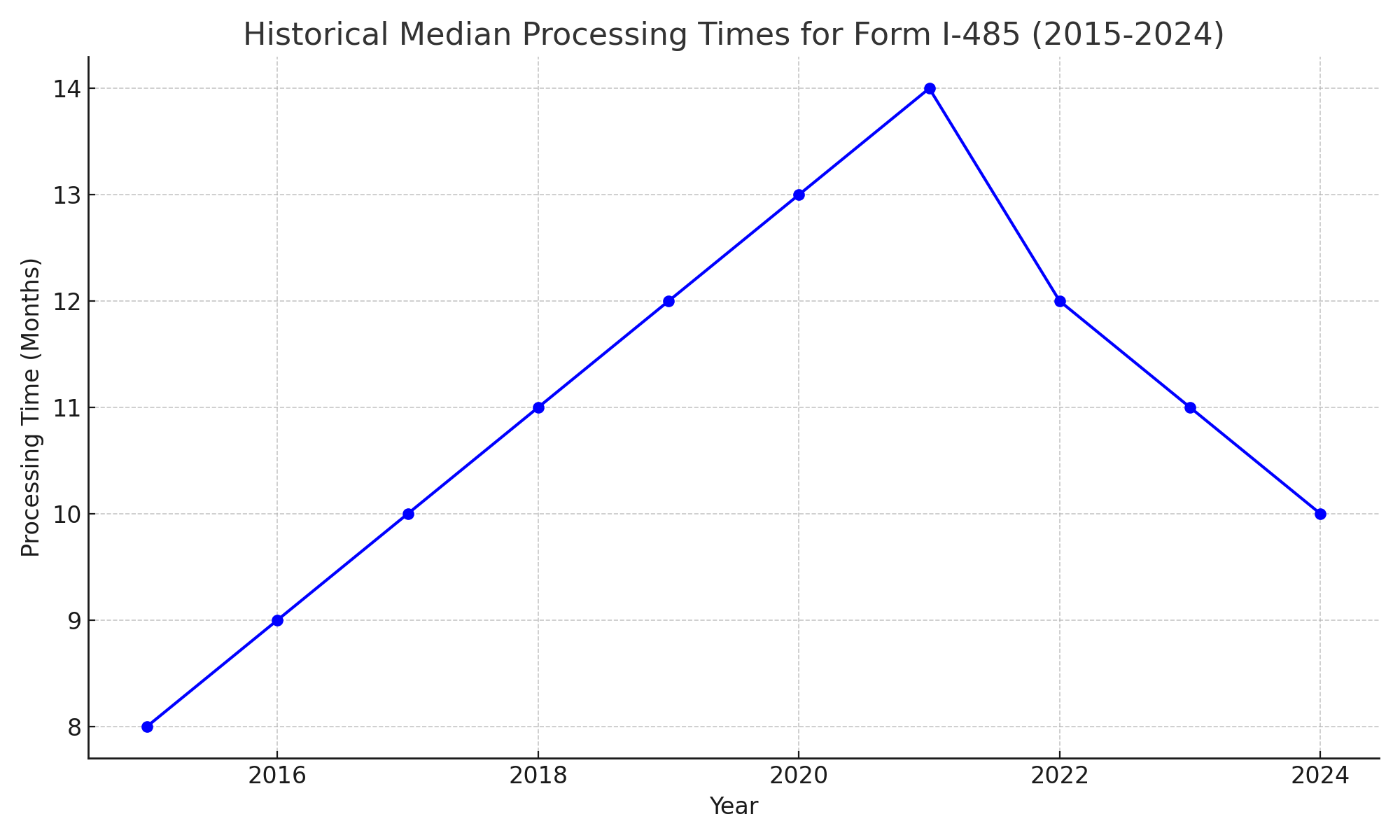
USCIS Historical Processing Times: USCIS data shows fluctuating processing times over the past decade. Policies under different administrations have influenced these timelines.
Managing Delays and Backlogs
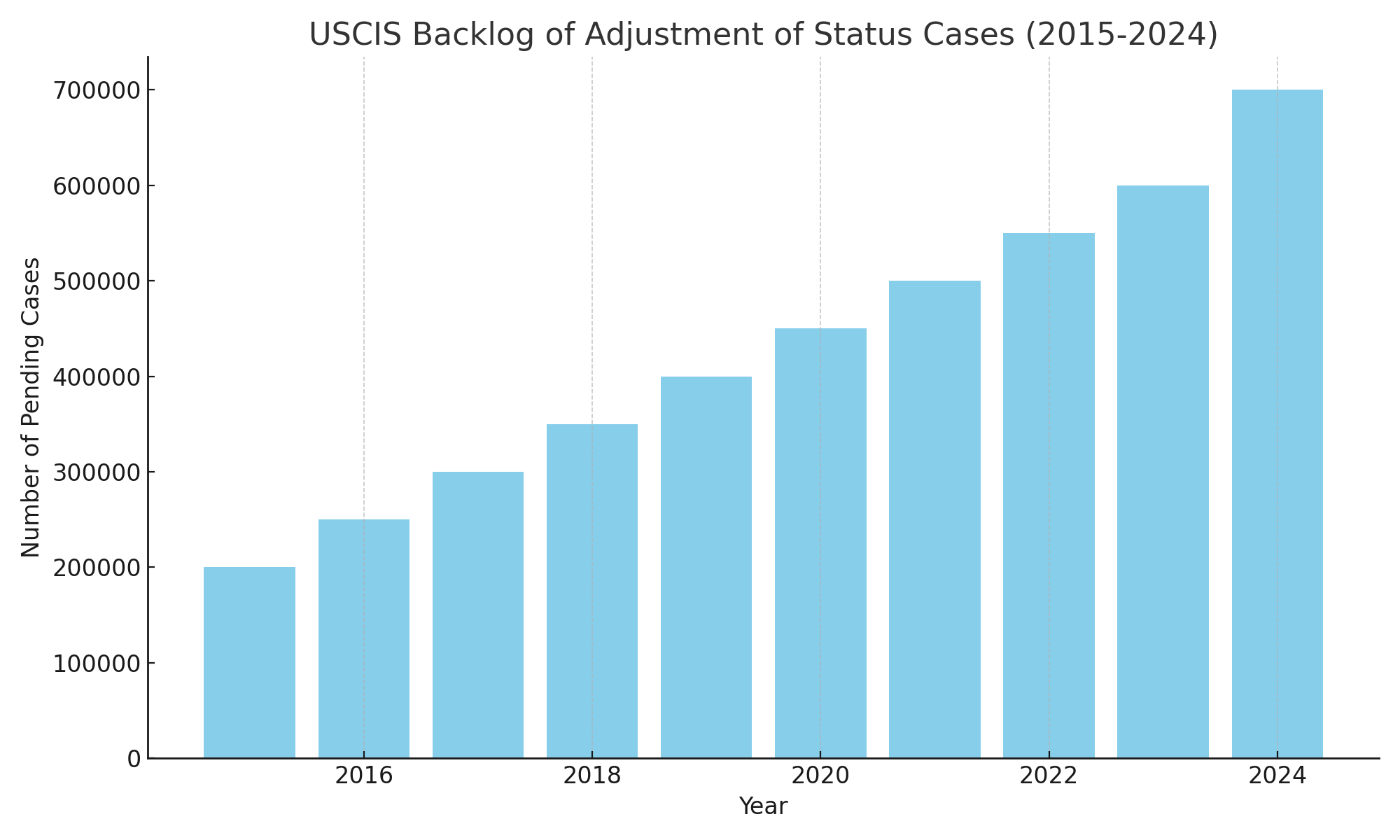
Backlogs: An increasing number of adjustment of status applications has led to significant backlogs. As of FY2024, the number of pending cases reached record highs, contributing to longer processing times.
Tips to Avoid Delays:
- File Early: Submit your application as soon as you’re eligible.
- Double-Check Documents: Ensure all forms are filled correctly and supporting documents are included.
- Monitor Your Case: Use your receipt number to track your case status regularly.
Form I-485 Processing Times: Frequently Asked Questions (FAQs)
1. What is Form I-485?
Answer:Form I-485, Application to Register Permanent Residence or Adjust Status, is used by individuals in the United States to apply for lawful permanent resident status (a Green Card).
2. What factors affect the processing time for Form I-485?
Answer:Several factors influence processing times, including:
- USCIS service center workload
- Type of eligibility category (family-based, employment-based, asylum, etc.)
- Completeness and accuracy of the application
- Background checks and security clearances
- Requests for Evidence (RFEs) or additional documentation
- Priority dates for certain visa categories
- USCIS staffing and policy changes
3. What is the average processing time for Form I-485?
Answer:Processing times vary depending on the eligibility category and service center but generally range from 8 to 14 months. However, certain cases, like asylum-based or employment-based adjustments, may have different timelines.
4. How can I check the status of my I-485 application?
Answer:You can check your case status by:
- Visiting the USCIS Case Status Online Tool and entering your receipt number.
- Signing up for case status updates via your USCIS online account.
- Calling the USCIS Contact Center at 1-800-375-5283.
5. How do I find out the processing times for my specific USCIS service center?
Answer:Go to the USCIS Processing Times webpage, select Form I-485, choose your eligibility category, and pick the service center handling your case.
6. What is a “Receipt Notice,” and when will I get it?
Answer:A Receipt Notice (Form I-797C) confirms that USCIS has received your application. It usually arrives 2-4 weeks after filing.
7. Why is my I-485 application taking longer than others I know?
Answer:Each case is unique. Factors such as background checks, priority dates, biometrics delays, RFEs, or specific eligibility categories may cause variations in processing times.
8. What is a Request for Evidence (RFE), and how does it affect processing time?
Answer:An RFE is a USCIS request for additional information. Responding to an RFE can delay your application by several months depending on how quickly you respond and how soon USCIS processes the new information.
9. What happens after I file Form I-485?
Answer:
- Receipt Notice (Form I-797C)
- Biometrics Appointment (within 5-8 weeks of filing)
- Background and Security Checks
- Interview (if applicable)
- Request for Evidence (if needed)
- Decision Notice (Approval or Denial)
- Green Card Issuance (if approved)
10. Do all I-485 applicants need an interview?
Answer:Not all applicants are required to attend an interview. Employment-based and certain family-based categories may be waived, while most family-based (spousal, parental) and asylum-based adjustments usually require interviews.
11. How long after my biometrics appointment will I get my green card?
Answer:It varies, but typically you may wait 4-8 months after biometrics, depending on background check completion, interview scheduling, and overall case backlog.
12. How do I expedite my Form I-485 processing?
Answer:You can request expedited processing if you meet USCIS criteria, such as:
- Severe financial loss
- Humanitarian reasons
- Nonprofit organization interests
- U.S. government interests
Submit a written request to USCIS explaining your situation along with supporting documents.
13. What is “Case Is Ready to Be Scheduled for an Interview” status?
Answer:This status means USCIS has reviewed your application and will schedule your interview when a slot becomes available. It doesn’t guarantee immediate scheduling.
14. Can I work or travel while my I-485 is pending?
Answer:You can apply for:
- Employment Authorization (Form I-765) for work.
- Advance Parole (Form I-131) for travel.
Both can be filed concurrently with I-485 and typically take 3-6 months to process.
15. What happens if my priority date is not current?
Answer:If you’re in a visa category subject to numerical limits (like employment-based), your case will not proceed until your priority date becomes current in the Visa Bulletin.
16. Why did my case transfer to another USCIS office?
Answer:USCIS may transfer cases to:
- Balance workloads between service centers.
- Move cases closer to field offices for interviews.
- Speed up processing times at less congested centers.
17. What should I do if my case is outside normal processing times?
Answer:If your case exceeds normal timelines:
- Submit an online inquiry via USCIS’s website.
- Call the USCIS Contact Center.
- Request assistance from the Ombudsman if there’s no resolution.
18. Can I travel internationally while my I-485 is pending?
Answer:Only with Advance Parole. Leaving the U.S. without it may abandon your I-485 application, unless you have a valid H or L visa.
19. Does USCIS notify me if my background check is delayed?
Answer:USCIS rarely provides updates on background check delays. If you suspect delays, you can:
- Submit a case inquiry.
- Contact your Congressional representative.
20. What does “Case is Under Active Review” mean?
Answer:This status means a USCIS officer is currently reviewing your case. It does not indicate an imminent decision but signifies progress in processing.
21. How do government shutdowns affect my I-485 processing time?
Answer:USCIS is fee-funded and generally continues operations during shutdowns, but other agencies involved in background checks (like the FBI) may experience delays.
22. Will moving to a new address delay my application?
Answer:It could, if USCIS needs to transfer your case to a different field office. Always update your address promptly via USCIS Online Change of Address Tool.
23. Can hiring an attorney speed up my I-485 processing?
Answer:While an attorney ensures accuracy and helps respond to issues like RFEs, they cannot influence processing speed directly.
24. What if I miss my biometrics appointment?
Answer:You can reschedule by following instructions in your biometrics notice. Missing without rescheduling could result in application denial.
25. Can I contact my local USCIS field office for processing time updates?
Answer:No. USCIS field offices typically do not handle inquiries. Use the USCIS Contact Center or online tools for updates.
26. What is the difference between USCIS service centers and field offices?
Answer:
- Service Centers handle initial processing and paperwork.
- Field Offices conduct interviews and make final decisions.
27. Can delays in other forms affect my I-485 processing time?
Answer:Yes. Delays in Form I-130 (Petition for Alien Relative) or Form I-140 (Immigrant Petition for Alien Worker) can postpone I-485 adjudication.
28. Does USCIS offer premium processing for Form I-485?
Answer:No. Premium processing is only available for certain forms like Form I-140, not for I-485.
29. How does USCIS prioritize I-485 applications?
Answer:USCIS prioritizes cases based on filing order, visa availability, and case complexity. Humanitarian or urgent cases may be expedited.
30. What should I do if my green card is delayed after I-485 approval?
Answer:If you haven’t received your green card within 60 days of approval, file an inquiry through USCIS Case Status Online or call the USCIS Contact Center.
31. How important are immigration services in the I-485 application process?
Answer:Immigration services are crucial in providing dedicated legal representation and support throughout the application process with the U.S. Citizenship and Immigration Services (USCIS). Having an attorney advocate for your rights during interviews and the filing of the I-485 application can significantly impact the outcome. They help navigate the procedural steps involved in obtaining permanent residency, ensuring all requirements are met and increasing the likelihood of a successful application.
Where do I file Form I-485?Filing location depends on your residence and adjustment category. Check the USCIS filing chart.
Can Form I-485 be filed online?Some categories allow online filing via USCIS online account.
Can I file Form I-485 from outside the U.S.?No. This form is for individuals already in the U.S. For those abroad, consular processing is required.
Can I travel while my I-485 is pending?Yes, but you must apply for Advance Parole (Form I-131) before leaving the U.S.
How can I check my I-485 status?Track your application using the USCIS case status tool.
What if my I-485 is denied?You may appeal or reapply, depending on the reason for denial.
Will filing Form I-485 allow me to work?You can apply for a work permit (Form I-765) while your application is pending.
Can I file if I have a criminal record?It depends on the crime. Consult an immigration attorney.
What is Form I-485J?This form confirms a job offer for employment-based green cards.
What’s the difference between Form I-485 and consular processing?Form I-485 is for adjusting status within the U.S., while consular processing is for applicants outside the U.S.
Let Herman Legal Group Be Your Assistant Throughout the Complex Legal Procedure of the I-485
The Herman Legal Group, founded in 1995, can help. The law firm is AV-Rated and has been awarded the “Best Law Firm” designation by US News & World Report. The firm serves clients nationwide and worldwide on all types of US immigration schemes/programs.
Conclusion: While the I-485 processing time can vary, careful preparation and timely filing can help you navigate the process efficiently. Stay informed and proactive to ensure a smooth path to your green card.
Immigration withsteadfast support
For additional resources, visit:
The post What is Processing time for I-485? appeared first on Herman Legal Group.