
As enterprises accelerate the adoption of Large Language Models (LLMs) across internal workflows, naïve cost comparisons are no longer sufficient. Evaluating LLMs requires a multi-dimensional approach — balancing performance, reliability, security, and total cost of ownership (TCO) across the model lifecycle.
This guide provides a structured, five-pillar framework to help enterprise technology leaders move beyond API costs and assess the true fit, risk, and value of LLM deployments.
Readers will gain:
- A checklist-driven evaluation process.
- Real-world case studies.
- Sample vendor comparison matrices.
- Long-term cost management strategies.
- Integration best practices for hybrid AI systems.
1. The Evolving Enterprise AI Landscape
Enterprises are no longer asking “Should we use AI?” — they are asking “Which AI fits our workflows?”
- Vendor options span from closed models (GPT-4.5, Claude 3) to open-source models (Llama 3, Mistral).
- Capabilities vary across domains — legal, financial, creative, and compliance-heavy environments.
- The highest-performing model on academic benchmarks may still fail dramatically in handling your company’s unique data and processes.
The simple “price per token” comparison does not capture these complexities, which is why a structured, workflow-aligned evaluation framework is essential.
2. Five Pillars of Enterprise LLM Evaluation
| Evaluation Pillar | Key Evaluation Focus | Example Metrics |
|---|---|---|
| Performance | Can the model handle your domain-specific queries reliably? | Task accuracy, latency, retrieval precision |
| Reliability | Does the model produce consistent, non-contradictory responses across interactions? | Hallucination rate, longitudinal consistency |
| Security & Compliance | Does the model comply with data governance policies and regulatory frameworks? | PII leakage rate, compliance score, auditability |
| Integration Flexibility | How well can the model integrate with existing knowledge bases and workflows? | RAG precision, data source recall, API flexibility |
| Total Cost of Ownership | What is the all-in cost when considering monitoring, fine-tuning, and retraining? | TCO forecast, operational cost projections |
Practical Example – Scorecard Template
| Model | Performance | Reliability | Security | Integration | TCO | Total Score |
|---|---|---|---|---|---|---|
| GPT-4.5 | 9 | 8 | 8 | 7 | 6 | 38 |
| Claude 3 Opus | 8 | 7 | 9 | 6 | 7 | 37 |
| Llama 3 FT | 7 | 7 | 6 | 9 | 8 | 37 |
3. Performance — Workflow-Centric Testing Over Benchmarks
The Benchmark Trap
Standard LLM evaluations rely on datasets like:
- MMLU for general reasoning.
- TruthfulQA for factual accuracy.
- HellaSwag for common sense reasoning.
These tests do not reflect your internal document structures, unique vocabulary, or process constraints.
Custom Workflow Test Suites
Enterprise evaluations should instead:
- Create synthetic query sets based on real internal documents.
- Measure performance on actual contracts, customer emails, or compliance filings.
- Focus on precision within domain-specific terminology.
# Example Workflow-Specific Test
def evaluate_contract_risk(model, contract_text):
    analysis = model.generate(contract_text, task="risk_assessment")
    return score_risk_analysis(analysis)

def score_risk_analysis(analysis):
    # Domain-specific accuracy metric
    reference_clauses = ["limitation of liability", "force majeure"]
    return sum([1 for clause in reference_clauses if clause in analysis]) / len(reference_clauses)
4. Reliability — Monitoring Long-Term Consistency
Beyond One-Off Performance
LLMs degrade over time due to:
- Knowledge drift (outdated facts).
- Model version changes.
- Inconsistent responses across repeated queries.
| Metric | Definition |
|---|---|
| Longitudinal Accuracy | Accuracy measured over weeks/months |
| Contradiction Rate | % of responses that contradict prior correct answers |
| Hallucination Rate | % of confidently wrong outputs |

5. Security & Compliance — From Data Privacy to Legal Defensibility
Data Control Challenges
Enterprise-grade LLMs must:
- Avoid leaking sensitive data.
- Log all model queries and responses.
- Ensure full auditability for compliance teams.
| Security Focus | Example Practice |
|---|---|
| Data Isolation | Fully separate internal data stores for retrieval |
| Redaction Rules | Automatic removal of PII during generation |
| Regulatory Alignment | Compliance with GDPR, HIPAA, SOC 2, ISO 27001 |
| Legal Defensibility | Traceability of sources used in generated outputs |
6. Integration Flexibility — Bringing Internal Knowledge to the Model
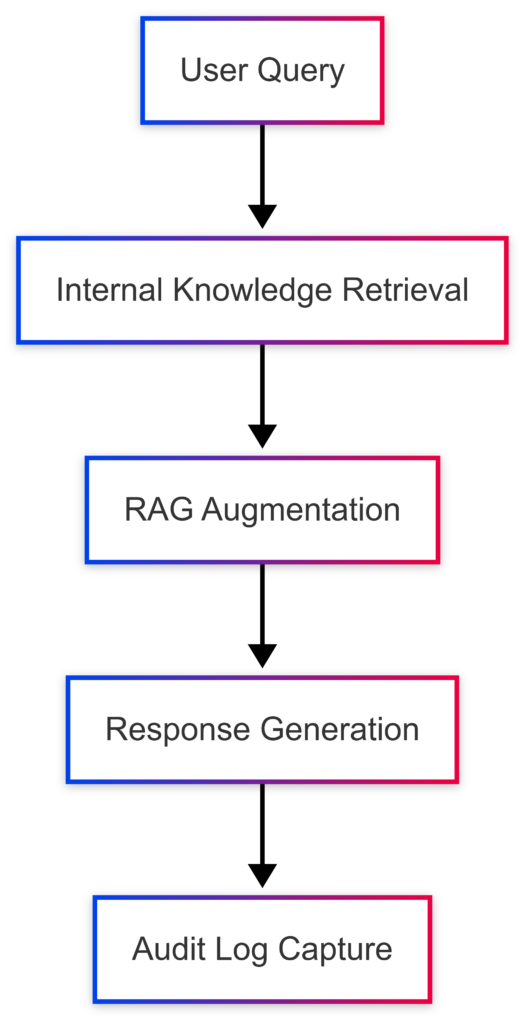
RAG (Retrieval-Augmented Generation)
Best-in-class enterprise LLMs:
- Seamlessly retrieve internal documentation.
- Incorporate real-time knowledge into responses.
- Support custom embeddings aligned to domain-specific terminology.
| Knowledge Source | Integration Method | Example Use Case |
|---|---|---|
| Policy Documents | RAG Embedding Retrieval | HR Compliance Bot |
| Contract Archives | Vector Similarity Lookup | Legal Review Assistant |
| Incident Reports | Context Injection | Incident Analysis Copilot |
7. Total Cost of Ownership (TCO) — Beyond Token Prices
Key Cost Factors
| Cost Component | Examples |
|---|---|
| Licensing Fees | Per-token costs, seat-based fees |
| Fine-Tuning Costs | Data labeling, review, feedback loops |
| Monitoring Infrastructure | Observability and anomaly detection platforms |
| Compliance Reviews | Regular external & internal audits |
| Model Drift Management | Ongoing refresh, knowledge injection |
Example Lifecycle Cost
| Phase | Estimated Cost Range |
|---|---|
| Initial Evaluation | $50,000 – $150,000 |
| Fine-Tuning | $30,000 – $100,000 per cycle |
| Ongoing Monitoring | $10,000 – $30,000 per month |
| Annual Retraining | $100,000 – $300,000 |
8. Real-World Case Study — Insurance Enterprise Rollout
| Step | Key Adaptation |
|---|---|
| Performance | Custom risk clause evaluation suite |
| Reliability | Contradiction monitoring pipeline |
| Security | Full audit & legal review process |
| Integration | Real-time claims database retrieval |
| TCO | Yearly fine-tuning & compliance audits |
Outcome: 52% hallucination reduction, 80% response consistency improvement across teams, and full legal traceability.
Conclusion — The Era of Holistic LLM Evaluation
LLM procurement is no longer just a cost exercise — it’s about ensuring:
- Long-term reliability.
- Security and defensibility.
- Seamless integration.
- Adaptability to change.
Enterprise leaders must adopt evaluation playbooks that match the sophistication of these models.
The post Evaluating Large Language Models for Enterprise Use — Beyond API Costs appeared first on Adyog | Creative Design and Digital Product Development Company.