


The Canadian government yesterday tabled its Budget Implementation Act. Running at over 600 pages, the bill includes several notable provisions related to digital policy including the repeal of the Digital Services Tax, the restoration of a privacy provision in the Broadcasting Act that was mistakenly deleted (yet no one noticed for two years), adding a new data mobility framework to Canada’s privacy laws, and creating a new Stablecoin Act. The Canadian Stablecoin Act is modelled on the U.S. GENUIS Act, though there are some notable differences.
The Canadian bill establishes a federal regime under the Bank of Canada to supervise issuers of stablecoins available to persons in Canada. The bill defines stablecoins as digital assets referencing a single fiat currency and requires issuers to be listed by the Bank. While it does not outright prohibit unlicensed issuing (unlike the U.S.), it effectively restricts issuance of stablecoins by requiring registration. The Canadian bill allows any person to the Bank of Canada to become an approved stablecoin issuer with a detailed application that covers governance issues, technical specifics, meeting anti-money laundering rules, and financial disclosures.
The stablecoin issuer must maintain reserve assets that back the stablecoin in the same currency or other high quality liquid assets in the currency and it must include redemption rights (the right to redeem the stablecoin for the underlying reserve asset). Regulations may provide further details on these obligations. There are also monthly reporting requirements to the Bank of Canada and requirements for policies on governance, risk management, data security, and recovery and resolution should the stablecoin cease to operate. The Bank of Canada is provided with a range of powers to enforce the law as well as administrative monetary penalties (about half of the bill related to enforcement and future regulations).
For a comparison of the Canadian and U.S. approaches, I uploaded both bills to ChatGPT, which generated the comparison chart posted below. More on stablecoins and their regulation in this recent Law Bytes podcast with Mohamed Zohiri.
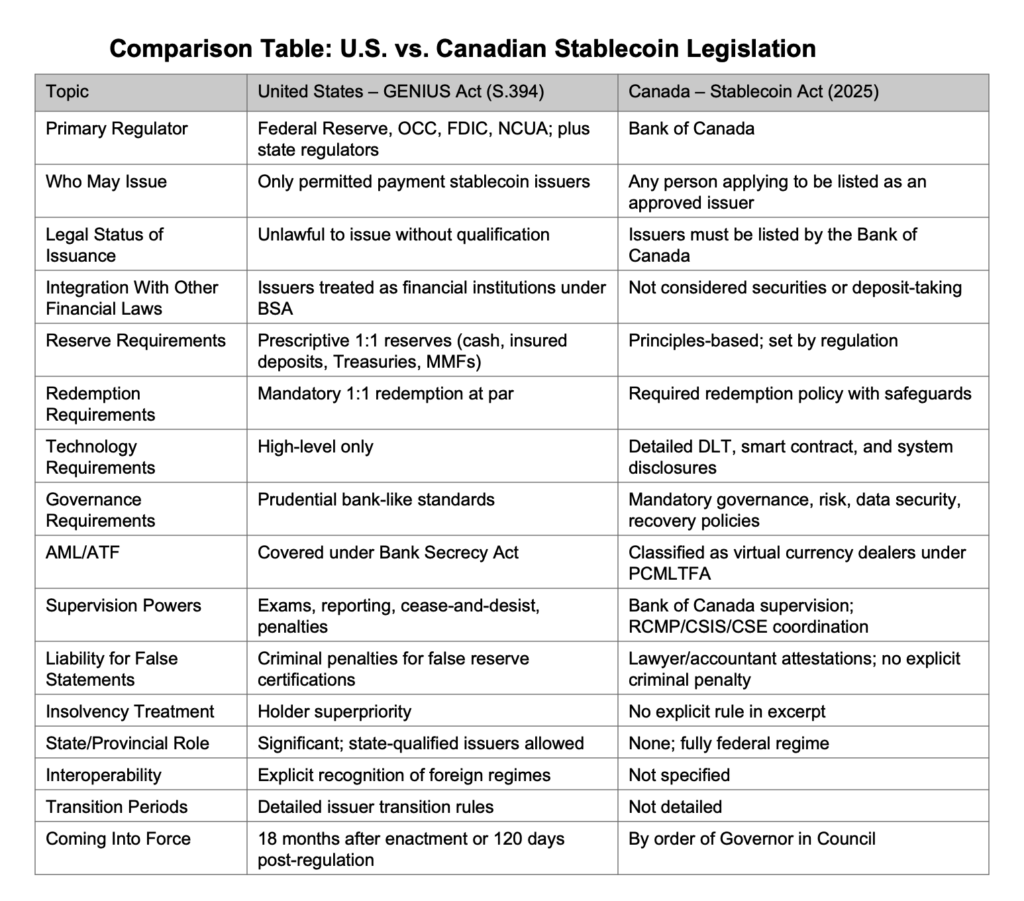
Stablecoin Legislation Comparison (ChatGPT generated)
The post Canadian Government Introduces New Stablecoin Act as Part of Budget Implementation Legislation appeared first on Michael Geist.