

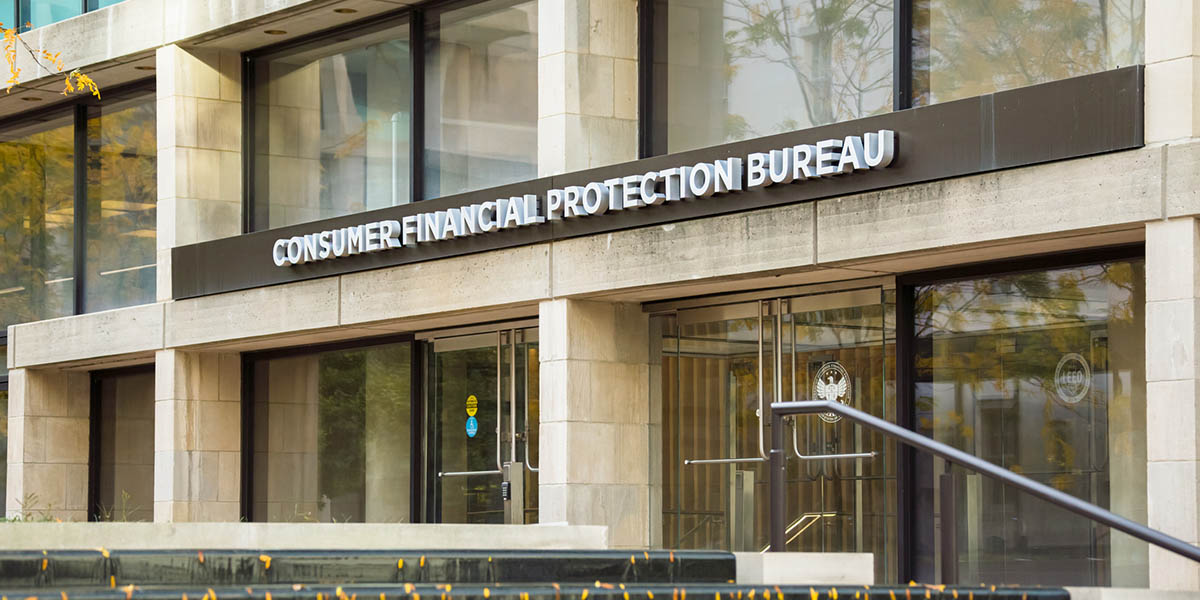
Three nonprofit organizations have filed a complaint in the Northern District of California seeking declaratory and injunctive relief to prevent what they describe as a de facto shutdown of the Consumer Financial Protection Bureau (CFPB or Bureau). Their suit targets Acting Director Russell Vought’s refusal to request funding for the Bureau from the Federal Reserve Board (Fed), arguing that Congress designed a statutory provision that provides stable, standing appropriation to support the CFPB’s mission and that the Director’s recent interpretation of the statute — which is being used to support the refusal to request funding — unlawfully cuts off those funds. The plaintiffs ask the court to compel the CFPB to fulfill its statutory duty by requesting funding immediately.
Background
As we discussed here, the current funding dispute turns on what “combined earnings” under 12 U.S.C. § 5497(a)(1) means and what the Director must do when requesting funding. The motion to clarify in National Treasury Employees Union (NTEU) v. CFPB squarely challenged the position advanced in a U.S. Department of Justice (DOJ) notice and DOJ’s Office of Legal Counsel (OLC) opinion (discussed here) that the CFPB’s primary statutory funding stream is unavailable while the Fed is operating at a loss. The plaintiffs in that matter argued that the statute’s text, structure, and history confirm that “combined earnings” refers to the Federal Reserve System’s total or gross earnings and that the Fed “shall transfer” amounts reasonably necessary for the Bureau to carry out its authorities up to a statutory cap. In accordance with that reading, the Bureau cannot precipitate a funding lapse by declining to request funding, and the Antideficiency Act cannot excuse noncompliance when the statutory mechanism to request funding remains available. By contrast, OLC recently interpreted “combined earnings” to mean profits (revenues net of interest expense) and concluded that there are currently no funds from which the CFPB may lawfully draw, thus projecting a potential funding lapse in early 2026 and framing continued operations after existing balances are exhausted as constrained by the Antideficiency Act.
The new California complaint situates itself against that same backdrop. The plaintiffs are Rise Economy, National Community Reinvestment Coalition, and Woodstock Institute. Collectively, the plaintiffs assert that the Bureau’s reading of “combined earnings” departs from statutory design and longstanding practice, and creates immediate, concrete harms for organizations that depend on the CFPB’s complaint infrastructure and public datasets to fulfill their missions.
Legal Analysis
The plaintiffs contend that the CFPB’s funding statute imposes a non-discretionary duty on the Director to determine and request the amount “reasonably necessary” to operate the Bureau, subject only to the statutory cap. They argue that the statute does not authorize the Director to withhold requests for funding based on an independent determination of the Federal Reserve System’s “earnings,” nor to redefine “combined earnings” as net profits to deprive the CFPB of transfers.
Separately, the complaint advances an Administrative Procedure Act theory that the decision not to request funding and the adoption of the “profits-only” reading constitute final agency action that is arbitrary, capricious, and contrary to law because it abdicates a statutory duty, destabilizes a congressionally designed funding structure, and fails to consider reliance interests and operational consequences. Finally, the plaintiffs note that even under the OLC’s definition of “combined earnings,” recent Federal Reserve System balance sheet data indicate positive weekly amounts that reduce the System’s deferred assets, undercutting any categorical claim that no transfers are possible; either way, they say, the CFPB must request funds and cannot manufacture a lapse by declining to do so.
Our Take
This case provides a second forum in which a court has been asked to opine on the Fed’s “combined earnings” funding issue for the CFPB. However, at a time when the CFPB is engaged in a number of rulemaking efforts that the industry views as beneficial, a shutdown of the agency may be counterproductive. The CFPB has stated that it may issue interim final rules for the Section 1033 and 1071 rulemakings before year-end (which we will be blogging separately about), but there are numerous other items on the Bureau’s rulemaking agenda, including the proposed Regulation B amendments that would eliminate disparate impact liability. We will be sure to comment on further events regarding this issue and related issues as they unfold.