


Skip to content

Menu

LexBlog, Inc. logo
NetworkSub-MenuBrowse by SubjectBrowse by PublisherJoin the NetworkGet StartedSubscribeSupportContact
Search
Close

Coming January 2026: The Nutrition Symbol That Could Change Canadian Grocery Carts

By Marie Lussier of Fogler Rubinoff LLP & Elizabeth Varkovetski of Fogler Rubinoff, LLC on December 19, 2025
Email this postTweet this postLike this postShare this post on LinkedIn

Authors: Marie Lussier, Partner, and Elizabeth Varkovetski, Articling Student, Fogler, Rubinoff LLP


Today, roughly 60% of the average Canadian family’s diet consists of prepackaged and processed foods. These are often high in saturated fat, sugars, and sodium and Health Canada has flagged those ingredients as major contributors to obesity, heart disease, and diabetes.
To combat these health risks and empower Canadians to make informed choices, Health Canada published the Regulations Amending the Food and Drug Regulations (Nutrition Symbols, Other Labelling Provisions, Vitamin D and Hydrogenated Fats or Oils) on July 20th, 2022. The transitionary period allotted for in the amendments ends on December 31, 2025 and, at that time, important changes to Canadian food labelling requirements will occur.
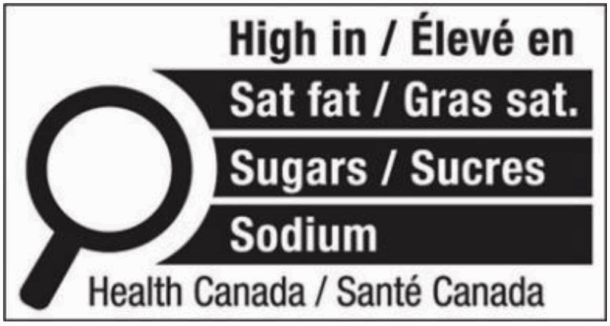
In fact, as of January 1, 2026, most prepackaged foods that are high in saturated fat, sugars or sodium will be required to display a front-of-package nutrition symbol (the “Symbol”).


What is needed now?
Manufacturers must now determine whether their products require the black-and-white Symbol and ensure that the Symbol displayed meets the new format requirements.
What will be required over time?
In most cases, the threshold for packaged foods is 15% of the daily value for each relevant nutrient in a serving size.
Despite this, the legislature has provided for some important exemptions, including:

1. Technical exemptions for foods such as those sold at farmers’ markets and raw, single-ingredient meats, poultry and fish, and certain products with very small packaging, such as single serving coffee creamers.

2. Health related exemptions for foods recognized as having health benefits, including whole or cut fruits and vegetables, 2% and whole milk, and eggs, or any combination of exempt “healthy foods”.

3. Practical exemptions for foods where the Symbol would be redundant, such as packages of sugar, honey, maple syrup, table and flavoured salt, butter and other fats and oils.

Additional exemptions include foods with special dietary uses such as meal replacement and nutritional supplements and infant formula and foods.

What will this look like come January 1?
Soon, many grocery items will feature the Symbol with a magnifying glass to “call out” products that are high in saturated fat, sugars, sodium, or any combination of these. It of course remains to be seen whether manufacturers implement the new Symbol in a timely and effective manner, whether it will affect how Canadians shop and eat and how penalties will be meted out for those traders who do not comply.

Photo of Marie Lussier of Fogler Rubinoff LLP Marie Lussier of Fogler Rubinoff LLP

Marie’s practice extends to all facets of branding and advertising law, and her expertise lies in helping businesses acquire, manage and defend their trademarks in Canada and abroad.

Marie has worked with and managed the international trademark portfolios of many of Canada’s largest…

Marie’s practice extends to all facets of branding and advertising law, and her expertise lies in helping businesses acquire, manage and defend their trademarks in Canada and abroad.

Marie has worked with and managed the international trademark portfolios of many of Canada’s largest corporations and the Canadian portfolios of some of the world’s largest trademark owners. She is ranked as a leading trademark lawyer by both World Intellectual Property Review and WTR 1000 – the World’s Leading Trademark Professionals.

Marie is a member of the Institute of Intellectual Property of Canada (IPIC). She served for several terms as an instructor in its trademark agent training course and for two terms on the committee charged with administering the trademark agent examination. She is also the former Director of the McGill-IPIC course on Managing Trademark Disputes. Marie is also actively involved with the International Trademark Association (INTA). She has worked on several of its committees, including the Trademark Reporter Committee, the Building Bridges Committee, and is a former co-chair of the Law and Practice North America Subcommittee of the INTA Bulletin. In 2021, she was appointed to the Trademark Examining Board of the newly created College of Patent Agents and Trademark Agents.

Marie is fluent in both French and English and has studied and worked in both languages. She received a B.Sc. in 1987 from Queen’s University, specializing in Life Sciences. She then attended McGill University and obtained her common and civil law degrees in 1991. While at McGill, she was Comments Editor of the McGill Law Journal. Subsequently, as part of her articles, Marie clerked with Madam Alice Desjardins of the Federal Court of Appeal.

Read more about Marie Lussier of Fogler Rubinoff LLPEmailMarie's Linkedin Profile
Show more Show less
  • Posted in:
    Food, Drug & Agriculture
  • Blog:
    ILN IP Insider
  • Organization:
    International Lawyers Network
  • Article: View Original Source

Call us at 1-800-913-0988 or email sales@lexblog.com.

Facebook LinkedIn Twitter RSS
The Library at LexBlog
  • About LexBlog
  • The Field We Built
  • Library at LexBlog
  • Our Beliefs
  • Our Team
  • Contact LexBlog
  • Disclaimer
  • Editorial Policy
  • Terms of Service
  • Get Started
  • Publishing Solutions
  • Compass
  • Submit a Request
  • Support Center
  • System Status
Copyright © 2026, LexBlog, Inc. All Rights Reserved.
Law blog design & platform by LexBlog LexBlog Logo