

Lawyers face constant distractions that hinder productivity. Deep work, a concept introduced by Cal Newport, involves focused, distraction-free time spent on challenging tasks. For attorneys, this means concentrating on activities like drafting legal briefs or conducting research, rather than shallow tasks like answering emails.
Here’s why deep work matters for lawyers:
- Interruptions reduce productivity by up to 40%.
- Focused work can achieve in 4 hours what might otherwise take a week.
- Deep work improves accuracy, efficiency, and prevents burnout.
How to start building deep work habits:
- Schedule focus blocks: Reserve mornings for high-priority tasks.
- Create a distraction-free workspace: Silence notifications and declutter.
- Batch administrative tasks: Group emails and similar tasks to avoid interruptions.
- Prioritize impactful work: Use the 80/20 rule to focus on tasks that matter most.
- Use technology wisely: Automate repetitive tasks and centralize workflows with legal practice software.
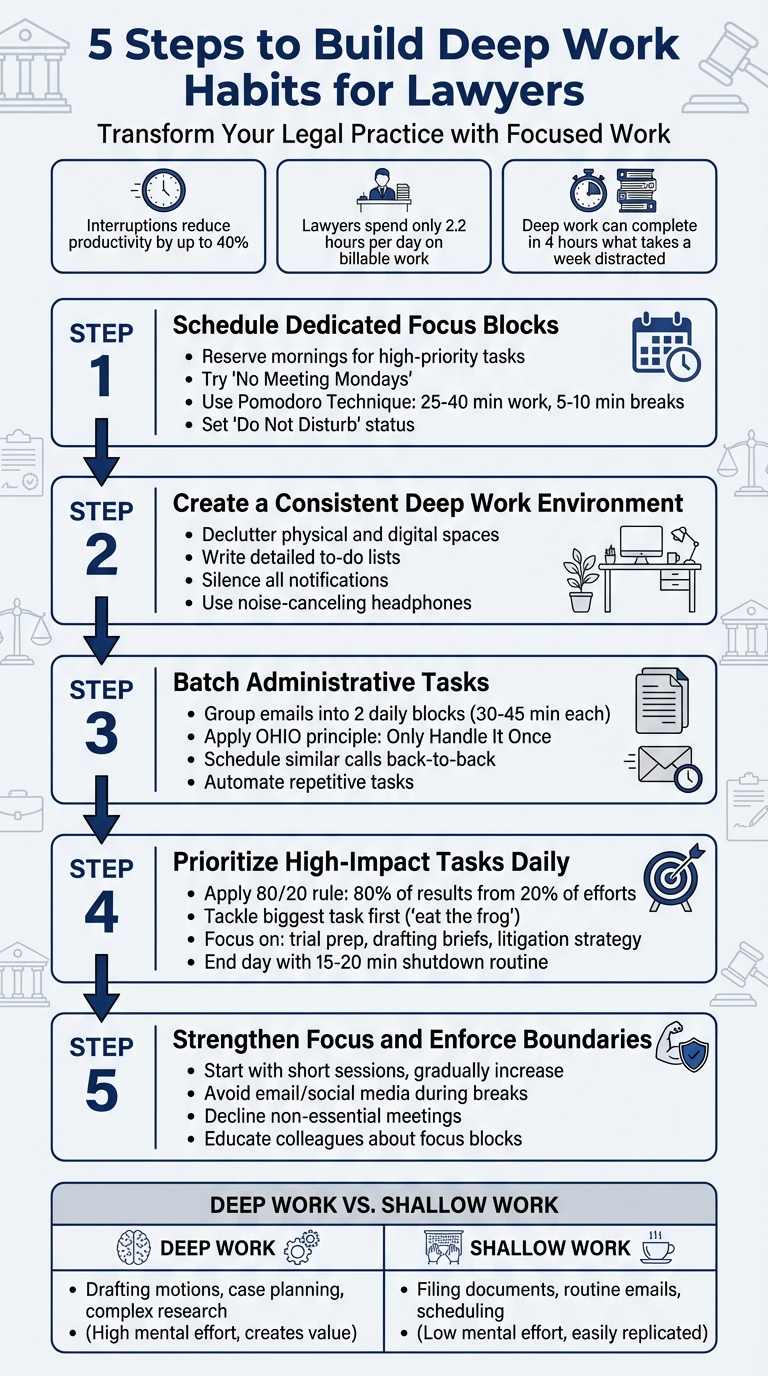
5-Step Guide to Building Deep Work Habits for Lawyers
What Deep Work Means for Lawyers
Deep Work Defined for Legal Professionals
For lawyers, deep work means dedicating distraction-free focus to demanding tasks like crafting legal arguments, drafting intricate contracts, or conducting in-depth legal research. It’s about slowing down to tackle complex problems, whether it’s planning litigation strategy or writing a persuasive summary judgment motion.
On the other hand, shallow work includes routine, lower-effort tasks like responding to emails, entering data, or scheduling hearings.
Deep work is focused, distraction-free concentration on complex legal tasks – it unlocks mastery of challenging concepts and high-quality outcomes.
| Work Type | Characteristics | Legal Examples |
|---|---|---|
| Deep Work | High mental effort, distraction-free, creates new value, difficult to replicate | Drafting legal motions, strategic case planning, complex research |
| Shallow Work | Low mental effort, logistical, easily replicated, often done with distractions | Filing documents, routine emails, scheduling hearings |
Recognizing the difference between these two types of work is the first step toward incorporating deep work into your legal routine.
How Deep Work Improves Legal Practice
Beyond its definition, deep work offers tangible benefits that can transform how lawyers approach their daily responsibilities. By cultivating deep work habits, attorneys can enhance accuracy, efficiency, and even job satisfaction. Focused work helps eliminate “attention residue” – the mental drag caused by frequent task switching – which can save up to 40% of your productive time.
For example, deep work allows tasks that might otherwise take 100 hours of distracted effort to be completed in just 45 hours of focused concentration. Attorney Gary Miles shared his experience:
Each interruption didn’t just cost the time of the interruption – it required additional time to regain focus on the original task. This pattern was destroying my productivity and draining my energy.
In addition to improving productivity, deep work can combat burnout by reintroducing the intellectual challenges that inspire many lawyers to pursue the profession in the first place. It can make daily tasks feel more engaging and provide a sense of purpose, reinvigorating the practice of law.
sbb-itb-95f4849
How to Build Deep Work Habits as a Lawyer
Building deep work habits takes deliberate effort and a thoughtful approach to structuring your day. Here’s a practical guide to help you integrate focused work into your legal practice.
Step 1: Schedule Dedicated Focus Blocks
Successful lawyers protect their time by prioritizing high-impact tasks. Start by scheduling deep work during your most productive hours – usually in the morning when your mind is sharp. Reserve afternoons for less demanding tasks like emails and meetings.
You can also set aside specific “no-meeting” times, like “No Meeting Mondays”, to create uninterrupted workdays. For example, in May 2024, Relativity’s marketing team introduced “Meeting-Free Monday Mornings”, blocking calendars from 7:00 a.m. to 12:00 p.m. to give employees a head start on the week without interruptions.
To maintain focus, try the Pomodoro Technique: work in 25–40 minute bursts, followed by 5–10 minute breaks. Jay Harrington, founding partner at Latitude Legal, offers this perspective:
Work is like fitness – it’s best done in short bursts of intensity, followed by periods of rest and recovery. So start the day with a sprint.
Set clear boundaries to protect your focus. Update your email or chat status to indicate you’re unavailable, and provide an “emergency only” contact for urgent matters. Once your schedule is locked in, the next step is creating a workspace that supports deep focus.
Step 2: Create a Consistent Deep Work Environment
Your environment plays a huge role in your ability to concentrate. Start by decluttering both your physical and digital workspaces. Clear your desk, organize files, and use shortcuts to minimize distractions. Adjust your monitor settings to go to sleep after a few minutes of inactivity, reducing the temptation of incoming emails. Paul H. Burton, a time management expert, highlights the importance of quiet:
Focus requires a quiet space, internally and externally – and the internal and external worlds are noisy places.
Before diving into deep work, write a detailed to-do list to combat the “Zeigarnik effect”, where unfinished tasks linger in your mind. Silence notifications and consider noise-canceling headphones to block out distractions in busy environments.
With a distraction-free workspace, you’ll be better equipped to handle administrative tasks efficiently, which brings us to the next strategy.
Step 3: Batch Administrative Tasks to Reduce Interruptions
Lawyers spend only about 2.2 hours (28%) of an eight-hour workday on billable work. Constant task-switching can slash productivity by up to 40%. To combat this, group administrative tasks into dedicated time slots.
Set aside two 30- to 45-minute blocks each day for emails. Use the OHIO principle (“Only Handle It Once”) to quickly delete, delegate, respond, or defer messages. Similarly, batch similar tasks – like scheduling back-to-back calls on low-energy days, such as Friday afternoons. As Jay Harrington explains:
Variety may be the spice of life, but it’s a productivity killer. So when I’m writing, I want to write. And if I’m connecting with people on calls, I want to connect.
Leverage tools like The Legal Assistant to automate repetitive tasks, such as document generation and billing management. This reduces manual work, freeing up time for more focused efforts.
Step 4: Prioritize High-Impact Tasks Daily
To make the most of deep work, focus on tasks that require your full attention and deliver the greatest value. The Pareto Principle (80/20 rule) suggests that 80% of results come from 20% of your efforts. Identify high-priority tasks each morning, such as preparing for trial, drafting briefs, or devising litigation strategies. As Mark Twain once said:
If it’s your job to eat a frog, it’s best to do it first thing in the morning. And if it’s your job to eat two frogs, it’s best to eat the biggest one first.
End your day with a short shutdown routine. Spend 15–20 minutes reviewing emails, setting priorities for the next day, and tying up loose ends. This helps you mentally disconnect and start fresh the next day.
Step 5: Strengthen Focus and Enforce Boundaries
Focus is like a muscle – it grows stronger with practice. Start with shorter deep work sessions and gradually increase their length as your concentration improves. During breaks, steer clear of email or social media to avoid breaking your flow. The average American checks their phone every 10 minutes, so staying disciplined takes effort.
Protect your focus time by setting firm boundaries. Decline meetings that don’t align with your priorities and educate colleagues and clients about your focus blocks. With communication errors accounting for over 40% of LAWPRO claims in many legal practice areas, uninterrupted work time isn’t just about productivity – it’s essential for accuracy and quality in your practice.
Using Technology to Support Deep Work
The right tools can safeguard your focus time. Technology plays a key role in supporting deep work by cutting down on administrative hurdles. On average, lawyers lose 4 to 6 hours daily to non-billable tasks, and constant task-switching can drain up to 40% of productivity. Legal practice management platforms like The Legal Assistant help reclaim this lost time by automating repetitive tasks and consolidating workflows into one streamlined system.
Automating Repetitive Tasks
Automation can be a game-changer for lawyers aiming to focus on deep, meaningful work. For instance, instead of manually drafting NDAs or lease agreements, you can use workflow templates to generate customized documents in seconds. The Legal Assistant’s document automation tools take care of these repetitive tasks, freeing up valuable hours for more complex legal analysis.
Billing automation is another major time-saver. With the average lawyer logging just 2.9 hours of billable work in an 8-hour day, and the median “total lockup” period for unbilled or unpaid work sitting at 93 days, automating billing can make a huge difference. The Legal Assistant tracks billable hours automatically and generates invoices, eliminating the need for manual entries that disrupt focus. As productivity expert David Allen puts it:
Your mind is for having ideas, not holding them.
By shifting deadlines and billing tasks into a reliable system, you can minimize interruptions and better protect your deep work time.
Using Customizable Calendars for Focus Blocks
Customizable calendars in The Legal Assistant allow you to carve out and safeguard focus periods. You can organize your schedule by case, view key deadlines at a glance, and block off dedicated time slots for specific tasks. This approach ensures that other responsibilities don’t encroach on your deep work sessions.
Reducing Interruptions with Centralized Management
Centralizing your workflow is another way to cut down on distractions. Bryce Tarling highlights the issue with juggling multiple apps:
Every hop from email to spreadsheet to billing system to Word document creates re-orientation time and raises the odds that something falls through the cracks and never gets billed.
The Legal Assistant consolidates essential functions – like email, task management, billing, and document generation – into one platform. This centralization reduces the need to switch between tools, helping you stay focused. In fact, using a single practice management system can recover up to 9% of annual work time, directly supporting the sustained concentration required for deep legal work.
Conclusion
Developing strong deep work habits is crucial for navigating the challenges of today’s legal profession. With 80% of legal professionals experiencing burnout in the last year and the average lawyer dedicating only 2.2 hours of an eight-hour day to billable work, it’s clear that a shift in approach is needed. Setting aside focused time, minimizing distractions, and adopting effective deep work techniques can make a significant difference.
The good news? Deep work is a skill you can build. Begin with manageable 25-minute sessions and gradually extend them to 90 minutes. Simple physical signals, like closing your office door or wearing headphones, can help reinforce your focus. Prioritize your most mentally demanding task early in the day when your energy is at its peak. As Michael Kruse from Kruse Law Firm emphasizes:
To produce more, you must stop believing that you are a good multi-tasker.
Technology should be an ally in this process, not a hindrance. Tools like The Legal Assistant can streamline workflows, reduce unnecessary app-switching, and allow you to focus on higher-value tasks like legal analysis. By integrating such tools with deep work habits, you can make the most of your time.
Lawyers who embrace deep work don’t just increase their billable hours – they deliver higher-quality results, avoid burnout, and reconnect with their passion for the law. Start small: block out your first deep work session for tomorrow, limit email distractions, and let automation take care of repetitive tasks. These steps will benefit both your practice and the clients you serve.
FAQs
How long should my deep work blocks be?
Deep work blocks for lawyers are most effective when kept to about four hours daily. Studies indicate this time frame strikes a balance – enabling professionals to sustain focus and accomplish meaningful work without overexerting themselves. While it’s possible to build up to longer sessions over time, four hours is often ideal for tackling complex, high-priority tasks in a setting free from interruptions.
How do I protect focus time with clients and colleagues?
To preserve your focus time, start by setting clear boundaries and scheduling specific blocks dedicated to deep work. Let your colleagues and clients know about these times to reduce distractions like unexpected calls or emails. A helpful strategy is creating a daily “strike list” of your most important tasks to keep your efforts purposeful. Protecting these focus periods allows you to tackle high-priority work effectively while ensuring your productivity remains intact.
What tasks should I automate to free up deep work time?
Automating repetitive, non-billable tasks – like administrative duties, client intake, conflict checks, case management, legal calendaring, and billing – can free up time for deep, focused work. By incorporating legal workflow automation, you can significantly cut down on the hours spent on these routine activities. This shift allows you to dedicate more energy to high-value, mentally intensive tasks. Focusing on automating administrative and practice management workflows not only boosts productivity but also helps you maximize your billable hours.
The post How Lawyers Build Deep Work Habits appeared first on The Legal Assistant.