

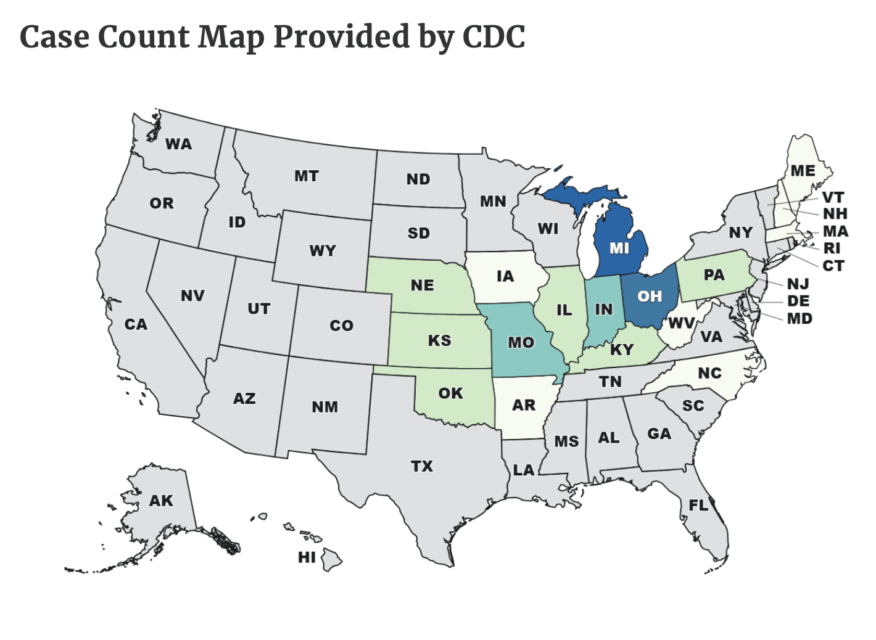
The fifty state health departments now report 29,912 cases of cyclosporiasis this season, up 114 from yesterday. Ohio confirmed 4,949 and Florida moved to 407. The states are the smaller story tonight. The federal outbreak grew by half in a single update.
FDA updated on August 13 for the first time since August 5, and the outbreak it describes is now 9,481 illnesses and 398 hospitalizations across seventeen states. Eight days ago, it was 6,358 and 278 across fifteen. That is 3,123 more people and 120 more hospitalizations added in one update. Maine and Massachusetts joined the list.
That figure answers a question I get asked constantly and nobody publishes an answer to. Of all the cyclosporiasis in the country this season, how much do the federal agencies actually attribute to Taylor Farms? The answer is 9,481 cases, and what it means depends entirely on which denominator you put under it. It is 68 percent of CDC’s 13,895 domestically acquired laboratory-confirmed cases. It is 62 percent once the travel cases are added. It is 39 percent of the 24,350 confirmed and awaiting investigation. And it is 32 percent of the 29,912 the states themselves are publishing.
The hospitalizations say the same thing from another angle. FDA attributes 398 to this outbreak against CDC’s 740 nationally, a little over half. Both deaths are attributed. And 4,414 confirmed domestic cases this season are not part of this outbreak at all — CDC states plainly that it is investigating other clusters from other sources, and that sentence has been on its page since July.
Two cautions before anyone runs with those percentages, and they cut in opposite directions. The first is that the attribution is epidemiological, not laboratory. The case definition is people who reported eating processed Taylor Farms de Mexico iceberg lettuce at various points of sale, including those who reported eating at Taco Bell. There is no whole genome sequencing for this parasite, and CDC says so on its own surveillance page, so no patient isolate has been matched to a product isolate because the tool does not exist. Nor has any product sample tested positive. The July 18 border sample was withdrawn as a false positive the next day, and FDA has only now begun sampling inside the Doctor Mora plant. The entire 9,481 rests on traceback and interviews.
The second caution is the one people skip. The 20,431 cases outside the attribution are not evidence of a second source. Most of them are cases nobody has interviewed yet, cases awaiting laboratory confirmation, and probable cases the states count and CDC does not. That is the six-week lag doing exactly what CDC says it does. I do not know how that pile breaks down and neither does anyone else, and the honest expectation is that the attributed share keeps rising as the interviews catch up.
Seventeen states have attributed cases. Thirty-one states have confirmed distribution of the recalled lettuce, and for the first time all seventeen outbreak states appear on that list — West Virginia had been missing from it for weeks. Nine more states and territories are named as places the product may have reached.
That leaves fourteen states that received the recalled lettuce and have no attributed cases at all: Alabama, Connecticut, Florida, Georgia, Louisiana, Maryland, Mississippi, New Jersey, New York, South Carolina, Tennessee, Texas, Virginia and Wisconsin. Twelve of them publish a cyclosporiasis count, and those twelve add to 2,174 cases this season. The other two, Mississippi and South Carolina, publish nothing at all. I am not saying those 2,174 people ate this lettuce. I am saying that fourteen states got the product, at least 2,174 of their residents have cyclosporiasis, and so far, as I can find, nobody has publicly asked whether any of them are connected.

Two things in the new advisory matter more than the count. FDA says it has begun an onsite inspection and sampling at Taylor Farms de Mexico, working with Mexican officials — the first report of inspectors inside the Doctor Mora plant in this outbreak, twenty-seven days after the recall and about seven weeks after the median patient was exposed. And FDA now states plainly that customer information from the firm shows recalled product was sold to consumers in Mexico. I have been asking whether Mexican consumers were ever told.
The distribution list grew too, and it fixed something. FDA now names thirty-one states where distribution is confirmed, up from twenty-seven, adding Maine, New York, Nebraska and Virginia — and West Virginia, which had been missing from the distribution record for weeks while appearing on the outbreak list. Nine more places are named as possible: California, Delaware, North Dakota, Rhode Island, South Dakota, Vermont, Washington, the District of Columbia and Puerto Rico. CDC’s national surveillance page is unchanged at 13,895 laboratory-confirmed plus at least 10,455 awaiting further investigation, a total of 24,350 with 740 hospitalizations, across 47 states plus the District of Columbia and Puerto Rico.
CDC’s investigation page carries the same figures: 9,481, 398 hospitalizations, two deaths, seventeen states with two of them new. The two agencies are aligned on this outbreak, which has not always been true this summer and is worth saying when it is.
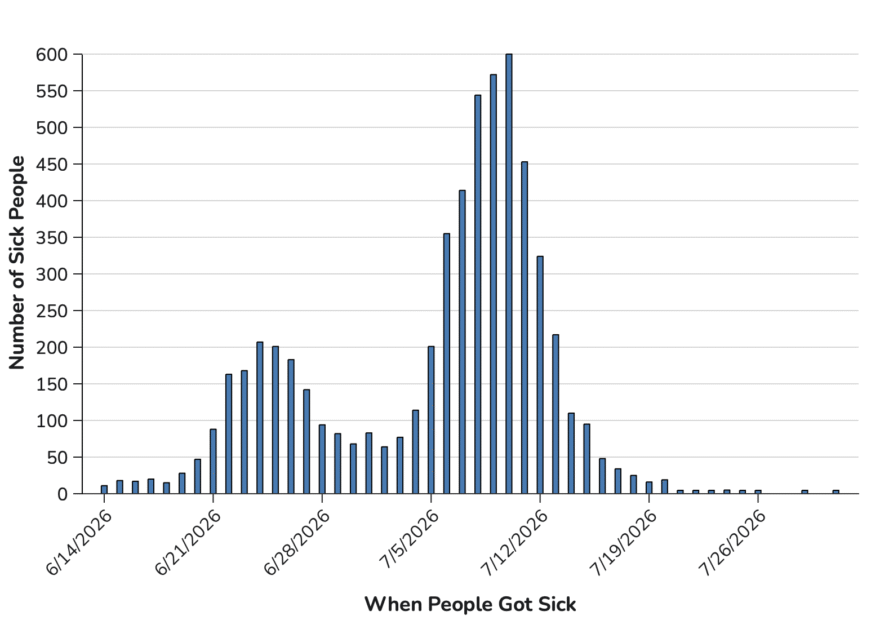
CDC’s national surveillance page is a different count and has not moved since Tuesday: 13,895 laboratory-confirmed cases acquired in this country since May 1, 740 hospitalizations, two deaths, across 47 states plus the District of Columbia and Puerto Rico, with data through August 10. The comparison CDC prints beside it is the one to remember. Between May 1 and August 31 of last year, the entire country reported 1,180 cases. This season is at 13,895 with eighteen days still to run.
That page also carries a series this chart has never included and probably should mention. On top of the 13,895 acquired in the United States, another 1,530 laboratory-confirmed cases were acquired abroad this season, with 58 more hospitalizations, reported by 46 states. Those are travel cases and they are not this outbreak, which is exactly why I leave them out of the fifty-state floor. Add them anyway and CDC is carrying 15,425 confirmed cases and 798 hospitalizations. The patients in the domestic group ranged in age from one to ninety-eight, median forty-five, and 57 percent were women. The median illness onset was July 7.
The thirteen states that publish a hospital figure now total 735 between them, after Michigan moved from 279 to 314. CDC’s national surveillance, updated August 11, reports 740 hospitalizations among its laboratory-confirmed cases.
The last column of this chart is that state’s entire 2025 total from CDC’s weekly notifiable-disease tables, which is a different series from the state figures beside it. It counts travel-associated cases and covers a full calendar year against a season still running.
| State | 2026 cases | As of | All of 2025 | Lettuce |
| Michigan | 13,909 | Aug 13 | 50 | Yes |
| Ohio | 4,949 | Aug 6 | 76 | Yes |
| Indiana | 1,893 | Aug 10 | 27 | Yes |
| Missouri | 1,577 | Aug 9 | none reported | Yes |
| Illinois | 995 | Aug 4 | 301 | Yes |
| North Carolina | 906 | Aug 11 | 300 | Yes |
| New York | 898 | Aug 10 | 694 | Yes |
| Kansas | 748 | Aug 12 | 29 | Yes |
| Kentucky | 620 | Jul 29 | 45 | Yes |
| Oklahoma | 506 | Aug 11 | 41 | Yes |
| Florida | 407 | Aug 8 | 210 | Yes |
| West Virginia | 296 | Aug 11 | 8 | Yes |
| Arkansas | 252 | Aug 10 | 13 | Yes |
| Iowa | 226 | Jul 30 | 64 | Yes |
| Nebraska | 218 | Aug 6 | 51 | No |
| Wisconsin | 216 | Aug 5 | 65 | Yes |
| Texas | 198 | Aug 5 | 512 | Yes |
| Virginia | 197 | Aug 10 | 115 | Yes |
| Colorado | 150 | Jul 17 | 205 | No |
| Massachusetts | 145 | Aug 5 | 74 | Yes |
| Alabama | 85 | Aug 3 | 19 | Yes |
| Pennsylvania | 82 | Jul 29 | not notifiable | Yes |
| Maryland | 69 | Jul 17 | 123 | Yes |
| New Hampshire | 69 | Aug 4 | 7 | Yes |
| New Jersey | 46 | Jul 11 | 180 | Yes |
| California | 41 | Jul 14 | not available | No |
| Minnesota | 41 | Jul 17 | none reported | No |
| Washington | 36 | Aug 7 | not available | No |
| Connecticut | 35 | Jul 17 | 41 | Yes |
| Maine | 27 | Aug 7 | 4 | No |
| Oregon | 23 | Jul 24 | not available | No |
| Arizona | 19 | Jul 17 | 49 | No |
| Georgia | 11 | Jul 17 | 116 | Yes |
| Tennessee | 11 | Jul 17 | 38 | Yes |
| Alaska | 5 | Jul 16 | 6 | No |
| Rhode Island | 4 | Jul 17 | 6 | No |
| Louisiana | 1 | Jul 17 | 99 | Yes |
| Utah | 1 | Jul 17 | 37 | No |
| Delaware | no count published | — | 1 | No |
| Hawaii | no count published | — | not available | No |
| Idaho | no count published | — | not notifiable | No |
| Mississippi | no count published | — | not notifiable | Yes |
| Montana | no count published | — | 8 | No |
| Nevada | no count published | — | not notifiable | No |
| New Mexico | no count published | — | 9 | No |
| North Dakota | no count published | — | 4 | No |
| South Carolina | no count published | — | 45 | Yes |
| South Dakota | no count published | — | 3 | No |
| Vermont | no count published | — | 3 | No |
| Wyoming | no count published | — | 0 | No |
| All fifty states | 29,912 | 50 |
29,912 is a floor, not an estimate. It is the sum of what fifty health departments have published, on schedules running from weekly to never, with four states reporting only a range that I count at the bottom. Where a state publishes two series, I use the one this chart has always used: for Florida that is the since-May-1 figure of 407 rather than the calendar-year total, and for New York the since-May-1 figure of 898 rather than 932. Ohio and Iowa and Kansas and Arkansas are calendar-year, because that is the series those states publish.
Most people with cyclosporiasis never get a stool test, because the parasite is missed by the routine ova and parasite exam and has to be requested by name, and because people with a diarrheal illness that comes and goes for a month often never see a doctor. The standard estimate of that gap comes from Scallan and colleagues, Foodborne Illness Acquired in the United States, Major Pathogens, in Emerging Infectious Diseases in 2011, which puts the underdiagnosis multiplier for Cyclospora at 83.1. Applied to CDC’s 13,895 laboratory-confirmed cases, that puts the real number near 1,155,000.
This chart crosses 30,000 tomorrow or the day after. It stands 88 short tonight, and West Virginia posts Friday, Missouri Sunday, Arkansas and Virginia Monday, CDC and North Carolina and Oklahoma Tuesday, Kansas and New York next Wednesday. Any one of them does it. Watch the federal number too: FDA added 3,123 cases in a single update after eight days of silence, and if that is the new cadence the outbreak figure will keep arriving in lumps that look like surges and are not.
The season closes on August 31, eighteen days from today. Inspectors are in the plant. The counting does not stop either way.