

By Louis Lehot. Market data as of the August 21, 2026 close.
The sun was dropping behind the Ferry Building when the question got asked. After two years of a closed IPO window, is it open? And if so, are you ready?
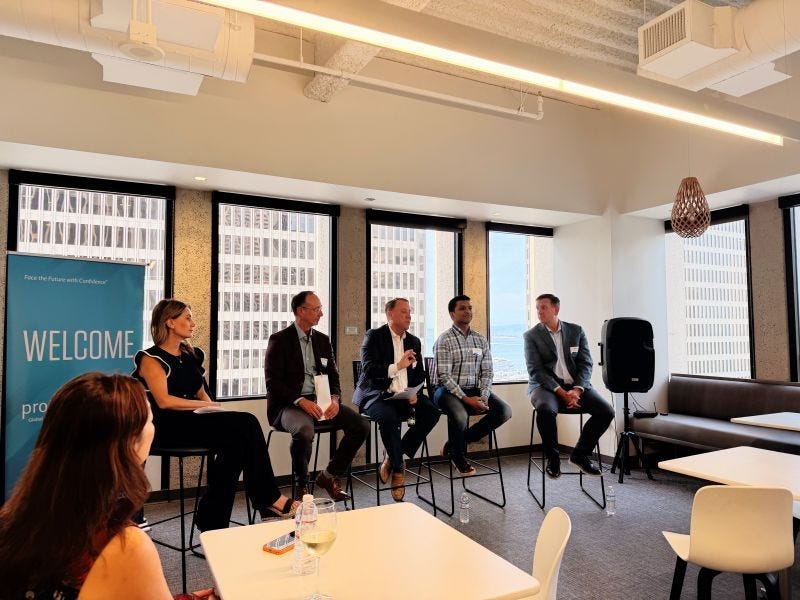
That was the premise of a panel at Protiviti’s San Francisco office, moderated by Golreez Naderi of Protiviti. Garett Poston of BMO Capital Markets covered banking, Yogi Goel of Maxima operations, Jeff Meyer of Protiviti systems and controls. I covered the legal bits. The room was CFOs, investors, bankers, and advisors, almost all preparing for something. Whether they had started is the question.
You do not control timing
People ask whether 2026 is about readiness or timing. Wrong question. The market chooses the timing.
This year proved it twice. In mid-March a week passed with no IPOs scheduled. The window closed in days. Then the second quarter blew it open. SpaceX raised $85.7 billion on June 12, including the greenshoe, more than every U.S. IPO of the prior two years combined. EY puts first-half U.S. IPO proceeds at $128 billion, up 646 percent year over year. Without SpaceX, Renaissance Capital notes, the quarter was still the biggest since 2021.
Now look at August 21. SpaceX closed at $136.97, barely above its $135 offer price after spending much of August below it, and about 39 percent off its June high, with lock-ups still unwinding. Cerebras closed near $210, above its $185 offer but about 45 percent below its May peak. Lyntris priced below range Wednesday. Anthropic is targeting a year-end listing; OpenAI is reportedly weighing 2027. The window is open but pricing harder than in June.
The private side set records too. PitchBook and NVCA count $412.7 billion of U.S. venture investment in the first half, more than all of 2025, 86 percent of it in AI. Secondaries, tenders, and continuation funds remain the liquidity source for everyone else.
Garett’s point was simple. Investors will buy a good company at a fair price, but each cohort of IPOs has to trade well for the next to get out. PitchBook counted 44 venture-backed IPOs through July against 50 in all of 2025, and the summer aftermarket is the kind that makes the next cohort wait. The recovery is real, narrow, and fragile.
The open window is misleading
2026 is on pace to be the biggest year for IPO proceeds on record. The headline hides a longer trend. The number of U.S. public companies has fallen about 40 percent since the 1990s. Most CEOs would rather do almost anything than take on the reporting burden. The SEC Chair said as much in April, calling the IPO the financing option of last resort. Companies try everything else first. That is backwards, and it is the market we have.
One attendee argued the system’s incentives are structurally bent against going public. Nobody on the panel could argue with that. That is usually the sign of a room working.
The IPO is one option among many
Most CFOs were taught one path. The menu is longer once you are public. Follow-ons on Form S-3 are the main tool, so protect your eligibility: below $75 million of public float, you lose your shelf. PIPEs are fast but come at a discount; use one to bridge an event, not as a habit. Convertibles get cheaper the day rates fall.
The rule I gave the room: pick the product based on your news calendar, not how much you need. Map the next eight quarters of events, then choose the instrument. Pick the product first and you usually end up with neither.
SPACs are back, with rules
SPACs are back in volume. PwC counts 118 SPAC IPOs raising about $20.9 billion in the first half, the most since 2021. This cycle has a rulebook. Under the SEC’s 2024 rules the target is a co-registrant with IPO-level disclosure, including projections. Nasdaq raised its listing standards in 2025. The 2021 shortcuts are gone. The results remain sobering: roughly 80 percent of recent de-SPACs trade below trust value within a year.
What is left is a useful tool for cross-border businesses and complex companies with real revenue that a roadshow cannot explain. My test has not changed: if a company could not survive as an IPO, it should not do a de-SPAC.
Readiness is a company problem, not a finance problem
Yogi has taken a company public. The value, he said, was never the bell-ringing. It was the discipline the process forced eighteen months out. Jeff added that most companies treat readiness as a finance problem. It is a whole-company transformation, and by the time they see that, it is too late.
Close the books in days. Build controls that survive a quarter-end without a scramble. Hire people who have done it.
The survey data is not flattering. In Accordion’s survey, 60 percent of private equity sponsors think a quarter or more of their portfolio could go public within three years. Fewer than 20 percent of their portfolio CFOs are preparing. Sponsors expect readiness in six to twelve months; the CFOs building it say twelve to twenty-four. That gap costs sponsors money when the window opens.
The best question came from the floor. Why is readiness only discussed once a company is IPO-track? Operational discipline should be the standard years earlier, whatever the exit. I agree. Every company in that room will need a banker eventually and a lawyer always. What most realize too late is that they also need someone doing the work in between: the systems, controls, and infrastructure that must exist long before anyone talks to the market. That is the difference between being ready when the window opens and finding out you were not.
What “file ready” means
The standard we use with clients is file-ready every day of the year: able to execute any transaction, public or private, without a year of cleanup.
The list is specific. A clear path to $100 million in revenue. Eight quarters of documented growth and a credible view of the next eight. Gross margins above 40 percent. Two years of clean audits. A public-company CFO and a public-company GC, hired early. A majority-independent board with a seasoned audit chair. An equity story an investor, an acquirer, and a lender would all accept.
This is not only about an IPO. A company ready to go public is a better acquisition target, gets better secondary terms, and has more leverage with lenders. Readiness keeps every option open.
The costly mistakes are ordinary ones
Golreez asked about the most expensive mistakes. Every panelist gave the same answer: ordinary, found late.
A cap table nobody has reconciled since the Series B. Option grants with missing paperwork. A founder who never signed an IP assignment. Related-party deals that were fine among three investors and are not in a proxy statement. A round where one tranche closed at $200 million and the next at $500 million three weeks later, and no one can say why.
None kills a deal. All cost time and leverage when you have the least of both. Buyers and underwriters discount you not for what they find but for what they cannot verify.
The advice
After 25 years of taking companies public, the lesson never changes. Optionality beats perfection. Liquidity beats price. Readiness beats hope. The companies that do best do not start preparing when the window opens. They never stopped.
Thanks to Protiviti, Robert Half, and my fellow panelists. Our 2026 IPO e-book, Recent Insight into the IPO Market, goes deeper and is available from Foley.
Louis Lehot is a partner at Foley & Lardner LLP in Silicon Valley, advising growth companies, sponsors, venture funds, and investment banks on public offerings, M&A, de-SPACs, and governance.