

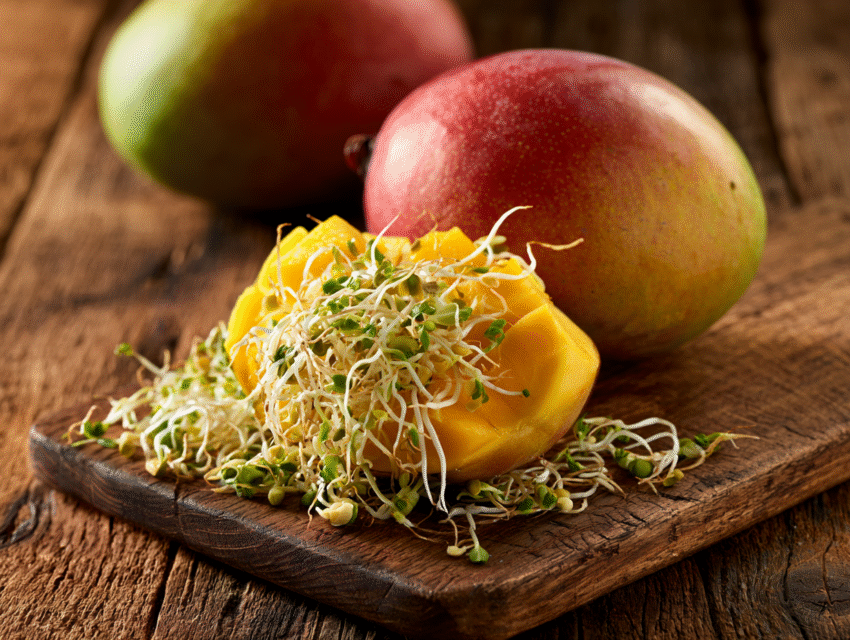
FDA published two produce recall notices on August 29, 2026. Everything Sprouts, LLC of Minneapolis expanded its August 22 alfalfa sprout recall to add Robust Radish Sprout Mix in 5-ounce cups, barcode 087906000075, lots 223, 226, 230 and 233, distributed to wholesale distributors and grocery stores in Minnesota and Wisconsin between August 13 and August 26. Panorama Produce of Mamaroneck, New York recalled 302 boxes of size 9 mangoes sold in Connecticut, New York, New Jersey and Pennsylvania and at select Walmart stores. Neither of the two newly recalled products has been tied to a reported illness. The alfalfa sprouts behind the original recall are tied to 55 illnesses in 15 states.
The sprout recall now covers four products and six lot codes.
Everything Sprouts recalled its alfalfa on August 22 in 5-ounce containers under both the Everything Sprouts and Calco brands, lots 222, 223, 225, 226 and 230, along with two mixed cups the notice said were made with the same alfalfa: Crunchy Protein Sprout Mix and Zesty Garlic Mix. Friday’s notice adds a fourth product. Here is the whole recall in one place.
| Product | Brand | Lot numbers | Distributed |
| Alfalfa Sprouts, 5 oz containers | Everything Sprouts, Calco | 222, 223, 225, 226, 230 | May 27 – Aug 21, 2026 |
| Crunchy Protein Sprout Mix, 5 oz cups | Everything Sprouts | 222, 223, 226, 230 | May 27 – Aug 21, 2026 |
| Zesty Garlic Mix, 5 oz cups | Everything Sprouts | 222, 223, 225, 226, 230 | May 27 – Aug 21, 2026 |
| Robust Radish Sprout Mix, 5 oz cups | Everything Sprouts | 223, 226, 230, 233 | Aug 13 – Aug 26, 2026 |
Source: the Everything Sprouts recall notices published by FDA on August 22 and August 29, 2026. Product-and-lot combinations: 5 + 4 + 5 + 4 = 18. Distinct lot codes across all four products: 222, 223, 225, 226, 230 and 233 — six. The alfalfa carries barcodes 860014523113, 860014523120 and 850079470149; the radish mix carries 087906000075.
Lot 233 is new, and the radish mix shipped four days after the company recalled its alfalfa.
Three of the four radish lots — 223, 226 and 230 — are numbers that also appear on the recalled alfalfa. Lot 233 appears nowhere in the August 22 notice. The distribution window is the part of this worth stopping on. The alfalfa went out from May 27 through August 21 and was recalled on August 22. The company’s own notice says the Robust Radish Mix went out from August 13 through August 26, which is four days after the alfalfa recall published.
The notice does not say why the radish mix was added. It does not say that the recalled alfalfa was an ingredient in it, the way the August 22 notice said plainly that the same alfalfa went into the Crunchy Protein and Zesty Garlic cups. It does not say whether a sample came back positive, whether radish seed is implicated, or whether the two products share a room, a hose, a cooler or a spent irrigation water line. Those are four different problems with four different answers, and a shopper holding a cup cannot tell which one she is looking at.
The expansion notice tells consumers to throw out alfalfa sprouts, which is not the product being recalled.
Read the bottom of Friday’s notice. The consumer paragraph instructs anyone who may have received affected lots of the alfalfa sprouts to dispose of them. The retailer paragraph instructs retailers and distributors to stop selling and distributing the alfalfa sprouts. Robust Radish appears in the headline, in FDA’s summary block and in the first sentence, and then the instructions revert to alfalfa. Someone built the expansion by editing the August 22 notice and did not finish the edit.
That matters more than a typo usually does. A grocery manager who acts on the headline pulls the four radish lots and has done the right thing. A grocery manager who reads to the bottom and acts on the instructions pulls alfalfa he already pulled a week ago and leaves the radish cups on the shelf. Recall notices are operating instructions for people who have thirty seconds. This one contradicts itself inside four hundred words.
FDA’s outbreak advisory still lists three products, and the outbreak count is still fifty-five.
FDA’s outbreak advisory for this investigation was last updated on August 24 and its product section names the alfalfa and the two mix cups. It does not mention Robust Radish Sprout Mix. The case counts on that page are unchanged: 55 people in 15 states, 4 hospitalizations, no deaths, illness onsets from May 31 through August 8, 2026, and confirmed distribution in Minnesota and Wisconsin only. Four organisms in one product — E. coliO26:H11, E. coli O103:H25, E. coli O168:H8, and Salmonella Agona. CDC’s alert page carries the same numbers.
Friday’s notice says no illness has been reported to federal or state agencies in connection with the radish sprout mix. Read that precisely. Nobody has been reported sick from the radish mix. Fifty-five people have been reported sick from sprouts grown by the same company, and the last of those illnesses began on August 8, which is five days before the radish mix started shipping.
The mango recall came out of an FDA sample of fruit that never entered the country.
Panorama Produce of Mamaroneck, New York recalled 302 boxes of size 9 mangoes on August 28. The fruit shipped between August 10 and August 21 to Connecticut, New York, New Jersey and Pennsylvania, and sold in select Walmart stores. The cases are Martina branded. The individual mangoes carry a light blue sticker reading Agrofepac, Produce of Mexico, with PLU 4584 and UPC 07503061948050.
The trigger is the interesting part. FDA sampled mangoes grown on the same farm that were never distributed into United States commerce, and found Salmonella. Because the recalled fruit shares that source, the company pulled it. Nobody had to get sick first. That is the system working the way it is designed to work, and it is worth saying out loud on a weekend when the other recall on this page arrived a week after the outbreak it belongs to was announced.
What the notice does not say: where or when the sample was collected, which serotype of Salmonella was found, where the farm is beyond the Agrofepac name on a sticker, and which Walmart stores. Three hundred and two boxes is a small recall by weight. It is not small by count. Mango sizing runs by fruit per tray, so 302 boxes of size 9 is on the order of 2,700 individual mangoes, and every one of them left the store loose, in a bag, without a package.
The only identifier on a recalled mango is a sticker, and the number on it names a color and a size, not a farm.
PLU codes are administered by the International Federation for Produce Standards. Under the National Mango Board’s chart, 4584 is large green mango, sizes 8 to 10, used mainly for the Keitt and Francis varieties. Every green mango in that size range in every produce department in America carries 4584, whether it came from this farm or a farm two thousand miles away. It is a price look-up code for a cash register. It is not a lot code, it is not a grower code, and it is not traceability.
The identifier that actually narrows this recall to this fruit is the word Agrofepac on a sticker the size of a thumbnail, and the Martina name on a case the shopper never sees. If the sticker came off in the bag, the mango on the counter cannot be identified at all. That is the ordinary condition of loose produce in this country. The rule written to fix it is FSMA 204, and its compliance date now sits in 2028.
Mexican mangoes and Salmonella have a history, and PLU 4584 was on that list too.
In 2012, CDC counted 127 people in 15 states infected with the outbreak strain of Salmonella Braenderup traced to mangoes grown by Agricola Daniella in Sinaloa. Thirty-three of the 101 patients with information available were hospitalized. Canada counted 21 more. California carried 93 of the American cases. FDA put the grower on import alert, and four distributors recalled. I wrote about it at the time, when the recall ran to roughly a million mangoes.
The identifiers in that recall were Daniella brand stickers bearing PLU codes 3114, 4051, 4311, 4584 and 4959. PLU 4584 is on both lists, fourteen years apart, on fruit from two different growers in two different outbreaks. It tells a shopper nothing about either one. That is the point.
Three questions people are asking
I have a cup of Everything Sprouts sprout mix in the refrigerator. What do I do? Check the lot number and the barcode. The radish mix is barcode 087906000075 in lots 223, 226, 230 and 233. The alfalfa, the Crunchy Protein Sprout Mix and the Zesty Garlic Mix are covered in lots 222, 223, 225, 226 and 230. If it matches, or if the label is gone and you cannot tell, throw it out, then wash and sanitize the drawer and anything the package touched. Product distributed through August 26 can still be in a refrigerator this weekend.
I bought a mango at Walmart in the last three weeks. Should I worry? Look for a light blue sticker reading Agrofepac, Produce of Mexico, with PLU 4584. If you still have that fruit, throw it out or return it to the store. If you already ate a mango and you feel fine, you very likely are fine — Salmonella symptoms usually begin 6 to 72 hours after exposure, and the last of this fruit shipped on August 21.
When should I call a doctor, and what should I ask for? Shiga toxin-producing E. coli symptoms begin a few days after exposure and can take up to nine days. Call a doctor for bloody diarrhea, a fever over 102, vomiting that keeps you from holding liquids down, or signs of dehydration. Ask for a stool culture, and ask the laboratory to preserve the isolate. Whole genome sequencing is what connects one person’s illness to an outbreak, and isolates are routinely discarded.
More on this outbreak: the full lot codes and what the August 22 recall covered, the nineteen investigations FDA now has open, and, on Marler Blog, what the first recall notice failed to give a consumer.