

The Centers for Disease Control and Prevention, the U.S. Food and Drug Administration and health officials in several states are investigating a multistate hepatitis A outbreak potentially linked to imported frozen clams: La Serranita-brand concha negra (black shell) shell meat from Ecuador, sold in 16-ounce packages and typically eaten raw or marinated in ceviche. As of September 17, 2026, CDC counts 37 people sick in four states — New York (27), Pennsylvania (4), Massachusetts (3) and Minnesota (3). Thirty of the 37, or 81 percent, have been hospitalized. No deaths have been reported.
Outbreak at a glance
- Illnesses: 37 in four states, as of September 17, 2026
- Hospitalizations: 30 (81 percent)
- Deaths: none reported
- Illness onset dates: July 30, 2025 to June 23, 2026
- Ages: 6 to 40 years; 54 percent male
- Product: La Serranita-brand concha negra (black shell) fresh frozen shell meat from Ecuador in 16-oz. plastic packages, recalled by dealers in New Jersey and New York
- Status: investigation open; traceback ongoing
Where people got sick
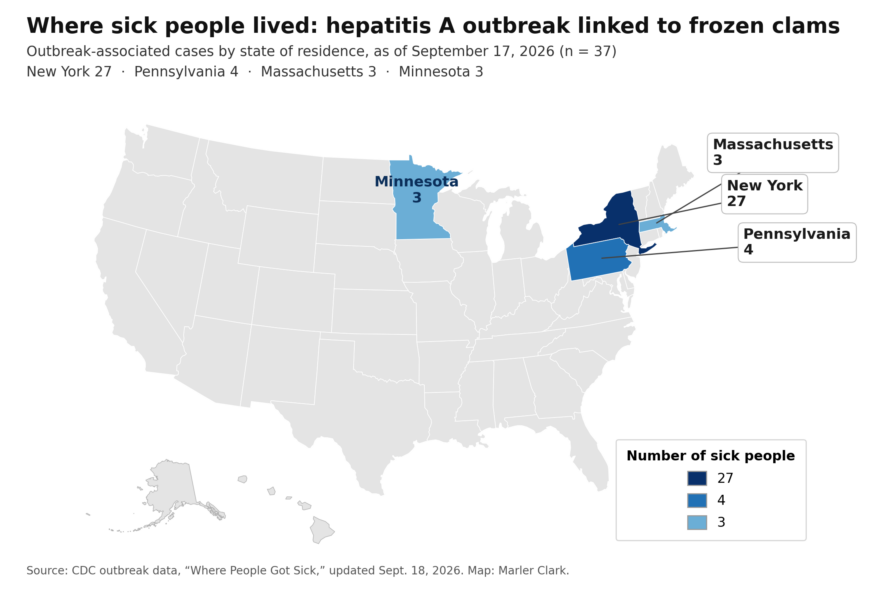
Outbreak-associated cases by state of residence, as of September 17, 2026 (n=37). Data: CDC.
New York accounts for 27 of the 37 illnesses, nearly three-quarters of the outbreak. The rest live in Pennsylvania (4), Massachusetts (3) and Minnesota (3). CDC cautions that the outbreak may not be limited to these four states: some people recover without medical care and are never tested for hepatitis A, and it usually takes weeks to determine whether a new illness belongs to an outbreak. FDA’s alert says the clams were distributed to restaurants and retailers in Connecticut, Massachusetts, New Jersey, New York, Ohio and Pennsylvania and may have been distributed further. Minnesota is not on that list.
When people got sick

Illness onset dates by week, July 30, 2025 through June 23, 2026 (n=37). Data: CDC.
The epi curve stretches across nearly eleven months. The first person became ill on July 30, 2025. Thirty-two of the 37 illnesses began between late July 2025 and mid-February 2026, with the heaviest stretch from November through January, when 20 people got sick. Then came a 74-day gap with no reported onsets. Five more people fell ill after it: one on May 1, 2026 and four in June, the last on June 23, 2026.
Those dates matter. FDA did not publish its safety alert until April 30, 2026, nine months after the first illness, and CDC says its investigation began in May 2026. Five of the 37 people became ill after the alert was issued. Hepatitis A virus survives freezing, as the frozen-berry and frozen-strawberry outbreaks of 2013 and 2016 showed, so a package bought in 2025 and kept in a freezer was as dangerous in June 2026 as the day it was sold. That is why FDA’s alert remains in effect, and CDC notes that recent illnesses may not yet be reported.
What people ate
State and local health officials interviewed sick people about the foods they ate in the 15 to 50 days before they became ill. Of those interviewed, 77 percent reported eating ceviche (raw fish or shellfish marinated in citrus juice), 76 percent reported eating raw or undercooked shellfish, and 47 percent reported eating raw or undercooked conchas negras. Those percentages were significantly higher than what people report in CDC’s FoodNet Population Survey, the comparison that pointed investigators to raw or undercooked clams. Traceback investigations are ongoing to identify the source or sources of the frozen clams.
The recall and FDA’s alert
On April 30, 2026, FDA advised restaurants, retailers and consumers not to serve, sell or eat La Serranita-brand concha negra fresh frozen shell meat from Ecuador. FDA says it was first notified of the outbreak by the New York State Department of Health. The original alert listed distribution in New Jersey and New York only; FDA expanded it on May 22 to six states. Dealers in New Jersey and New York have recalled the product. A New Jersey notice circulated in late April through the Interstate Shellfish Sanitation Conference described the clams as illegally imported from an unapproved source; Ecuador has no molluscan shellfish agreement with FDA. FDA’s alert does not name the importer or the dealers that recalled the product, and as of this writing it still lists onset dates only through February 2026, four months short of CDC’s count.
What to do
If you have La Serranita concha negra shell meat in a freezer, throw it out or return it; do not eat, serve or sell it. Clean and sanitize any surfaces or containers it touched, because food contaminated with hepatitis A looks, smells and tastes normal. If you ate this product raw or undercooked within the last 14 days and are not vaccinated against hepatitis A, contact your local health department or health care provider about postexposure prophylaxis; hepatitis A vaccine or immune globulin can prevent illness if given within two weeks of exposure. Symptoms usually appear two to seven weeks after exposure and include fatigue, fever, loss of appetite, nausea, stomach pain, dark urine, clay-colored stools and jaundice. Anyone with symptoms should contact a doctor.
Marler Clark has followed this outbreak since New York first reported it in April. See our earlier coverage at Marler Blog and the firm’s La Serranita concha negra outbreak page.
Hepatitis A
Here is what makes hepatitis A so maddening: it is entirely vaccine-preventable. A single infected food handler can expose thousands of diners, and a safe, inexpensive vaccine could have stopped it. Marler Clark, The Food Safety Law Firm, is the nation’s leading firm representing victims of hepatitis A outbreaks. Our hepatitis A lawyers have represented thousands of victims in the only U.S. law practice devoted exclusively to foodborne illness, which has recovered more than $850 million for victims and families nationwide. We have traced outbreaks to green onions, lettuce, and restaurant food, and we have brought hepatitis A lawsuits against Costco, Subway, McDonald’s, Red Robin, Chipotle, Quiznos, and Carl’s Jr. We proudly represented the family of Donald Rockwell, who died after eating hepatitis A–tainted food, and Richard Miller, who needed a liver transplant after a meal at a Chi-Chi’s restaurant, in what remains the largest hepatitis A outbreak in U.S. history. For years we have urged restaurants and public health officials to vaccinate food service workers—the simplest, surest way to stop these outbreaks before they start.
If you or a family member became ill with a hepatitis A infection after eating contaminated food, contact the Marler Clark hepatitis A attorneys for a free case evaluation.
FAQ
What is Hepatitis A?
Hepatitis A is a contagious liver infection caused by the hepatitis A virus and spread through the fecal-oral route—often by an infected food handler. It is entirely vaccine-preventable. Symptoms typically appear about 28 days after exposure (range 15 to 50 days) and include fatigue, nausea, abdominal pain, and jaundice.
How is hepatitis A spread through food?
An infected food handler who does not wash thoroughly can contaminate food and expose everyone who eats it. Outbreaks have also been traced to contaminated produce such as green onions, berries, and pomegranate.
Is there a vaccine, and should restaurants use it?
Yes. A safe, effective hepatitis A vaccine exists, and we have long urged that food-service workers be vaccinated—the simplest, surest way to prevent these outbreaks.
How serious can hepatitis A get?
What should I do if I was exposed at a restaurant?
See a doctor promptly; a vaccine or immune globulin shot given within two weeks of exposure can prevent illness. Keep your receipt and any health-department notice.
Additional Resources: