

Effective July 1, 2025, Code Section 17.1-403(ii)(c) expanded the CAV’s authority to dispense with oral argument. Before that date, the statute directed the Supreme Court to adopt rules allowing the CAV to dispense with oral argument “if the parties agree that oral argument is not necessary or if the panel has examined the briefs and record and unanimously agrees that oral argument is unnecessary because (a) the appeal is wholly without merit, or (b) the dispositive issue or issues have been authoritatively decided, and the appellant has not argued that the case law should be overturned, extended, modified, or reversed.”
That posed a problem in practice, because (1) litigants will rarely agree that oral argument is unnecessary, (2) very few appeals are “wholly without merit,” and (3) the whole point of the CAV is to develop the law because Virginia law has not “authoritatively decided” many issues (because until 10 minutes ago, it did not have an intermediate appellate court of general jurisdiction.
So the CAV soldiered along, overworked and understaffed, and heard an awful lot of arguments in cases that maybe could have been resolved with them.
But then in 2025, the General Assembly amended Code Section 17.1-403, to read as follows:
The rules shall prescribe procedures (i) authorizing the Court of Appeals to prescribe truncated record or appendix preparation and (ii) permitting the Court of Appeals to dispense with oral argument if the parties agree that oral argument is not necessary or if the panel has examined the briefs and record and unanimously agrees that oral argument is unnecessary because (a) the appeal is wholly without merit
or; (b) the dispositive issue or issues have been authoritatively decided, and the appellant has not argued that the case law should be overturned, extended, modified, or reversed; or (c) the facts and legal arguments are adequately presented in the briefs and record, and the decisional process would not be significantly aided by oral argument.
That’s pretty reasonable. It gives the CAV authority that every federal circuit court enjoys. See FRAP 34.
But by their terms, these amendments sunsets on June 30, 2027. (Always check the Acts of Assembly!) As I understand it, the General Assembly was worried that the CAV would grow “miserly” in awarding oral argument, so they put a check on this new authority.
And so the Boyd-Graves conference tasked a committee with considering whether the amendments should become permanent. Erin Ashwell chaired the committee, whose members included Judges Friedman and Raphael and Official Friends of De Novo John Eure and Matt McGuire.
The answer: of course they should! What are we even doing here?
The report is fantastic. I’ll include a link when the VBA posts it. The report digs into just how stingy the CAV has gotten in awarding oral argument. The answer: not so stingy! More like, generous. Lavish, even. Liberal, open-handed, dare I say extravagant in granting oral argument.
In FY 24, before the new power went into effect, the CAV heard argument in 65% of merits cases. In FY 25, with the newfound power to dispense with oral argument, that dropped to 57%. Now, an 8% drop is not nothing, but how does that compare with peer institutions? Pretty well, as it turns out:
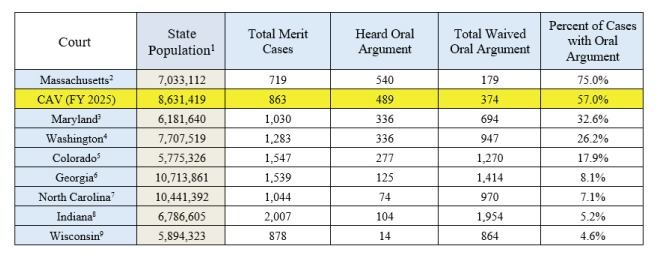
And for reasons we don’t need to get into, that Massachusetts number may be wildly overstated. It could actually be 30%. So the CAV looks to be doing a pretty good job.
How does it compare to federal circuit courts? The Ashwell committee is glad you asked:
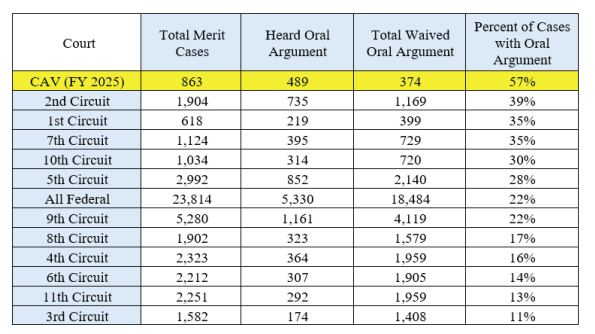
The only surprising thing about this chart is that some courts are even more miserly than CA4. And on that point, the report even gives a shout out to Dean Larsen’s excellent article on circuit personalities.
Anyway, the whole report is worth your time.